

Magazine
From Wuhan to the World: Rabbi Yosef Dorfman and the Hidden Story of Global Kosher Supervision
How a veteran kashrut inspector navigated COVID travel bans, Chinese factories, and nonstop fraud attempts to protect the kosher food on our tables
- David Fried
- | Updated
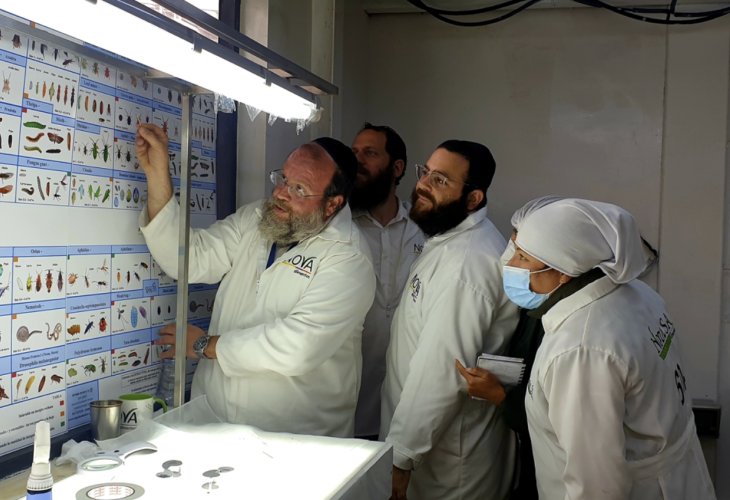
The first reports that spread around the world about the discovery of a mysterious virus in China caught Rabbi Yosef Dorfman just days after he returned from a tour in China’s Hubei Province – the very region where the coronavirus pandemic began. At that time, just hearing the name “Hubei” sent a shiver of dread through many people worldwide. The chilling video clips coming out of that Chinese province, showing people collapsing in the streets, certainly did nothing to calm anyone’s nerves.
Rabbi Dorfman himself managed to escape China at the very last moment – just before the borders closed, or worse, before he could be infected with the virus. But despite that narrow escape, he would soon discover that although he had gotten out of China, he had not escaped the far-reaching consequences of what erupted in the place where he had just been.
From then on, corona completely disrupted the work routine of the veteran kashrut supervisor, who has spent days and nights supervising food production for about twenty years, six of them all over the world. In between, he is also a sought-after lecturer on kashrut. After some effort, we managed to reach him through the “Cheker” Institute, which deals with the subject of insect infestation in food.
“The work of a kashrut supervisor is not easy,” he says at the start of our conversation. “I only recently returned to Israel after 64 hours of failed attempts to enter the country.”
The reason for this long delay was a combination of the coronavirus pandemic, and the “Guardian of the Walls” military operation that was taking place in Gaza at the time.
“The journey started in Ecuador, passed through London, and ended, after a long time and several stopovers, in the Holy Land.”
It seems that corona taught those engaged in the sacred work of kashrut supervision quite a bit about difficulties, bureaucracy, and – as is often the case in such situations, about G-d’s kindness and special Divine providence.
“After I came back from Wuhan at the beginning of the corona outbreak, I flew abroad again, this time to Thailand. When I returned to Israel from Thailand, it suddenly turned out that corona had appeared there too. Its huge borders were sealed completely, and once again I got out at the very last moment.”
Divine providence accompanied Rabbi Dorfman again when he later flew to Morocco to supervise strawberry production. “Right after I came back to Israel, they shut Morocco down. I felt very strongly watched over from Above during that period.”
“In general,” he says, “the corona pandemic completely changed the work of kashrut supervisors. It made flying between countries very difficult, and to some countries you simply couldn’t fly at all during certain periods. Beyond that, the procedures for moving from one country to another became especially complicated. For example, anyone entering Turkey has to fill out a special form and explain why he wants to leave the country. In the past year I flew abroad only three times, instead of at least fifteen,” he sums up.
Does restricted travel impact the level of Kashrut?
“Absolutely. The first effort is always to try not to create a shortage of any food product. But certain sectors were affected. For example, there were periods when there was a shortage of skinless fish under the ‘Eida HaChareidit’ supervision, because the kashrut procedure for these fish is complex and requires close, on-site supervision. That was very hard to do during corona – especially considering that the main country of origin for these fish is China.”
120 Ingredients in One Loaf of Bread
As we speak, Rabbi Yosef Dorfman is preparing for another trip abroad – but this time it won’t be a routine flight.
“I’m used to flying,” he says in our interview, held while he’s in the middle of his last preparations before leaving Israel, “but this flight is completely different.”
Rabbi Dorfman is about to fly to China, where he will supervise a food factory – one of many. But first, like anyone who dares to enter China of his own free will during the corona period, he’ll be required to undergo a kind of two-week “imprisonment” from the moment he lands in the communist state.
“It’s not a standard quarantine. The Chinese are very efficient and very organized – that’s also why they managed to fight corona so effectively. When I get there, they’ll take me straight to a hotel, where I’ll have to stay for two full weeks in one room, without being allowed out, not even for a minute. They’re not even expected to turn on the air conditioner in the room, for fear that the AC system might spread viruses from room to room.”
This unsettling reality perhaps explains the “victory” of the eastern superpower over corona. The price of this Chinese victory, as we understand it, was paid by hundreds of millions of citizens and travelers.
This is not Rabbi Dorfman’s first time in China. “I’ve been in this field for 20 years,” he says. “In those years I’ve flown abroad almost countless times to supervise many different kinds of factories – from South America to the Far East.”
While we’re talking, the veteran kashrut supervisor surprises us with a confession: “I got into this field completely by chance. It was when I lived in Bnei Brak. At that time, I was learning in kollel all day, and I was looking for something Torah-related to do after kollel hours.
“It was during the break during Av, when a well-known wedding hall opened and they were looking for a kashrut supervisor. The owner of the hall, a baal teshuva, recommended me to the kashrut organization and told them that I study with him in kollel under Rav Edelstein. They called me in for an interview. I remember how the legendary chief inspector of the kashrut at that time spoke with me at length. Afterwards they informed me that I had passed successfully.”
Rabbi Dorfman worked in that hall for three years until the hashgachah (kashrut authority) there changed. And then came the turning point that made his name well-known in the world of kashrut.
“After leaving the hall, I started organizing different projects: holiday hotels, Pesach programs, and more.” Later, Rabbi Dorfman decided to leave that field, and today he serves mainly as a supervisor abroad, overseeing different food products.
“My main destinations are the Far Eastern countries, from which food products, fish, and canned goods are exported to the US.”
 (צילום אילוסטרציה: shutterstock)
What are the biggest challenges facing the modern kashrut world?
“With technological progress,” Rabbi Dorfman answers, “the challenges facing kashrut supervisors are getting bigger. Technological advancement has not skipped over the food industry, which has undergone dramatic changes in recent years. Today most products – even the simplest ones, are made of dozens of components.
“Even a simple sliced loaf of bread today is made up of about 120 ingredients,” he says. “This technology can create many serious kashrut problems, and supervisors have to prepare to deal with them.”
Rabbi Dorfman points to one of the most popular food ingredients today as an example: “E120 is a red food coloring made from the blood of a scale insect. This additive presents a major challenge to the kashrut world, and supervisors across the globe watch very carefully to make sure this popular ingredient is not used in products under kosher certification.”
He recalls a yeshiva man who told him he bought white beans and soaked them in water, only to discover to his shock that the water turned white.
“It turned out that in the factory they had dyed the beans so that they would look very white. Even in that area, various food colorings have entered the picture,” he says.
Is there a specific food that is especially difficult to supervise?
“Leafy vegetables such as lettuce and cilantro are extremely difficult to supervise, because they serve as a breeding ground for insects – especially now, in the summer. To give some sense of scale: a single leaf, grown in the open air, can have up to around 200 insects on it, some of which can never be removed.
“Therefore, they must be grown in special greenhouses, where certain types of insects that can’t be washed off – such as the leaf-miner fly, do not enter. The greenhouses are protected with very fine nets that prevent most insects from getting in. But even so, they still remain a fertile ground for insects after being grown in the greenhouse.
“That’s why there is a need for repeated spraying and constant inspections by the supervisors, including physically shaking the leaves to check what falls out.”
In the Role of Detective
Food factories are not particularly welcoming places for a kashrut supervisor.
“The factory owners – almost all of them non-Jews, don’t really understand what supervision is, and even when they do, they don’t see any difference between kosher and non-kosher food products. Add to that their desire to cut costs and shorten the inspector’s time in the plant – and you get an even more problematic picture.
“That’s why,” says Rabbi Dorfman, “every supervisor has to arm himself with detective skills as well.”
He recalls an incident that took place about a year and a half ago. “I was in a large fish factory in one of the Far Eastern countries when I suddenly felt that the factory owners were trying to get me away from the production area. Generally speaking,” he explains, “whenever factory owners say to a supervisor: ‘Come to the office, we’ll give you fruit to eat there,’ or ‘Why are you standing here so long for nothing?’ – the supervisor must intensify his supervision even more. These are exactly the kind of invitations used to distract and mislead him.”
“I understood they were trying to trick me,” he continues, “so I told the second supervisor who was with me: ‘Follow the fish very closely – we’re probably going to catch them lying soon.’”
Their alertness paid off. After long tense minutes, the moment they were waiting for arrived.
“Suddenly I saw a worker bringing in a pallet that was only half full. I quickly approached him and asked: ‘Why are you bringing only five rows instead of ten?’ He tried to dodge the question and explained that they were arranging the pallets in the freezer and that’s why they were only bringing half for now. At the same time, he kept trying to persuade me to leave the area. I realized something very suspicious was going on, but it was hard to pinpoint the fraud because while I was standing there everything indeed seemed to be running properly.”
Eventually, the picture became clear. “It turned out that the workers had brought in only half the kosher product, leaving them with many cartons that were only partially filled but already had our hologram stickers indicating that the fish inside were kosher. Their plan was to later add more fish and pack them under the same holograms, as if they were all kosher.
“Of course, production in the factory was immediately stopped.”
What did they hope to gain?
“The main goal was to shorten the processing time for the fish. When an importer approaches several factories to order fish, he’ll usually choose the one offering the shortest production time. The presence of a supervisor in the factory naturally slows down the work.
“In addition, they wanted to reduce the time that I and the second supervisor spent there, because they have to pay for our stay.”
Have you encountered other attempts to cheat the supervision?
“Attempts to mislead us happen all the time. One such attempt I ran into recently in a field I’ve been working in a lot: supervising canned goods. As part of the supervision, the kashrut agency stamps a production code on the cans. To protect the kashrut, the factory workers don’t know the code, and it changes every morning by the supervisor.
“One day, while I was working in a well-known factory, the workers tried to fool me by placing an ink-jet device near the packing area so they could stamp the code I had chosen onto non-kosher products. Of course, their plan was exposed because I was standing there at the time of packing, and I prevented any possibility of trickery.”
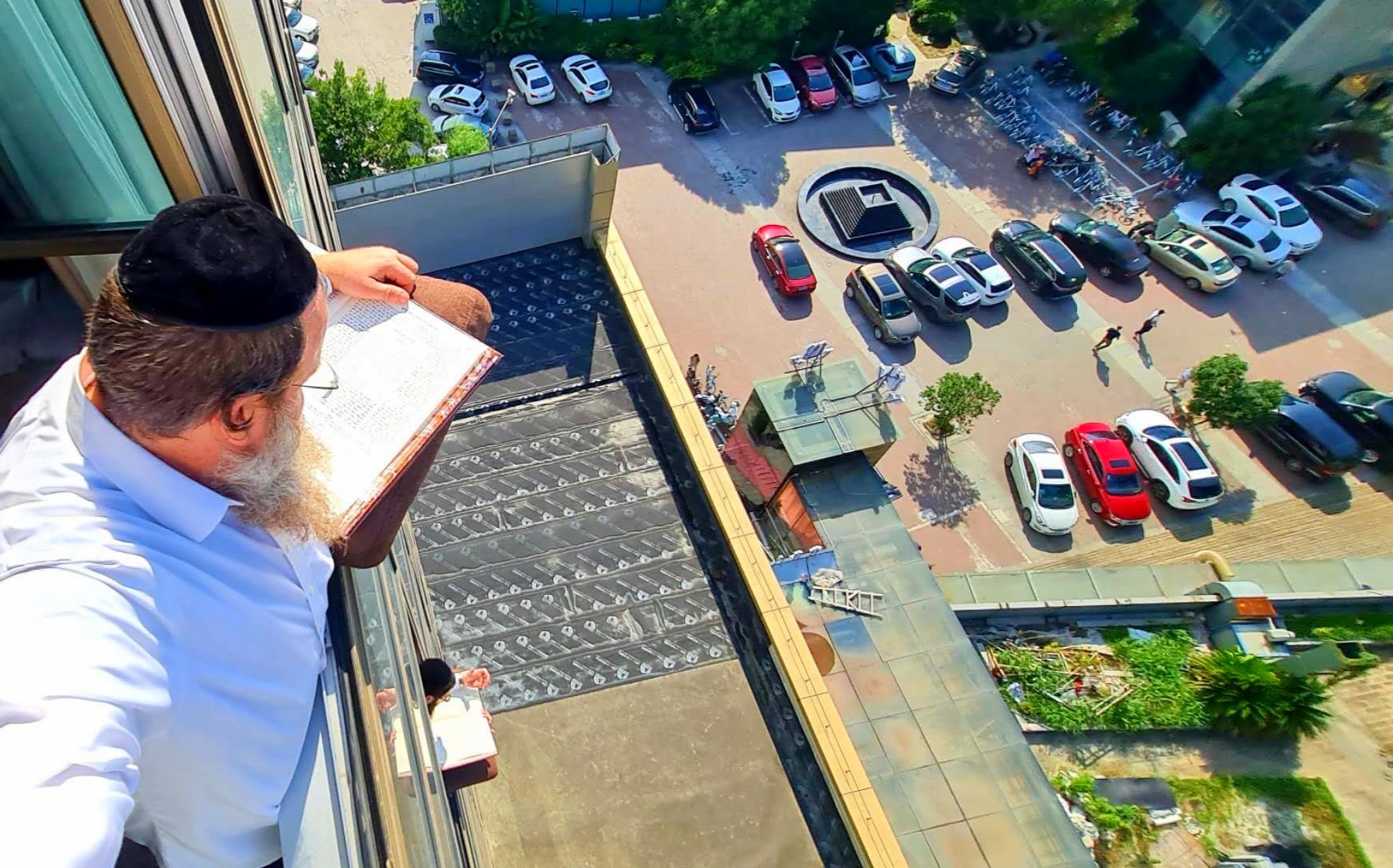 הרב דורפמן לומד עם משגיח אחר בשעה ששניהם נמצאים בבידוד במזרח הרחוק
How can you manage in distant places without a Jewish community, and with difficulty obtaining kosher food?
“Hardships are part of a supervisor’s life – especially one who constantly travels around the world,” notes Rabbi Dorfman. “The work forces the supervisor to daven alone for weeks at a time. In some kashrut organizations, they do allow the supervisor to get to a minyan at least on Shabbat.
“There were many times when I had to pray alone during the week, but when Shabbat came, I flew to a Jewish area and spent Shabbat there. Suddenly, after many days, you see Jews again and can warm yourself together in the light of Torah and chassidut – it’s a completely different feeling.”
Another major issue for supervisors in places with very few Jews is food.
“In that respect,” he says, “supervisors live on fruits and vegetables grown abroad, which have no terumot and maasrot issues. They mainly rely on canned goods they bring from Israel. I’ll be facing this dilemma very soon myself,” he adds, “when I get to China, where it’s especially hard to find kosher food. I’ll have to make do with fruits, vegetables, and kosher fish that can be found almost anywhere in the world.”
Have you encountered antisemitic incidents during your work abroad?
“Only once did I face an anti-Semitic incident. It was after I returned from a synagogue in Milan, Italy. A car passed by, and the driver started cursing the Jews and spitting in my direction. But I know I am a soldier of God, representing the chosen people in my Jewish appearance, and I trust fully that I will be protected from harm.”
As someone who works in such an important field and also travels the globe frequently, what is your message to the people living in Israel?
“These days, you can clearly see the special Divine protection that covers the Holy Land. In the course of my travels I see it with my own eyes. While the whole world is frozen, we in Israel can move around fairly freely and without the severe restrictions others face.
“Recently I was in Ecuador, where there is a harsh nighttime curfew with a penalty of three years in prison for anyone who breaks it. In neighboring Peru, people are required to wear two masks when walking in the street. On layovers in Spain, you’re not allowed out of the terminal at all. That even caused me distress once when I lost a suitcase while transferring between two airlines and couldn’t retrieve my belongings. I was promised the suitcase would be sent to Israel by mail, but that never happened, with all the loss and frustration that entails.
“At the same time, we in the Holy Land are free of these strict limitations. This is nothing less than the fulfillment before our eyes of the verse: ‘A land which the eyes of Hashem your G-d are upon it, from the beginning of the year to the end of the year.’”

