

Magazine
From Neo-Nazi to Torah-Observant Jew: The Unbelievable Journey of Yonatan Langer
How a former German extremist left hatred behind, converted to Judaism, and began a new life of faith and inner repair in Tel Aviv
- Itamar Mor / Olam Katan
- | Updated
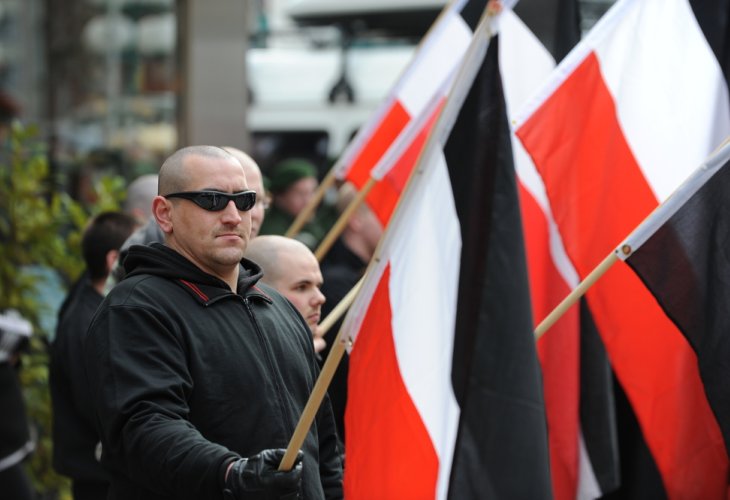 (Photo Illustration: Shutterstock)
About forty minutes into my conversation with Yonatan Langer, there was this strange, disorienting moment when, for a split second, I wasn’t sure who I was talking to: Yonatan the Jew, or Lutz, the German neo-Nazi. It happened after Yonatan himself admitted that he is still afraid of who he used to be.
He’s 38. His eyes are light, his hair is already whitening at the temples. His appearance is youthful. On his head – a black kippah. Under his black T-shirt you can see tzitzit, and also well-built biceps. When he walks the streets of his city, Tel Aviv, he looks like any other young local blending into the colorful diversity of the Herzl–Rothschild–Allenby triangle. But under all of that lies an impossible, almost unimaginable story: a young German neo-Nazi who chose to convert to Judaism and settle in Israel.
He starts his day every morning at 6:30 in a small synagogue on Lilienblum Street, near his apartment. It’s a small, fairly young minyan where Langer serves as the gabbai. He opens and closes the ark, and is responsible for rolling the Torah scrolls in advance to the weekday and Shabbat readings. Over the last year he has also been certified as a scribe (sofer STaM), and dedicates time daily to writing.
When we sit down to talk, he refuses a Nescafé because he’s “still fleishig,” and opts for a small, strong Turkish coffee. Despite more than fifteen years that have passed since he began his journey towards Judaism, and the five years since he converted, Yonatan is still afraid of the person he was when his name was still Lutz and he led an anti-Semitic neo-Nazi group in Berlin.
“I know and feel that since I received a Jewish soul, Lutz no longer exists,” he says. “At the same time, the psychological parts that express themselves in revolutionary thinking, opposition, extremism and even violence still exist within me,” he adds, with unmistakable genuine sadness in his voice. “In order to restrain those parts, I need to do avodat hamiddot – lifelong inner character work. Observing the mitzvot and halacha helps me a great deal to atone for things I did in the past.
“By nature, I’m a person drawn to hatred, cruelty and judgmentalism. I was never convicted of any crime under the law, but that nature exists in me. Keeping halacha and learning Torah gives me tools that prevent me from being pulled back into those circles. Sometimes people ask me if I was violent or anti-Semitic. To me there’s no difference between the definitions. It’s all in the same box. Radicalism puts on and takes off different costumes. You can be a neo-Nazi, then convert and become a Jewish extremist in the name of religious ideology or God. In that sense, the work of my life is balance.
“Today, whenever I encounter negativity inside myself or in others, instead of sinking into that feeling, I’m learning to accept reality. To discover gentleness, to avoid being judgmental. Inside me there are still the parts that characterized Lutz – strong, extreme, violent. But thank God, today there is also facing him within me Yonatan, with a Jewish soul. My journey is to introduce them to each other and balance between them.”
“Both sides were always inside me”
He was born in Berlin to an average German, middle-class family. His father was an athlete on Germany’s national Olympic rowing team. From childhood he went in the athletic direction of the family, started training in martial arts – specifically karate, and very quickly became an outstanding athlete. In his teenage years he discovered that his coach was part of a brotherhood group of the extreme right, holding neo-Nazi views.
The combination of physical strength, strong opinions, and a sense of justice and security cast a spell on Lutz, and he was pulled very quickly into neo-Nazi activity. The daily meetings of the group he belonged to turned him very quickly into an ideological leader. His wardrobe was made up mainly of clothes with Nazi symbols, and most of the music he listened to was composed in the Nazi era or was modern neo-Nazi techno carrying messages of hatred and antisemitism. That’s exactly why, when you sit in front of Yonatan today, it’s hard to connect those descriptions of the past with the gentle, thoughtful man he is now.
What made you become a neo-Nazi? What’s the source of the seed of violence you say exists in you?
“When people ask a question like that, they usually look for some trauma from the past that will explain why I chose what I chose. I’m sorry to disappoint, but I didn’t experience any abuse or harm as a child, certainly not in my family, which gave me an excellent childhood and wonderful parents. But at school I was bullied a lot, and that’s something I didn’t tell anyone about. Today I understand that the repression of that created in me a need for revenge.
“The power I gained in karate training strengthened my self-confidence, but also a repressed violent side. As a teenager I didn’t always know how to express those feelings, and that paved my way to neo-Nazism in a pretty natural way. At the same time, I was always also a sensitive person who could read situations and emotions.
“I grew up in a secular family, but religiously we were affiliated with the Evangelical-Lutheran church. We never actually went to church or celebrated the holidays, but certain pieces of that atmosphere we did mark.
“In the Lutheran church they mark a child’s coming of age at 14. It’s a bit similar to a Jewish bar mitzvah. Practically speaking, it boils down to the child receiving lots of gifts and especially lots of money. The day after the party they made for me, I took all the money I’d received and gave it to my friend’s mother, who wanted to fly to Africa to visit her son and didn’t have money for a plane ticket. My parents went crazy over that move. Seeing how much she needed the money, I didn’t hesitate for a second. So both sides were always inside me.”
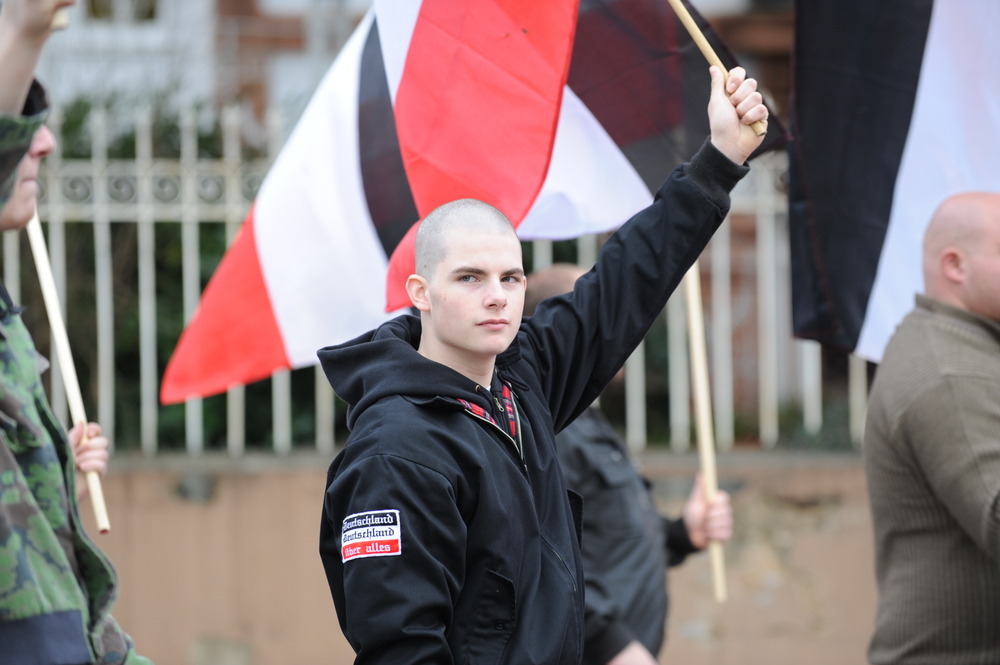 (צילום אילוסטרציה: shutterstock)
What exactly attracted you to the neo-Nazi group?
“Mainly the feeling of rebellion and belonging to people who ‘fight for a truth’ that no one else is willing to say. There’s something very rewarding in being not politically correct, in doing things ‘davka’ (to spite), in shoving ‘the truth’ in people’s faces.
“My karate coach was a neo-Nazi, and I admired him. He was everything I wasn’t: tough, self-confident, strong, with a sharp truth.
“When you’re a 15–16-year-old boy flooded with hormones and rebellious impulses, you get swept away by that. And when the news shows violence by Muslim foreigners, you go out of your mind. It becomes almost impossible not to agree with the ideology of German racial superiority and the claim that democratic politics sold out Germany, its identity and its honor.
“This supposed superiority gives you a sense of control, power and freedom. You think you’re free, but in practice you’re completely captive to the extremist ideology. The ability to blame someone else for all your problems is insane. There’s nothing more convenient than a scapegoat you can dump all your frustrations, sicknesses and issues onto. It frees you from any responsibility. And on top of all that there’s a big hope of going back to the ‘glorious, better days’ – days of order, rules, hierarchy and roles.
“We spent most of our time in the group analyzing maneuvers from World War II to show what mistakes led to the war being lost. No one thinks the war itself was a mistake – only that there were certain moves that led to defeat. From a psychological point of view, today I understand that it’s a processing of national trauma through the desire to recreate it, this time from a position of control.”
Do Germans have a national trauma from World War II? They’re the ones who caused trauma to others!
“Of course the Germans caused a terrible, horrific disaster, but the consequences of the war also affect the Germans. I’ll give you an example: in my family there was no party member and no one in a central army role during the war, and so we simply never spoke at home about that period. But that silence characterizes almost all of German society, because there are things you don’t talk about. It’s repression that does not allow processing and passes things on from generation to generation.
“It happened on the political level too. The day after the war, Germany had to focus on rebuilding itself. They had to refill all the positions, but this time with people who weren’t Nazis: police officers, judges, clerks, politicians. Where exactly are you going to find so many professionals all at once? So they bent the rules. They took people who maybe didn’t personally do terrible things but had served in the Nazi system, and put them back in place. I’m talking about police officers, about Nazi judges who went back to serving in the courts. Even politicians with a Nazi past were elected again to parliament, sometimes even to senior leadership positions.
“They ‘solved’ the problem with a pledge of loyalty to the new democratic republic of Germany – but inside, the ideology remained the same, even if it wasn’t spoken out loud. That baggage continues rolling on until today. Thirty years after the war, the official term in Germany forbade using the word ‘defeat’ regarding the war. The official expression was ‘the liberation of Germany.’ If Germany had to be ‘liberated,’ that means it was supposedly a hostage to Hitler and the Nazis – which in effect spares the Germans from having to admit they supported Hitler, who was elected democratically. It spares them admitting responsibility for war crimes, atrocities, genocide.
“A regular person can barely admit his own mistakes – so an entire nation? Psychologically, that kind of repression creates trauma. And what better way to deal with that trauma than to revive the idea of the Third Reich? Outwardly you speak nice, democratic language, but inside the feeling is that Germany was wronged – that it wasn’t liberated, but destroyed, and the ‘correction’ is to become a strong nation again.”
But Germany is a strong nation. One of the seven leading powers in the world.
“In the value system of liberalism that might be how it’s presented, but from the perspective of the average neo-Nazi, today’s Germany is weak, flabby, small and humiliated. Pre-war Germany was larger in territory. Today’s German army is a walking joke. Even if you say Germany has no conflict with anyone and therefore doesn’t need a strong army, in the eyes of neo-Nazis that’s irrelevant. A small, weakened army is a symbol of insult and spinelessness. Money, global influence, a strong economy and technology – these aren’t ‘power’ in their eyes.
“When I was in the neo-Nazi group, what gave me a sense of worth was knowing that people were afraid of me, that I was physically strong and had the ability to use violence. Those are the metrics. Technology is nothing compared to being able to conquer Poland in a week and crush Holland in four days. Turning real power into modern values is, for them, a symptom of sickness and brainwashing.
“It took me a long time to admit that my craving for power itself showed just how weak I really was – weak in my ability to listen to people, weak in sharing emotions and balancing viewpoints.”
Chazal say that Eisav’s hatred of Yaakov cannot be overturned – that antisemitism is an incurable disease.
“As a Jew, I can understand that statement. I too hated Jews more than anything else for many years – all while I had never seen or met a Jew even once in my life. The propaganda and ideology are strong enough to present that hatred as the ultimate truth.
“But from a spiritual perspective, today I think the Jews also have a central part in stoking the hatred against them. We, the Jewish people, have a calling and role to be a light unto the nations and to repair the world under the kingship of God. The world is thirsty for that repair and that light, and when Am Yisrael shirks that role, it also expresses itself in hatred toward us – like a child who starts to act out when he doesn’t get what he wants.
“There is no substitute for what the Jewish people are meant to bring to the world. Think about a taxi driver who could and should be a great singer, but for a thousand reasons is convinced he must remain a taxi driver all his life. You can only imagine how much frustration and anger such a person might feel.”
What do you think about the internal division and hatred within Israeli society itself? Isn’t it disappointing to discover that the place where you hoped to find peace and unity is just as sick with hostility?
“I’m not sure it’s right to compare hatred of Jews to the hostility among the Jews themselves. On my first visits to Israel, ten and eight years ago, before I converted, I didn’t notice the divisions in Israeli society at all. I was a bit like the spies the Israelites sent from the desert: you see what you want to see, anything but reality.
“Today, after four years living in Israel, I’m very surprised by the fragmentation in Israeli society. Our sages say that Eretz Yisrael is the navel of the world, Jerusalem is the heart of Eretz Yisrael, the Temple is the heart of Jerusalem, and the Holy of Holies is the center of the world. We live in the most spiritual place in the world, which naturally also draws into it the greatest light. That creates built-in tension within us as well.
“Spiritually, opposite every positive potential there’s an equal negative potential. The negativity that comes from the sitra achra (other side of holiness) can only exist by creating hatred and division. When we surrender to that hatred among ourselves, we ourselves block the possibility of that repair being revealed.
“The unofficial decision of Israeli society to focus specifically on the 20% where we differ, instead of the 80% we share, pains me deeply. Unfortunately, you can see something similar even inside a single family. For some reason most of us like our relatives from a distance. Sit everyone once a year around one table and see what happens: arguments, hurt feelings, personality clashes and what not.”
Connecting heart and mind
Yonatan’s approach to Judaism came in an unconventional way – you might even say mystical. After he began studying at university, the load of exams and assignments made it hard to attend his neo-Nazi group’s meetings as often. Around that time a spiritually inclined girlfriend also came into his life, and she dragged him almost every weekend to lectures and gatherings.
“We went together to all kinds of lectures on spirituality,” he recalls. “Mostly New Age, Eastern religions and the like. I delved into Osho’s teachings, started meditating, and things like that. I really loved it, but I felt that it was also a bit hollow. I wanted something more serious.
“One night I dreamt that I was floating toward a cave, and on its wall the word KABALA was written. In the morning I typed ‘Kabbalah’ into Google out of curiosity – and when the results appeared, my eyes went dark. It said it was the mystical tradition of Judaism. I felt strong revulsion – because what do I have to do with Jews? There was also a phone number for a Kabbalah center in Berlin. I wrote it down, but walked around conflicted with myself for weeks.
“After about two months I decided one evening to go over there and see what was going on. Even before I arrived I realized I was going to a place I wasn’t supposed to be in. The Kabbalah center in Berlin is located in the old Jewish quarter of the city, between the old Jewish cemetery and a Jewish school. At the entrance to each of those institutions stood police and security guards, protecting them from people exactly like me. And here I was – the enemy – walking right into the place that fears me most and that I hate most. I overcame my revulsion and went into the class.
“In front of me stood a man with a kippah and beard. The thought that I was learning from a Jew was driving me crazy. I found myself in deep conflict: here in front of me stands someone who looks normal, sane, intelligent, and says things that undermine my entire worldview. He says life is good, that they have purpose, that there is free will and a person can achieve more than he believes. That in order to receive you have to give first, and that you must not be selfish.
“This rabbi held up a mirror to me, and what I saw in it I didn’t like. I realized I was full of anger and hatred towards people – especially those different from me. Deep down I knew that what I was hearing was true, but could I change? Did I even want to change? Not to mention the price, which seemed way too high. I found myself going back again and again to the classes, and on the other hand going straight from them to neo-Nazi meetings.
“The learning helped me see my flaws and the tikkun (repair) I was being called to make. I understood that the hatred I had developed was destroying not only my relationships with those different from me, but also with my family, with colleagues at work, and with friends at the university. On the other hand, I couldn’t leave the group, because I had no other circle of belonging.”
So what made you decide to go all the way?
“After a few months, the Jewish teacher invited me for a Friday night Shabbat meal. It was the first time I’d ever taken part in Jewish prayer, in a meal with zemirot and divrei Torah. Even though I didn’t understand a word, what captivated me was the good energy and joy in the room. I had never encountered something like that. When I walked out to the street at the end of the evening, I was in seventh heaven on the one hand, and on the other felt like my brain was exploding.
“Thoughts started coming up that maybe being in the neo-Nazi group wasn’t good for me. That thought was so frightening that I felt I had to run back to the group immediately. I escaped into a week of neo-Nazi parties and gatherings. I drank huge amounts of alcohol and listened to neo-Nazi music day and night. Everyone around me was sure I was completely with them – but inside I felt I was betraying them.
“After that week, I went back to my apartment in Berlin and threw out all my Nazi music discs. I emptied my closet of all the clothes with symbols. I was shaved bald at that time, and decided to stop cutting my hair and let it grow. I went back to the classes and started actually doing some of the advice I’d heard from the rabbi. For the first time in my life I started volunteering.
“Within a few weeks I found myself coming by choice to synagogue on Shabbat morning. Even though I didn’t understand a word, I would sit with my eyes closed through the entire Torah reading and feel myself slowly healing. It was like meditation. Three months later I got it into my head that I wanted to put on tefillin. It didn’t come from a place of ‘mitzvah’ yet – just knowing that inside those boxes there were words from the Torah was enough for me. When the rabbi explained to me about the connection between the arm tefillin and the head tefillin, about connecting heart and mind, I knew that was exactly the connection missing in my life.
“A few months later I flew for my first visit to Israel. It was Rosh Hashanah, and my thought was that I wanted to plant a seed for the new year. I asked God to help me do teshuvah. I stayed in Israel for Yom Kippur, Sukkot and Simchat Torah as well. In Israel I started keeping Shabbat, eating kosher and immersing in the mikveh, and when I returned from the trip I knew I wanted to leave Germany. I moved to London for three years. I built connections there with a community and rabbis and progressed in learning.
“My great shock was that as soon as I started talking about conversion, the rabbis there tried to dissuade me. It was very painful. I couldn’t understand how people who had helped me for years were now trying to get me down from the tree, telling me conversion was a stupid idea and that I could live a full, beautiful life as I was. I was very angry at them for a long time.
“It took me almost a year to understand that they were actually testing me – that they wanted to know whether I really wanted to convert or if it was just a whim. The test ended the day I came to my rabbi and told him: ‘I don’t care what you say or think, I want to convert. Where do I sign up and what do I have to do?’
“That led to the next test: undergoing a brit milah. I didn’t have money to pay for the circumcision. Circumcision for an adult is a complex and expensive process. I needed a thousand dollars, and to get it I had to go through another challenge of telling my parents about the conversion and asking them for money. You could say that only after the brit did my real process begin.
“A little while later I moved back to Germany. That was a very difficult time for my faith.”
“Only when I was honest with my journey did things start to work out”
“In Berlin I found myself for the first time in my life with no friends, no community and no spiritual center I could go to. I had a new job, but felt unfulfilled. The emptiness ate away at me so much that one evening I found myself going to meet the guys from the neo-Nazi group. They looked at me like I was a space alien. They didn’t know what I’d been going through, but my sudden appearance after almost four years of no contact made them treat me with suspicion. I tried going back to sports, but even there I felt empty. That’s when I understood that I had no choice but to finish the conversion.
“I started sitting every day in my apartment in front of piles of halacha books, reading why a non-kosher spoon placed in soup at a certain temperature makes it non-kosher, while at another temperature it doesn’t – and how all that is also connected to the size of the spoon and the amount of soup. Every such thing I had to read ten times just to understand what I was reading. It was insanely hard, but as soon as I started learning halacha, somehow life started to fall into place. I found a different job. I went back to volunteering and found new teachers to help me. I began taking the conversion exams – and passing them. Only when I was completely honest and at peace with my journey did things start to work out. A year after I finished the conversion, I was already living in Israel.”
Antisemitism in Europe has grown significantly over the last two years. What do you think about the rise of the extreme right?
“You might be surprised, but I think the strengthening of the right in Germany is actually a good thing. I fully understand why people want to limit them, and I understand the fear that Germany might go backwards. But trying to stop their ideas through force is fundamentally mistaken. When you push someone away, you only strengthen him.
“On the contrary – when they get elected, they’ll be forced to give answers to existential problems, not just wild theories. They’ll have to sit at the same table in parliament with people they hate – and they’re not capable of that. They also have no answers to everyday questions like: how do you take care of education? Where do you build schools? How do you deal with social gaps? What’s the right policy on renewable energy?
“The extreme right has mainly empty slogans, because they don’t think about the future. They’re stuck in the past, and that’s the fuel of their hatred. You can expose that emptiness only when they actually get into parliament. The only way to burst that bubble is to challenge it. Hating them is not a strategy. When I was isolated in the neo-Nazi group, I was trapped inside hatred. Only when I was exposed to other, normal people did I begin to change.”
Do you see yourself returning to Germany one day?
“That’s a good question. Technically, at the moment I’m prevented from leaving Israel because I still haven’t received Israeli citizenship, and any trip abroad would cancel my tourist visa. But even after I get an ID card, I’m not sure I’ll want to go to Germany.
“My parents have visited me here twice, and they had a great experience. My brother has also visited. It’s strange, but today when I think about travelling there, I’m actually afraid. I look Jewish today. A lot of articles about me have been published in Europe, and I’m afraid people will attack me. It’s amazing – today I’m afraid of antisemitism being directed at me.
“Unfortunately, for two years now the Interior Ministry has not responded to my request for Israeli citizenship, even though I’ve presented all the documents, proofs, testimonies and certificates of the Orthodox halachic conversion I went through. The process is exhausting, because I’m in the dark about my future in Israel.
“I assume the delays stem from my former background as a neo-Nazi, and I completely understand the need to examine my past. I also understand the fear some people here have of me. I ask myself every day how long this cloud of suspicion will hang over me. Since 2017 I’ve been a Jew who keeps Torah and mitzvot. I left behind everything I had: family, job, status, language, friends, culture. I hope that one day I’ll be allowed to join not only the Jewish people, but also the State of Israel.
“One of the things I learned during the conversion is that it’s not a formal process but a spiritual journey in which you are born anew. Apparently, becoming an Israeli from a Jew is also a kind of conversion. People sometimes tell me I’m naïve and tend to attribute spiritual meaning even to bureaucratic things. If I’ve learned anything from my journey, it’s that I have no choice but to look at things only from the spiritual side. I have no choice, because I encounter so much rejection that hurts me, that I have to rise above reality and try to see beyond it. If I sink into the pain, I won’t make it through.
“I also don’t think conversion is only about religion. I see Judaism as a path and a journey of improving the human being.
“Every time I put on tefillin, I remind myself that by binding them I’m asking to control the anger that exists in me. By eating only kosher food, I keep things that could damage my soul from entering me. Shabbat observance gives me clarity about boundaries in my life and about what I can move forward and where I need to let go. For me, all of this has a large meaning and purpose beyond merely keeping halacha.”

