

Magazine
A Mother's Dream: 'My Son Said, I'm Not Leaving You'
Neriya Nagari had been in the army for just two months when he fell in combat on Simchat Torah. His mother Sharon reflects on a powerful dream, life after his loss, and the faith that continues to guide her.
- Efrat Talia Cohen
- | Updated
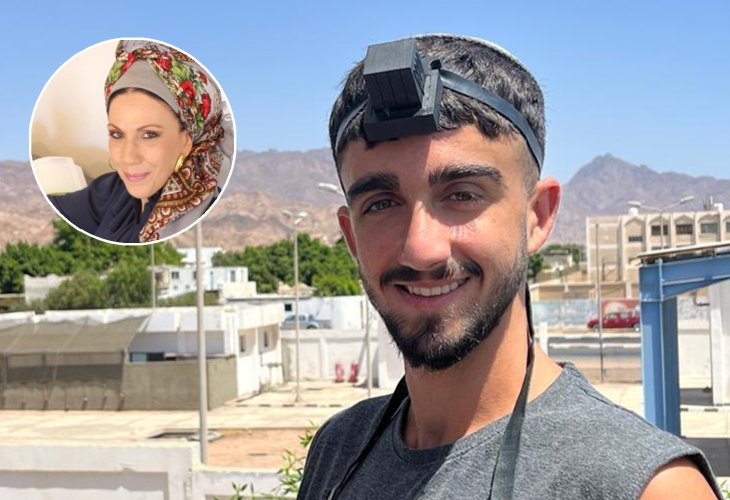 Neriya HY”D (Inset: Sharon Nagari)
It was Shabbat morning on Simchat Torah, the final day of Neriya Aharon Nagari’s life. At 6:30 a.m., heavy rocket fire began, sending all the recruits and commanders on the base into a shelter. As the minutes passed, officers were called out one by one and never returned. Later, it became clear that only one survived.
At a certain point, the recruits, including Neriya, were left alone in the shelter. Many were panicking, crying, and overwhelmed. Neriya stepped forward and took command. He loaded his magazine, assigned roles, gave clear instructions, and calmed those around him, embracing whoever needed reassurance.
Choosing Responsibility
“At some point, they received a message over the radio that a sergeant at the command post had been injured,” recounts Sharon, Neriya’s mother. “There was also a family with them who had come to be with the soldiers over the holiday. The mother, a nurse by profession, asked who would join her to help. Neriya was the first to volunteer, along with three other soldiers.”
They went out, carried the wounded soldier on a stretcher, and, in what would later be understood as a providential decision, chose not to bring her into the shelter but into the adjacent command room.
A Split-Second Decision
Neriya and another soldier remained outside, guarding the entrance. “At some point, terrorists disguised as soldiers arrived, armed with weapons and maps,” Sharon continues. “One of them fired near the structure. Neriya ran inside to ask his friends for help bringing the wounded soldier in. As he turned back, the terrorist shot him in the head. He fell instantly and did not suffer.”
Because the terrorist assumed the command post was the shelter, he did not fire toward the actual shelter where the soldiers and family were hiding. In drawing the fire toward himself, Neriya saved everyone inside.
Later, Neriya’s friend Daniel tackled the terrorist, knocking the weapon from his hands, but was stabbed in the head. Despite his injuries, Daniel dragged himself toward Neriya’s body to prevent it from being taken. “Thanks to him,” Sharon says quietly, “we were able to give Neriya a proper Jewish burial.”
 Neriya Nagari z"l
'Neriya’s Loss Didn’t Darken Our World'
Sharon Nagari, a coach and mentor for women focused on creating change in relationships, now travels across the country speaking about her son and the strength that allows her, even in grief, to choose joy.
“I feel that talking about him and spreading his light is another mission I’ve been given,” she says. “In the first weeks, I wondered how I could possibly fit my work into my life. I’m constantly giving talks, speaking to women, to seminary girls. I asked Hashem: ‘If You want me to do only this, show me. If You want both, show me that too.’ Slowly, things aligned. When a change happens, even a joyful one like a newborn or a painful one like loss, the family dynamic shifts. A new order forms.”
Your optimism in such circumstances is incredible.
“My husband, our children, and I feel this way because of who we are and what we’ve lived through. Losing a child is devastating. Neriya was a central presence in our home, and there are moments of deep longing and tears. But I always say it hasn’t painted our world black. There is still so much to be thankful for.”
She recalls a visit from Yemima Mizrachi, who came to strengthen the community. “She asked me how my outlook could focus on miracles even now. I told her this wasn’t something I worked on. I absorbed it at home. My parents are Holocaust survivors. Their families were almost entirely destroyed, yet they spoke more about miracles than tragedy. Not in denial, but in perspective.”
Sharon shares how a woman once asked her after a lecture, “I grew up in a pessimistic home. How can I be like you?”
“I told her that some things we aren’t given as gifts, but we can train ourselves. And it’s possible for anyone.”
She pauses. “Even through Neriya, Hashem sends strength. I even dreamed about him.”
What did you dream about Neriya?
"On the night after Simchat Torah, they came to inform us he had fallen, I couldn’t sleep. Then finally, towards dawn, I fell asleep and dreamed of him. I woke up from my weeping, cried both in my dream and reality. My husband asked what happened, and I told him 'Neriya was here'. It was truly amazing, he not only addressed me with general and personal messages but said 'Mom, I haven’t left you, I am with you, our souls are together. From here, everything looks different, I am swimming in light, I am well, I am in the highest place with the righteous of the world, so be happy'.
He also spoke about his siblings and his father and said Hashem loves the entire Jewish people, even those we disagree with.”
"Determined to remember every detail, amidst all the chaos, with the army here, arranging the funeral, I slipped into his room, sat on his bed, and wrote down every detail of the dream."
What can you tell us about Neriya that stood out about him?
“Neriya fell before turning nineteen, just two months into his army service. As a teenager, he was searching. He didn’t look religious like us and wanted to chart his own path. At first, we struggled with that. Later, we understood our work wasn’t to change him, but to love him unconditionally.”
She describes his inner peace, his refusal to judge others, and his quiet acts of kindness. “He was at peace with his search. He never closed the door on Hashem. Even when he struggled, he returned again and again.”
Since enlisting, Neriya became a source of inspiration within his unit. He organized Selichot prayers, arranged the four species during Sukkot, and helped soldiers connect to mitzvot with joy and sincerity. “In just two months,” Sharon says, “he drew incredibly close to Hashem.”
Friends from across the country came during shiva. “They all said the same thing: ‘He was our psychologist.’ He noticed pain, sat with people for hours, followed up the next day. He wasn’t judgmental. Because he accepted himself, he could accept everyone.”
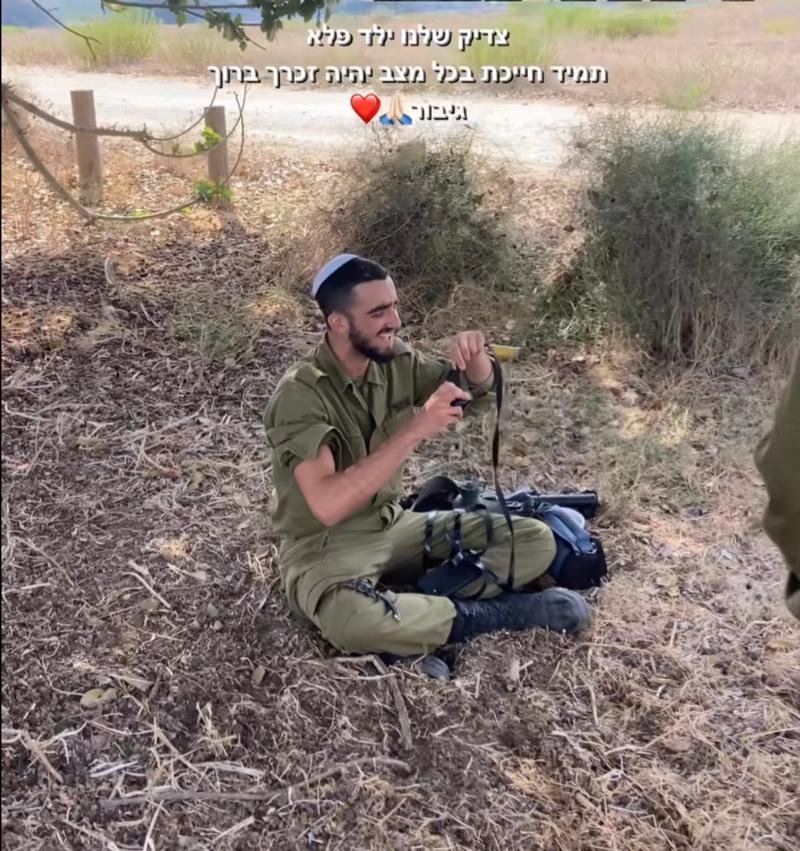 Neriya Nagari z"l
What gives you the strength to maintain such optimism in the face of such loss?
“Neriya was an extraordinary child. My brother-in-law, the head of Yeshivat Shavei Hebron, said during the thirtieth-day meal that before a soul descends into this world, it is shown its trials and asked whether it agrees to come. In our case, we were asked if we were willing to be the parents who would raise him for less than nineteen years and then let him die sanctifying Hashem, and we agreed. Neriya, too, was asked if he agreed to live a short life and give up his soul in sanctification of Hashem, and he agreed. We all agreed, and then an angel makes us forget that this agreement ever took place.
“For me, it is a profound privilege that such a soul passed through me, and a tremendous honor to have raised him.”
Sharon adds tearfully, “After Neriya fell, we visited Rabbi Eidel. It was an incredibly emotional meeting. He told my husband, ‘The mother gave Neriya all the light he needed in his life.’ I have always prayed to be the mother each of my children needs, and when he said that, I cried.”
She concludes softly, “I don’t need dreams to know what Neriya wants from us. I know he wants us to choose joy. It’s natural to cry and to miss him, and we need that. But he gives us the strength to be happy. He loved making us laugh, and you can’t think of him and feel only sadness. His light lives within us, bringing joy even in the midst of longing.”

