

Magazine
Songs of Faith: A Life Shaped by Judaism, Music, and Meaning
Inspiration, Teshuvah, Jewish values, and the power of sacred music
- Avner Shaki
- | Updated
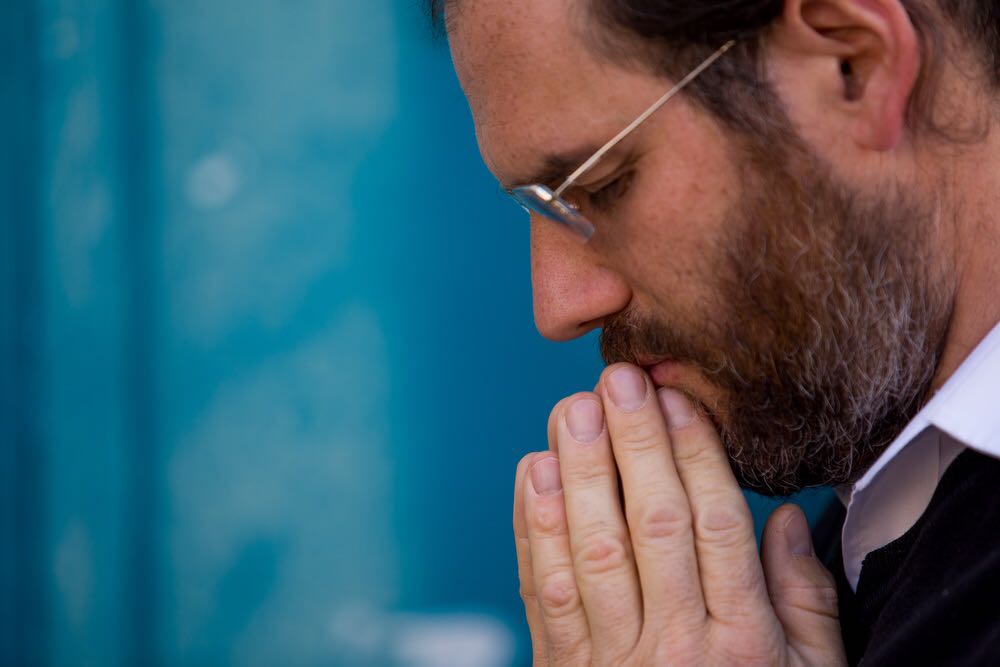
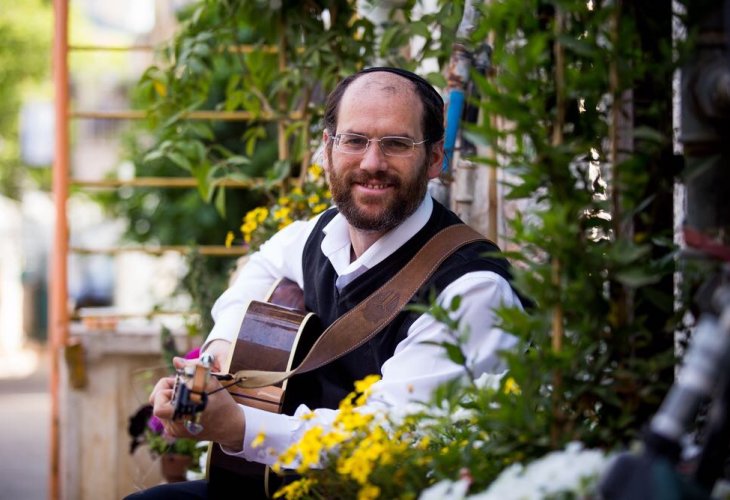 Aharon Razel (Photo: Liran Shemesh)
Aaron Razel is an Israeli musician, composer and singer.
A childhood story that stays with you?
“When I was ten years old I created a small melody, and suddenly forgot it. I was truly distressed about it. I tried desperately to remember it but couldn’t.
“While I was still thinking about it, my father suddenly said to me, ‘That’s it, we’re going to the synagogue. Come.’ I went with my father, and the moment we returned home, I remembered the melody. To this day, it remains with me as the very first melody I ever composed.”
A Jewish idea that you connect to?
“The Holocaust. It’s a very powerful subject in our family. My grandparents hid with non-Jews on a farm in northern Holland, and there were countless stories. My grandfather jumped from a train window and survived. I've heard many stories about Nazi searches, about how they came looking for Jews in the places where people were hiding.
“Thank God, they survived. They were well hidden. From their hiding place, they heard a Nazi ask the Dutch family’s child whether they were hiding Jews. They thought that was the end — until the child answered, ‘What are Jews?’ The Nazis then moved on.”
A figure who inspires you?
“The Lubavitcher Rebbe. Naor Carmi, a gifted musician and a Chabad chassid with every fiber of his being, once told me that the motto of Chabad shlichut is mesirut nefesh (self-sacrifice). Not only physical sacrifice, such as giving up comfort in life, but even spiritual sacrifice.
“Sometimes traveling to a remote place and bringing Jews closer to their Father in Heaven can come at the expense of family life, children’s education, and more. Still, it must be said that in the vast majority of cases, God ensures that you lose nothing.”
What is Judaism for you?
“What a question. To be a soldier of God. To be a light unto the nations. To know that God created the world for us and so that we engage in His Torah, and to bring about the rectification of the world.”
What is the strongest for ce that guides you?
“From a very young age, my brothers and I all played music. Beyond playing, I always loved creating in general — it’s a very strong and meaningful part of my life.
“I constantly see before my eyes the creation that flows from what I’m going through. I truly aspire to express my experiences through songs, whether in melody or in words.
“At different stages of my life, depending on what I was going through, I sang different songs. There was a time when I sang ‘The Time of Redemption Has Come’, later ‘Sing to Us from the Songs of Zion’. During the Disengagement period, I sang about staying connected. Recently, I’ve often sung ‘I Have Set My Seat in the Study Hall’.
“I also have a song called ‘Visiting the Sick’. Because of my profession, I’m often invited to play for people who, God forbid, are in very difficult health situations. It amazes me to see what music does for them. More than once, thank God, I’ve played for someone in critical condition, and later heard that the person fully recovered.”
What can you tell us about your new album?
“It’s a joyful but challenging period. Thank God, I’m a father to a large family, a kollel student, a singer, an arranger, and more. You have to know how to juggle — and of course, pray, because you need a lot of divine assistance.
“This time, unlike usual, I decided to approach top-tier producers and let each one produce two or three songs. As a result, the album includes productions by Yoeli Dikman, the young and promising producer; Yuval Stupel, arranger for Avraham Fried; Gil Smetana, producer for Ehud Banai; and Maor Shushan, producer for Ishay Ribo.
“In short, it’s an album that blends holiness with contemporary sound, including many combinations and different styles.
“After the success, thank God, of ‘I Have Set My Seat’, I decided to create a continuation and dedicate this album as well to the world of Torah. Indeed, it includes songs connected to that theme. For example, ‘This Is Our Business’, whose lyrics come from an old book written by a great Torah scholar in Jerusalem at the beginning of the last century, where he writes about a life of Torah toil and says: ‘This is our business — to engage in Torah.’ I turned that sentence into the chorus of the album’s title track.
“Another moving song is based on a letter written by my aunt, Orna Sharabi Razel of blessed memory, shortly before she passed away, to her young son — today already a kollel student. She wrote to him: ‘I want you to be a Torah scroll.’ That sentence became the song’s refrain.”
You’re approaching 20 years of creation. Did you image that this is how it would be?
“Many things surprised me. I never thought I’d survive this long in this field. It’s a profession full of uncertainty. Ultimately, you’re dependent on the inspiration God sends you.
“This profession requires a lot of humility and faith. Anyone who enters it with ego will fall quickly — or survive but live in torment. There’s a lot of falsehood around fame, honor, and competition. But when you come from a place of faith, it’s different. Those things still exist — but you have tools to cope with them, or at least to try.”
A favorite holiday?
“First and foremost, Purim. I’m deeply connected to the joy of Purim, a joy of ad d’lo yada — beyond limits, taste, and reason. I love making people happy. And beyond that, there’s the great matter of defeating wicked, poisonous Amalek.
“Many years ago, I heard that Rabbi Shlomo Alkabetz once sent mishloach manot to his father-in-law in the form of a book of Torah insights on the Megillah. I adapted that idea, recorded a Purim song and gave it as a gift to my neighbors. I called it ‘A Delivery of Melodies’.
“Since then, almost every year I enter the studio and add another verse to that Purim song, releasing it to radio ahead of Adar. Eventually, it became an album of original Purim songs.
“I’ll also add that I met my wife, Efrat, on Purim — so every year we celebrate the miracle of meeting on Purim night.”
How present is God in your life and how does He influence your work?
“Practically speaking, I’m a bit of a Breslover chassid — or at least I try to be. I practice hitbodedut from time to time. I go out to a field or a quiet place and simply talk to God in my own words.
“Since I got used to doing this, I sometimes need it like air to breathe. When I’m under pressure or something heavy is going on, my wife tells me: ‘Aaron, drop everything and go do hitbodedut.’”
A Biblical figure you'd want to meet?
“King David. He’s endlessly inspiring. A king of pure faith. He absorbs insults. He admits when he falls. He dances before the Ark of God like a simple man, without caring what people think. A king who knows that he has nothing of his own — only that God is the true King. Reading the Book of Shmuel is always inspiring.”
An interesting meeting or conversation you had?
“I once participated in a meeting where Rabbi Ginsburgh invited many musicians to speak about music according to the teachings of Kabbalah. It was fascinating.
“Musicians from different backgrounds — teshuvah and Jewish life, sat together, each from a different direction, discussing sacred music, inspiration, the role of music, Jewish music. More than leaving with answers, I left knowing how deep this subject truly is, and that it’s a lifelong search: What is Jewish music? What are you striving for? What is your role as a servant of God? What can you contribute to the Jewish people through your musical talent?”
What do you love most about Shabbat?
“It’s both a day of family and a day of simply being. Not chasing, not planning, not texting. I once heard an explanation of why Shabbat is a day of pure faith: it’s the day you say to God, ‘That’s it — I’m not managing anything. I’m taking my hands off the steering wheel.’
“And you see that everything works out on its own. God runs the world just fine without you.”
Your favorite prayer?
“I deeply love Lecha Dodi, ever since the days I lived in Safed — the city where the poem was written. I used to pray in the Breslov Great Synagogue there, facing the breathtaking view. Words can’t describe the experience.
“The sun setting at its peak, hundreds of chassidim dancing Lecha Dodi after immersing in the Ari’s mikveh. It was incredibly powerful and unforgettable.”
A person you admire who influenced you?
“Rabbi Shlomo Carlebach. His melodies gave me tremendous inspiration at the beginning of my path. I actually came from the world of classical music and wasn’t very familiar with Jewish music.
“The first Jewish melodies I heard were his, and they pierced my soul. That’s what convinced me to leave the academic world I was in and travel to Safed, where I began composing my own melodies.
“From Rabbi Shlomo, I learned that music can truly be your service of God — not just being a musician who happens to be religious. Shirah (song) has the same numerical value as tefillah (prayer). When a Jew sings, he is, in essence, praying.”
A life lesson you learned?
“How important it is to generate an energy of joy. Not to be angry or regret the past, but to know that everything is a test from God.
“My brother Yonatan says that nes (miracle) comes from the word lehitanes — to be elevated. Meaning, God gives you a challenge and says: ‘Yes, this is a test — but it’s actually a golden opportunity for you to grow.’
“I’m very connected to baalei teshuvah. I feel like one myself, even though my family began drawing closer to God when I was relatively young. After the army, for example, I was quite far from the world of holiness. Later, I decided to travel to Safed and learn in a yeshiva, and since then, thank God, I’ve been living in a world of Torah study, melodies, and performances.”

