

Magazine
The Shofar That Defied the British: Courage at the Western Wall
Under the British Mandate, even a single shofar blast at the Western Wall was forbidden. Yet year after year, courageous young Jews risked arrest and imprisonment to ensure it was heard at the close of Yom Kippur. This is the story of faith and sacrifice behind one of Jerusalem’s boldest acts of spiritual resistance.
- Shalom Pekasher
- | Updated
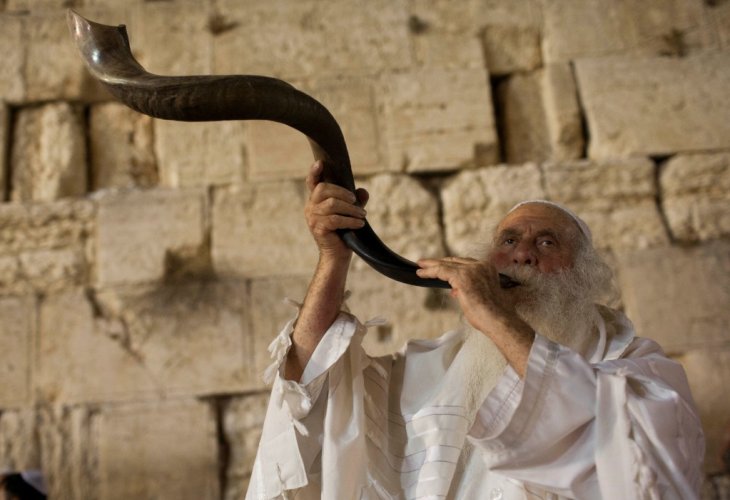 (Photo: Yonatan Sindel / Flash90)
Every Jewish child knows how the Ne’ilah prayer on Yom Kippur ends: the proclamation “Hashem Hu HaElokim, Hashem is God!” followed by one mighty blast of the shofar. It signals the end of the fast and the hopeful longing for redemption.
Not so long ago, during the British Mandate in the Land of Israel, brave Jews risked imprisonment to ensure that the shofar’s sound would be heard at the Western Wall, driven by a burning yearning to restore its call at the holiest place accessible to Jews.
Recently, Yaakov (Sika) Aharoni passed away. He was among the young men who blew the shofar at the Wall when the British forbade it. His story offers a glimpse into the long, dangerous struggle waged by courageous Jews against British restrictions. Those restrictions did not only target the shofar, but included bans on benches, prayer books, and even basic expressions of public Jewish prayer at the Western Wall.
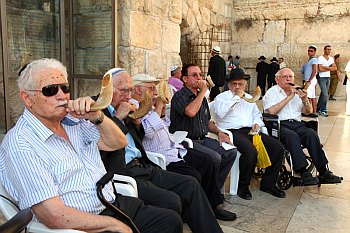 Reenactment of the shofar blast at the Western Wall (Photo: Sasson Tiram).
A Shofar Blast at Any Cost
To understand the background of these daring shofar-blowing protests, we must go back decades. In 1840 and again in 1912, Ottoman authorities declared that Jews had no rights to the Western Wall or its plaza, except for prayer itself. The British preserved this “status quo,” prohibiting benches, gender dividers, Torah reading, lighting, loud prayer, and shofar blasts.
The incident that ignited the protest campaign took place in 1928. Overwhelmed by the crowds during the High Holidays, Jews placed benches for the frail and erected a divider to separate men and women. British police stormed in and forcibly removed them, pushing through worshippers. At the same time, the Jerusalem Mufti, Amin al-Husseini, ordered music to be played during Yizkor.
Although the British government issued an apology, it still upheld the status quo. The result was outrage across the Jewish world, including among secular leaders and prominent thinkers, who saw this as a denial of Jewish heritage in Jerusalem.
Under pressure, Britain agreed to the League of Nations’ request to establish the International Wailing Wall Commission. The commission ultimately sided with the Muslim authorities, ruling that chairs and dividers were never historically placed at the Wall. Even photographs proving otherwise did not sway them. The decision allowed Jews to pray and bring prayer items, but banned chairs, benches, and dividers, and explicitly forbade blowing the shofar.
The Jewish community refused to remain silent. What followed became the longest pre-state underground operation in the Land of Israel. The shofar blast was not only a precious mitzvah. It became a symbol of national rebirth and Jewish presence at the sacred site. The message was clear: the shofar must be heard, no matter the cost. Blowing it at the close of Yom Kippur was not only a halachic act, but a declaration that strengthened Jewish pride across the land.
The “Wall Operation”
Officially launched in 1930, the “Wall Operation” ensured an illegal shofar blast at the Western Wall every Yom Kippur for seventeen years, until the Wall fell under Jordanian control. Everyone involved understood that the price could be arrest and imprisonment for their “offense.” The shofar blowers included Betar members, activists in the Revisionist movement, and Etzel fighters.
The operation developed creative methods to make the shofar blast possible. After the British ban, Etzel and Betar operatives smuggled shofars into the Wall area on Yom Kippur evening, designating volunteers to blow the final blast despite meticulous police searches.
British police closely monitored every approach to the Wall and searched worshippers thoroughly. Many shofar blowers were caught, arrested, and sentenced to the “Kishla,” the Old City police station that served as a jail, a building that still stands today as part of the Israeli police.
From then until the final pre-state Yom Kippur, young Betar members continued blowing shofars under intense surveillance meant to prevent it. Shofars were smuggled in at great risk. At times, two or even three shofars were sounded to confuse the police. Many were caught and punished, yet the blast repeatedly echoed through the Old City, stunning British officers who rushed to find the one who had dared to do it.
The 1931 Blast: The First at the Wall
On Yom Kippur 1931, Moshe Segal, Betar’s leader in Jerusalem, defied foreign rule and blew the shofar at the Western Wall after the prayers ended. The opportunity was reportedly flagged by Rabbi Orenshtein, the rabbi of the Wall. It was a bold act, one that could easily have inflamed tensions. Segal was arrested, but later released through the intervention of Rabbi Avraham Yitzchak HaCohen Kook.
The Courage of Sika Aharoni
Yaakov (Sika) Aharoni, who passed away at age 101, was among those who blew shofars during the Mandate period. In 1938, he blew alongside Israel Tavua, and the event was later recreated at the Wall in 2010.
Weeks before Yom Kippur, Aharoni was summoned by his Etzel commander, Yaakov Meridor, and asked whether he would blow the shofar at the Wall. “You will be arrested and imprisoned,” his commander warned. Aharoni, on his first Etzel mission, did not hesitate. “We swore to sacrifice ourselves for the Jewish people. It felt as though the Shechinah was with us,” he recalled.
It was decided that two people would carry out the forbidden blast: Israel Tavua for the Ashkenazim and Yaakov Aharoni for the Sephardim. If one failed or was seized first, the other would succeed.
Aharoni led the prayer in a minyan at the Wall’s edge. During “Avinu Malkeinu,” he inserted his own lines: “Raise Israel’s horn, break the horn of the British empire,” and the crowd repeated the words with excitement. He noticed British, Arab, and even Jewish secret police in the area, and he wove protective “instructions” into his prayers: “Our G-d and G-d of our fathers, take note of the agent wearing a cap among us. Surround me, so he cannot seize me.”
The crowd understood the signal, closed in around the detective, and protected the young blower. Tavua and Aharoni blew the shofar. They were arrested immediately and beaten, yet the Jewish excitement was immense. Once imprisoned, they took organized steps to protect one another from hostile Arab prisoners.
Aharoni also described the tense entry into the Wall area. “At the entrance they searched us,” he recalled. “I asked a Hasidic woman to bring my shofar inside, and she agreed.” When the shofar sounded and the crowd began singing “Hatikvah,” what was meant to be humiliation became a triumph.
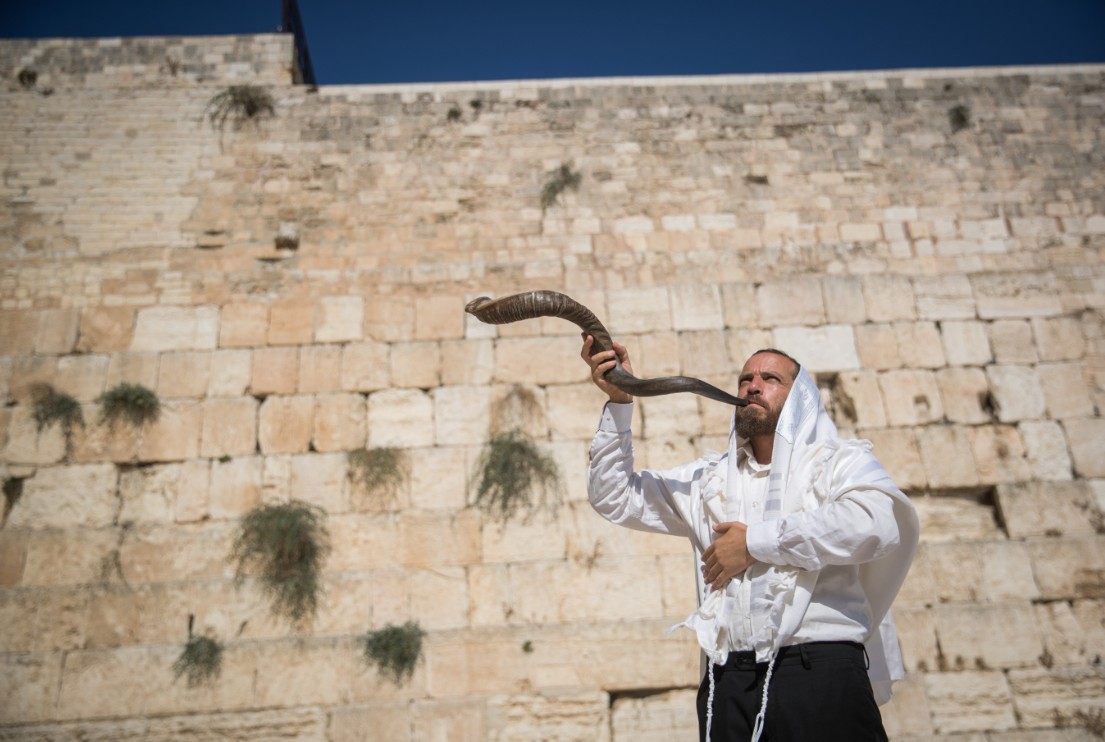 (Photo: Yonatan Sindel / Flash90)
The Shofar Resonated Loud
Only those in the group knew the full plan: one person began the blast, and when the police rushed toward him, another shofar would sound, passing the “baton” in midair.
“The shofar was heard exactly as planned,” Aharoni recounted. “I blew with all my might and then handed the shofar to a policeman. He arrested me. I was jailed for two weeks and later brought to court. My lawyer convinced the judge I was an innocent Sephardic boy with no understanding of politics, and they released me.”
The 1942 Blast: Menachem Begin’s Encounter
On Yom Kippur 1942, Etzel leader Menachem Begin stood at the Wall and witnessed British officers violently searching for the Betar youth who had dared to blow the shofar.
The 1941 Blast: Israel the Dane’s Shofar
Israel “the Dane” (Klein), born in Hungary, was the twelfth protest blower. In 1941, as Europe’s Jews were being consumed in the flames, his shofar blast served as a memorial for those dying in exile, unable to reach Jerusalem.
A shofar recently discovered from that era sheds light on a dark chapter at the Wall. Together with a cap, it was brought to the Kedem auction house in Jerusalem, not far from the place where his protest blast once rang out.
The shofar accompanied the Etzel fighter through those years. In the shadow of Europe’s inferno, it became a symbol of remembrance for Jews who perished in exile. Israel the Dane lived to see the Wall liberated in 1967, but his personal story carried profound pain. He lost a son in the Yom Kippur War, and his own life was ultimately claimed several years later.
Some of the earliest blowers were British Jewish soldiers. Israel the Dane’s friend Mordechai Shachary explained: “The Wall plaza was narrow, with a tight passageway and homes nearby. The British searched everyone. It’s likely the planners assumed that soldiers in uniform could carry a shofar without arousing suspicion.”
The 1944 Distraction Maneuver
In the summer of 1944, before Yom Kippur 1945, the struggle over the shofar ban flared again, but this time the plan was not limited to one blower at the end of the fast.
Weeks before the High Holidays, Etzel issued warnings to the British: anyone interfering with Yom Kippur prayers at the Wall would be treated as a criminal by Jewish youth, while Muslims and Christians would not be harmed as they passed through the plaza.
Tension rose sharply, creating the impression that Etzel planned to deploy armed forces at the Wall to block British access. In reality, the plan was entirely different.
As Yom Kippur ended, four stone police strongholds, Tegart Forts, named after engineer Sir Charles Tegart, were attacked across the country. The warnings about the Wall functioned as psychological warfare, drawing British focus and fear while the broader operation unfolded elsewhere.
Remarkably, the authorities heeded the threat. That Yom Kippur, there were no British officers at the Wall. The traditional shofar blast after Ne’ilah was heard without interruption. No confrontations erupted on the way to the Wall, leaving plainclothes British detectives confused as they waited for displays of weapons that never came. Meanwhile, Etzel units struck police fortresses nationwide.
The operation was not only a military success, but a symbolic triumph as well. For the first time, the mere threat of an underground movement shifted British behavior at the Western Wall.
The 1946 Return of a Seized Shofar
In 1946, Moshe Karavani was caught and arrested, and his shofar was seized by the British officer who detained him. About forty years later, in London, a friend of one of the Israeli participants met that same officer. The encounter led to an unexpected conclusion. “Return it to those it belongs to, to its place among Israel’s Jews,” the officer said, and the shofar was returned.
The 1947 Closing: The First and the Last
Among the last three shofar blowers on Yom Kippur 1947 was Avraham Elkayam. After the Six-Day War, during the celebrations at the liberated Wall, Avraham spontaneously asked someone holding a shofar to let him blow. A curious man asked, “Why are you blowing the shofar?” Elkayam answered, “I was one of the last, in 1947.”
The man stared at him in disbelief and then said, “And I was the first, in 1931.” It was Moshe Segal. In that moment, the circle closed, linking the first blower under the Mandate to one of the last.
With Rabbi Shlomo Goren’s shofar blast and the meeting of the Mandate’s first and last blowers, an era of foreign rule came to an end, and Jerusalem remained united under Israeli sovereignty.
In our time, when attacks on tradition reappear and disputes at the Western Wall surface again and again, Israelis would do well to remember the pre-state battles fought with holiness and sacrifice to protect the Wall’s sanctity and ensure that mitzvot could be fulfilled there. May the shofar of Mashiach be heard soon. Amen.
Despite the prohibition, the Ne’ilah shofar blasts at the Western Wall continued, thanks to brave Jewish youth who hid shofars with remarkable ingenuity and sounded them at the close of prayer. Some escaped before they could be arrested. Others paid with weeks, and at times months, in prison.

