

Magazine
Two Stones of Light: Rabbi Chaim Pinchas Benish Returns to Gross-Rosen
A moving journey through Poland’s forgotten camp, a mother’s survival, and the choice to rebuild after the Holocaust
- Yaakov Min / Bakihila
- | Updated
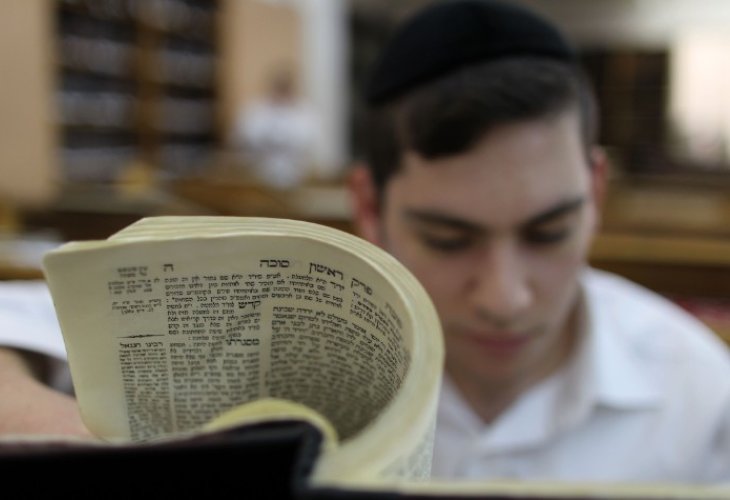
Rabbi Chaim Pinchas Benish holds two pieces of granite in his hands, visibly moved. They are unpolished, still raw stone, yet their beauty is unmistakable: snow white, scattered with blue sparks that catch the light and throw off tiny flashes. But that beauty carries a terrible story of the bondage, pain, and suffering that his parents endured.
“I just came back from there, from the place these stones come from,” he says emotionally. “I couldn’t leave without a tangible memory. I’m going to put them right here on the table in the center of the house, so we won’t forget the hell my mother, of blessed memory, went through because of these stones — until she was freed exactly seventy years ago, in the month of Iyar 5705 (1945).”
For those who may not know: Rabbi Benish is a well-known author and Torah scholar, with a long list of respected books and research works to his name. Now, exactly seventy years later, he feels it is time to open and address the personal chapter of his parents’ lives that he never truly dealt with — his parents Rabbi Shimon and Mrs. Golda Benish, and the story of their liberation. That is what brought him to Poland, on a journey tracing the path of torment his mother endured, reaching its peak in the remote and lesser-known extermination camp of Gross-Rosen.
“Everyone knows Auschwitz or Treblinka,” Rabbi Benish says, “but almost no one knows the camp that was nicknamed ‘Auschwitz B.’ It was a massive camp where tens of thousands of Jews were murdered and perished. It was the last camp to be conquered — and my mother remained there until it was liberated by the Russian army.”
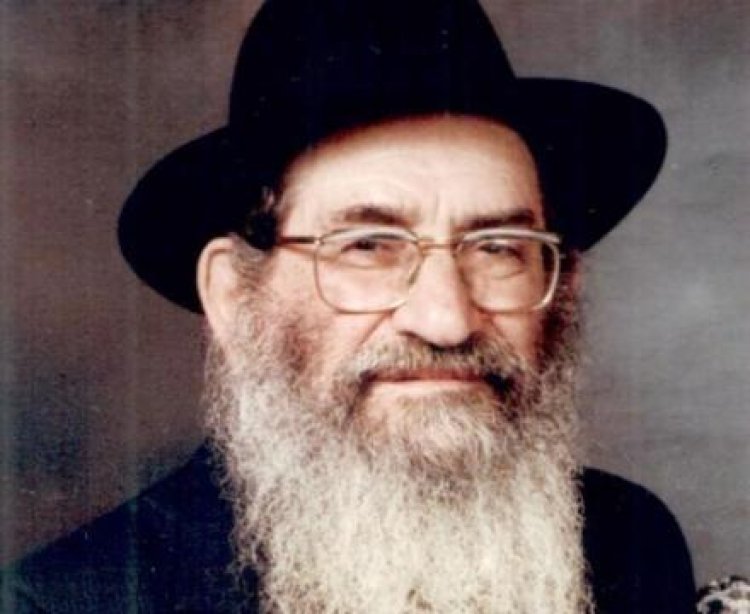
Kaddish at the Grave of His Stepfather
He began his journey in the town where his mother, Mrs. Golda, née Rubinstein, of blessed memory, was born: Wodzisław, Poland. There she married her husband, a student of the Chofetz Chaim who also studied in the Radin yeshivah, and they had five children.
“Her husband, may God avenge his blood,” Rabbi Benish explains, “who was actually my stepfather, first served as a rabbi. But how did a rabbi make a living in those days? He would answer halachic questions and receive an egg or a chicken leg — and that’s what he lived on. It wasn’t for him, so he left the position and moved to Ostrowiec. Later, when the Germans arrived and gathered all the Jews into the ghetto, he fled to the partisans. He was caught by the Gestapo and executed.”
Rabbi Benish and his brother visited the town hall, met the mayor, and heard the story directly from him.
“He took us down into the basement of what had once been the Gestapo offices. The jail cells are still there, as though untouched for seventy years. On the wall, names of prisoners were carved in Hebrew — they carved them themselves, as a memorial, and it’s still there. My stepfather was executed by gunfire and buried there. At his grave in the courtyard of the Gestapo building, we recited Psalms and said Kaddish.”
What happened to your half-siblings?
“There was an aktion in the ghetto. All the Jews were sent to Auschwitz, including my mother, who was left alone with five children. She managed to hand her youngest child to a Polish neighbor who promised to guard him carefully. With the other four children, she arrived in Auschwitz — where their fate was decided, life or death. She was sent to labor, and they were sent straight to the gas chambers.”
His mother was forced to work for long, brutal days in the hell of Auschwitz. Later, as the Germans began losing on the front, thousands of prisoners were driven on a death march into Germany — first and foremost to the camp meant to serve as a replacement for Auschwitz: Gross-Rosen.
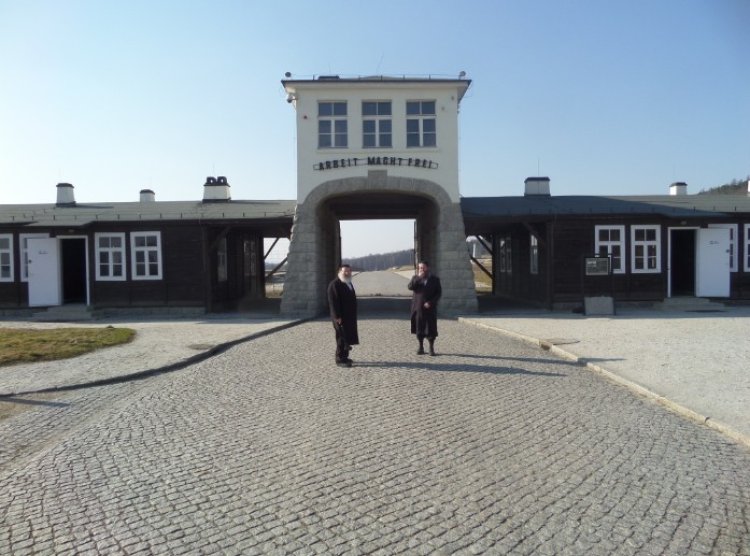
The Road to Gross-Rosen
“To reach it,” Rabbi Benish describes, “we went through a real ordeal ourselves. We landed in Warsaw, traveled to Łódź where Dariusz was waiting for us. Dariusz is a 40-year-old non-Jewish Polish guide who, for some reason, takes an interest in the Jewish people and our story. He even once visited Israel to see what a Jewish Shabbat looks like. A kind of righteous gentile.”
“From Łódź, we still had many hours to travel until we reached the Silesia region in southwest Poland, and its capital, Wrocław. The architecture is distinctly German with remnants of the days when Germany ruled the region. You see many descendants of Germans who once lived there, and it’s far more splendid and beautiful than other Polish cities.”
Rabbi Benish clarifies that Jewish history knows the city more by its older name Breslau, and for the great Torah giants who served there: Rabbi Yitzchak Teomim and Rabbi Binyamin Wolf Eiger, of blessed memory. One of its most famous Torah figures associated with that world was Rabbi Akiva Eiger, of blessed memory. Yet over time, the city declined under German Enlightenment influence and became a center of Reform.
“From Breslau we continued another sixty kilometers to Gross-Rosen. The road passes medieval German fortresses and villages that look as if they were lifted yesterday from Bavaria — hard to believe we’re in Poland. Everything feels German here: organized, developed, unlike the Polish villages. We stop for fuel, and a local tells us that the village — like the whole region, was German-controlled, and only after World War II were the Germans expelled and Poles settled in their place. ‘We didn’t even know what a faucet or sink was,’ he says. ‘We were used to wells. All the hygiene systems, all the upgrades were big innovations.’”
“And like everywhere borders changed hands, names changed too. We searched for ‘Gross-Rosen’ — but it doesn’t exist on the map. In its place stands the Polish village of Rogoźnica. After an exhausting drive, we reached the gates. Now there was no doubt: a sprawling structure near a railroad line, with the German words ‘Arbeit macht frei’ — ‘Work sets you free’ — greeting us.”
Gross-Rosen
“Unlike us,” Rabbi Benish says quietly, “my mother arrived here after Auschwitz, after all its horrors — after a death march of 300 kilometers in freezing cold, 18 degrees below zero. Around 50,000 Jews marched out in long columns, guarded by armed Gestapo men. A Jew who fell was shot on the spot. That was the fate of thousands. The entire road from Auschwitz to Gross-Rosen is scattered with their graves. My mother was among the few who survived.”
Was she especially strong?
“Not at all. But as they told me at the camp, the women endured more than the men — maybe because their drive to live was stronger. My mother believed she had a child who survived, and for him she fought to live one more minute, and another. She kept telling herself: ‘I have something to live for — to return and meet the little child I still have.’ That’s what kept her alive.”
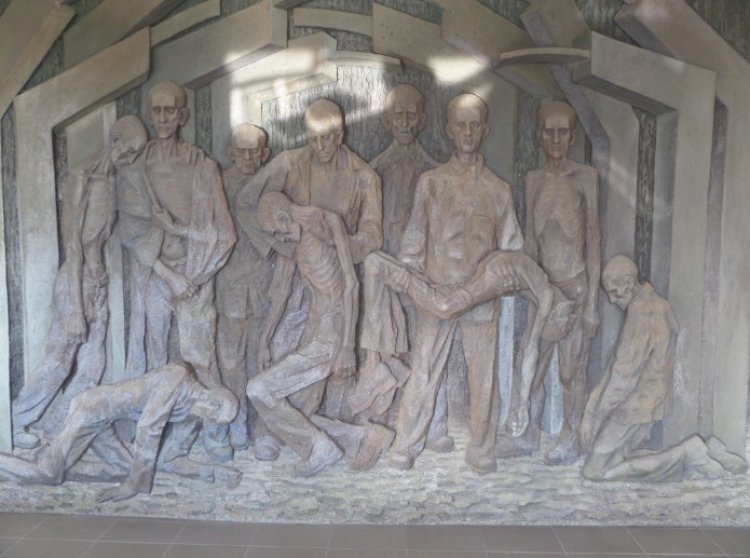
Gross-Rosen was established around 1940. The camp prisoners did horrific labor in stone quarrying. A unique type of granite was discovered there, with a pattern found nowhere else in the world. The prisoners were forced to extract the rare stone. An entire mountain was cut apart by their hands, and Rabbi Benish took his granite fragments from there. “Today,” he says, “the quarry is completely abandoned and filled with water.”
As Auschwitz was being evacuated, the Nazis expanded Gross-Rosen to function as a replacement. When prisoners arrived, they encountered what looked like the same hell they had just left: the same slogan, the same barracks. In practice it was even worse. Within days, tens of thousands of exhausted prisoners were crammed into a camp with no adequate means to receive them. The overcrowding was beyond description.
Barracks meant for about 200 prisoners held over 1,000 in those weeks — sometimes even 1,800. In what was then the largest camp in the Reich, people fought, and the struggle spilled into violence, over a tiny patch of space. Within a few weeks, tens of thousands died.
“My mother didn’t remain here,” Rabbi Benish says. “The Germans sent her from here to the town of Waldenburg. That’s where we continued; following the route of her suffering.”
Hitler’s “Future Palace” and the Underground Bunkers
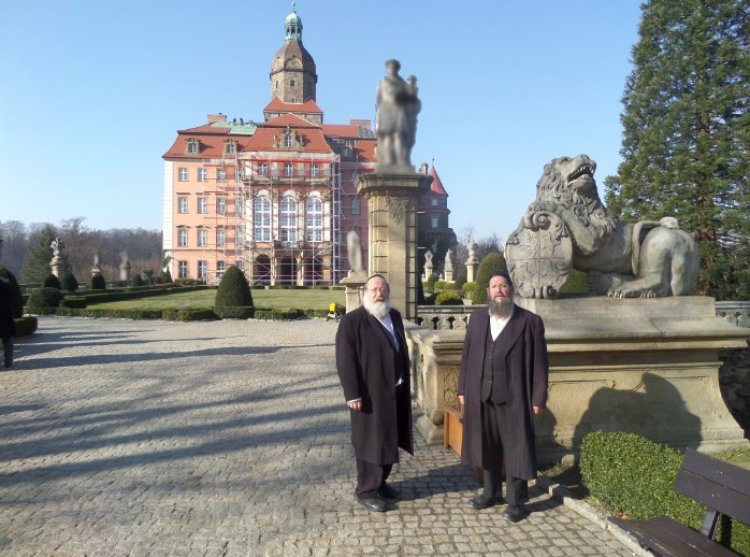
The Fürstenstein Palace near Waldenburg (today called Wałbrzych in Polish) is one of the most beautiful sites in Poland. In the heart of the mountains, atop a high forested cliff, stands a magnificent castle with a red roof and soaring turrets — dating back to the Middle Ages, isolated by valleys and rivers.
Hitler believed — perhaps because of the remoteness, the elevation, and the isolation, that this region would never be conquered by Allied forces and would remain in his hands. So he fortified the area and built underground bunker complexes beneath the mountains.
“We arrived there,” Rabbi Benish recalls, “to the magnificent palace that was meant to become Hitler’s palace. Beneath our feet, an enormous complex of underground halls and passages was carved, stretching for kilometers. A surviving document from Hitler’s staff requests an allocation of cement for a construction site defined as ‘the structure planned to be the Führer’s main headquarters.’ These caverns deep inside the mountain were meant to be the final stronghold where he would barricade himself. The construction required 28 million tons of cement — equivalent to the annual allocation for building all the air-raid shelters being constructed throughout Germany at the time.”
“After touring the palace prepared for the murderer, we wanted to descend into the underground spaces. Here my mother was forced to work in the backbreaking construction. The managers were polite and did not conceal the horrific past. But when we tried to enter the bunkers to see where she labored, we were met with firm refusal: ‘The caves are used for scientific seismograph equipment,’ they told us. ‘They cannot be visited.’”
Rabbi Benish notes that Hitler was, in a sense, right about how difficult Silesia was to conquer. During the winter of 1945, Germany fell, Berlin was taken by the Russians, and Hitler committed suicide on 13 Iyar. Even after his death, fighting continued and the killing machine at Gross-Rosen continued at full force for several more days. Only on 26 Iyar was Silesia conquered by the Russian army after a siege of Breslau that lasted three months. The Jews in Gross-Rosen were among the last to be liberated from Nazi camps — his mother among them.
After the War
After the war, Rabbi Benish continues, his mother returned to Ostrowiec. The first thing she did was go to the Polish neighbor to whom she had entrusted her baby — the child for whom she had clung to life.
Tragically, she discovered that the woman had decided one day she had “had enough” of guarding a Jewish infant. She went to the Gestapo and handed him over in exchange for one kilogram of sugar and one liter of kerosene. The baby was taken into the courtyard and shot immediately. In this way, his mother’s entire family was wiped out.
A small measure of consolation came when, by Heaven’s mercy, she discovered that all nine of her brothers and sisters survived the Holocaust — something Rabbi Benish describes as almost unheard of for a family in Poland, and the only comfort she had.
Broken and alone, she decided she had nothing left to seek on that cursed soil that cried out with the blood of her children. She began making every effort to secure papers to immigrate to the Land of Israel. In a displaced persons camp in Germany, she met the well-known activist Rabbi Shimon Benish, of blessed memory — among the founders of Poalei Agudat Yisrael and Kibbutz Chafetz Chaim. With the holy aim of rebuilding the Jewish future as an answer to their enemies, they married and established a home.
“The China of Europe” and the Fight for Shabbat
Rabbi Benish’s father, Rabbi Shimon, was born in Łódź. He was a Radomsk Chassid and studied in the famous “Keter Torah” yeshivot. He helped found Poalei Agudat Yisrael in the city.
To understand why, Rabbi Benish explains that Łódź was once “the China of Europe” — the textile manufacturing powerhouse of Eastern Europe. Much of Europe’s clothing and fabric was produced there.
Many factories belonged to Jews, including observant and Chassidic Jews. Some used a special “sale arrangement” for Shabbat — a kind of legal fiction to keep machines running. The arrangement was questionable, but widespread, and massive Shabbat desecration became normalized. The deeper problem was that wealthy religious factory owners refused to employ Shabbat-observant Jews. As a result, tens of thousands of yeshivah students and young men faced a brutal choice: desecrate Shabbat or starve.
His father and others organized a framework of religious workers to fight the phenomenon.
Rabbi Benish recounts a community meeting focused on strengthening Shabbat observance. One issue discussed was women selling herbs and vegetables on street corners until Shabbat. Activists would chase them off, but they would reappear nearby. At the meeting, his father stood up and confronted the older community leaders:
“Before you fight these women, make sure the religious industrialists hire their husbands and fathers in their factories. Then these poor women won’t need to scrape together a humiliating living selling parsley. After all,” he cried, “they can’t ‘sell their parsley factories to a non-Jew’ and make a living on Shabbat the way people here do.”
His father protested Chassidic factory owners who went to their shtiebel as usual while their factories ran on Shabbat, and he succeeded in changing things. He also founded a special shtiebel for religious workers that lasted until the Holocaust — guided by a motto he used to describe it: “Even a worker can be respected on Friday.”
The Holocaust, the Displaced Persons Camp, and a New Beginning
Like all the Jews of Łódź, Rabbi Shimon was imprisoned in the Łódź Ghetto with his wife and three children. Toward the end of the war, when the Germans evacuated the ghetto, he was sent to Auschwitz, stayed there for months, was transferred to another camp, and survived.
He too dreamed of reaching the Land of Israel. In the displaced persons camp he found the woman who would become his partner in the second chapter of his life. Together they set out to rebuild and to immigrate.
Cyprus
Their story of aliyah is gripping on its own.
“They came on an illegal immigrant ship,” Rabbi Benish says. “My father gathered a group of religious Jews around him and they ensured a kosher kitchen and religious needs on board. This was a ‘new generation’ immigrant ship that carried thousands. The ship’s commander was Mordechai (‘Muka’) Limon.”
Rabbi Benish says he later met Limon and heard firsthand stories about his father. Limon remembered how Rabbi Shimon asked for the keys to the kitchen: “Without a kosher kitchen,” he told Limon, “a third of the passengers will starve.” Thanks to him, there was kosher food.
As the ship neared Israel, British destroyers attacked, firing tear gas and water cannons. The immigrants tried to respond by hurling bottles and cans, but the ship was boarded and captured. The outcome was bloody: two Jewish dead and 24 wounded. The ship was dragged to Haifa, and the immigrants were deported to Cyprus, where a new exile began.
Even there, Rabbi Shimon became a pillar for the exiles — organizing Torah study and strengthening religious life. In Cyprus, the firstborn son of the new Benish family was born.
In 1948, the British decided to release the Jews and allow them into the Land of Israel, giving priority to babies and their parents. Rabbi Shimon would say that it was thanks to the children they merited to go up — echoing the prophet Malachi: “He will restore the heart of fathers to children.” The fathers, he said, would live in the merit of their sons.
Look Forward and Build
Rabbi Shimon helped found Kibbutz Chafetz Chaim, later moved to Kiryat Ata, and worked in the textile factory “Ata,” using the expertise he had gained in Łódź. He played a central role in establishing synagogues and educational institutions, and became prominent among Poalei Agudat Yisrael activists in Israel. He also worked to revive Radomsk Chassidut in the Land of Israel — pushing for an ongoing Rebbe after the last Rebbe, Rabbi Shlomo Chanoch, was murdered in the Warsaw Ghetto. He headed the Chassidut’s kollel and devoted himself to preserving its memory.
Where did they find the strength to start over?
“My father,” Rabbi Benish says, visibly moved, “always told us: ‘We Jews must look forward — to the future — not backward.’ He didn’t fear speaking about the Holocaust. In his role as head of the culture department in Kiryat Ata, he produced Holocaust exhibitions and made sure it would not be forgotten. But he did not dwell in despair. His gaze was always toward rebuilding.”
He would cite Lot’s wife, who was commanded not to look back at the destruction of Sodom and Gomorrah — because in a time of catastrophe, you must focus on rescue, not on looking backward. When she disobeyed, she became a pillar of salt. “We too,” he would say, “must not look backward.”
Rabbi Benish adds that only recently has the Holocaust become more openly discussed in parts of the Haredi public. In earlier years, the focus was on rebuilding, not on being trapped in the past. “Today,” he explains, “after we are stronger and have built ourselves, we have the capacity to look back.”
He recalls how his father once saw an advertisement for a major Jewish outreach organization promoting a seminar titled: “Why did the Holocaust happen?” His father went, and listened as a young lecturer listed sins and reasons for why God decreed the Holocaust. When the lecturer asked if everything was clear, his father stood up, deeply shaken, and said:
“According to your beautiful explanations, if the Holocaust hadn’t happened, we would have had to ask: Why is there no Holocaust?”
People laughed, but his father remained pained. He told them: “Today people want to know and understand everything. But we must know there are things beyond our understanding — decrees tied to the existence of all Israel and to the roots of creation and Divine will, as Chassidic works discuss at length. Our task is not to explain, but to accept with simple faith. Never forget Amalek — and keep looking forward and building.”
Rabbi Benish has just completed printing his comprehensive book “Ish Lehavah” (“A Man of Flame”), which tells the remarkable life story of his extraordinary parents, following deep research and visits to the historical sites. Only a small portion of that story appears here.
The article was originally published in the magazine “Bakehillah.”

