

World News
Iran Still Dark as Protests Rage Into Third Week, Death Toll Reported in Hundreds
With internet and phone lines cut, conflicting casualty figures emerge, hospitals report crisis conditions, and Tehran threatens death penalties for demonstrators
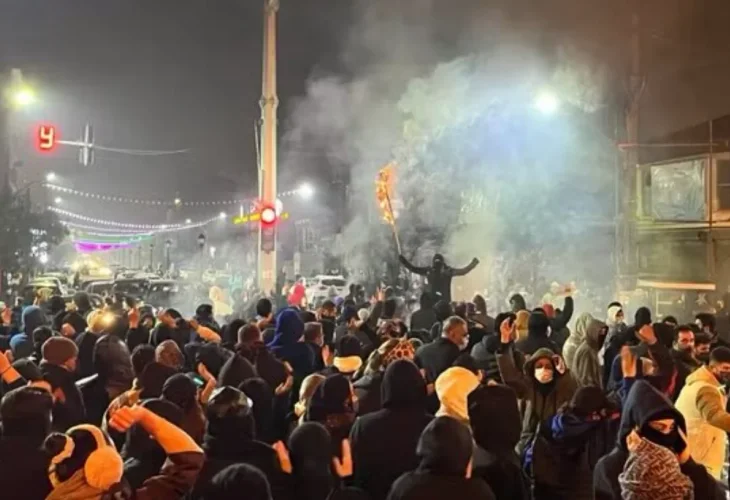 Iran (Photo used in accordance with 27a)
Nationwide protests challenging Iran’s theocratic rule continued into Sunday, crossing the two-week mark as authorities maintained a near-total communications blackout and reports emerged of hundreds killed in unrest across the country.
Demonstrations were reported overnight in Tehran and Mashhad, Iran’s second-largest city, even as a shutdown of internet access and international phone lines, now in place for more than 60 hours, has limited independent verification and intensified uncertainty around reports of violence and mass arrests. Authorities cut off communications late Thursday, effectively disconnecting the country’s 85 million people from the outside world, a tactic previously used during unrest in 2019 and 2022 but now coinciding with escalating warnings from senior officials and expanded deployment of security forces.
Rights groups and medical sources have reported differing casualty figures. The U.S.-based Human Rights Activists News Agency (HRANA) said at least 116 people have been killed since protests erupted on December 28, with more than 2,600 detained. At the same time, doctors speaking anonymously to international media have claimed significantly higher numbers, with some estimating that more than 200 protesters may have been killed. Iranian authorities have not released official casualty figures.
Despite the blackout, images and videos have continued to emerge from Iran, likely sent using Starlink, a satellite internet service that allows users to connect directly to satellites rather than relying on local networks. The equipment is illegal in Iran, and using it carries serious risk, as authorities have previously accused people of spying for foreign powers. Digital rights experts say Iranian officials appear to be trying to interfere with the service, reporting sharp drops in data transmission consistent with jamming.
Footage circulating online showed protesters gathering in northern Tehran neighborhoods such as Punak and Saadat Abad, waving lit mobile phones, banging pots and pans, and setting off fireworks, while other clips showed peaceful marches and motorists honking horns in support. In Mashhad, Iran’s second-largest city and home to the Imam Reza shrine, the holiest site in Shiite Islam, videos appeared to show confrontations between protesters and security forces, with burning debris, blocked streets, and separate footage released by Iranian state and semi-official media showing government buildings and mosques set on fire.
Medical workers have described hospitals across Iran as overwhelmed. Doctors told the BBC that Farabi Hospital, Tehran’s main eye treatment center, had entered crisis mode, while a medic in Shiraz said there were not enough surgeons to treat the influx of wounded patients. Multiple sources reported treating gunshot wounds and injuries caused by live ammunition.
Iranian state television on Sunday morning attempted to project a sense of calm, sending correspondents to selected cities and displaying date stamps to underscore the timing of its reports. A state TV anchor said that “peace prevailed in most cities of the country at night” and claimed there was “no news of any gathering or chaos in Tehran and most provinces last night.” Notably, the broadcasts did not include footage from Tehran or Mashhad. Later, video independently verified by the Associated Press showed large crowds in Tehran’s Saadat Abad neighborhood during the same period, directly contradicting the official narrative.
Authorities escalated their rhetoric on Saturday. Iran’s attorney general, Mohammad Movahedi Azad, warned that anyone participating in protests would be considered an “enemy of God,” a charge that carries the death penalty under Iranian law. State television reported that the designation would also apply to those who “helped rioters.”
The Islamic Revolutionary Guard Corps and the regular army issued statements accusing “terrorists” and “enemy plots” of fueling the unrest and vowed to “firmly safeguard national interests, strategic infrastructure, and public property.” Iranian media reported that 100 people described as “armed rioters” were arrested in the town of Baharestan near Tehran.
According to HRANA, protest tactics have increasingly taken the form of “scattered, short-lived, and fluid gatherings,” reflecting heavy security deployments, drone surveillance, and mounting pressure on demonstrators.
For Iranians abroad, the blackout has intensified fear and uncertainty. “You can’t understand our feelings. My brothers, my cousins, they will go on the street. You can’t imagine the anxiety of the Iranian diaspora,” said one Iranian expatriate quoted by the Associated Press. “A lot of people are being killed and injured by the Islamic Republic of Iran, and we don’t know who.”
As Iran remains largely cut off from the world, protests continue under the shadow of mass arrests, disputed death tolls, and warnings of severe punishment from the country’s leadership, headed by Ayatollah Ali Khamenei. With independent verification limited, the full scale of the unrest and the crackdown remains unclear.

