

World News
Iranian Regime Under Growing Pressure as U.S. Signals Readiness to Act
Trump warns the regime against killing civilians, saying the United States “stands ready to help”
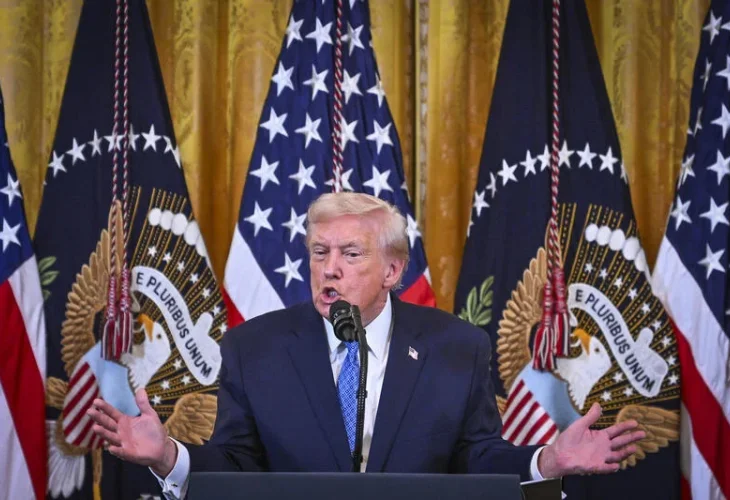 Donald Trump (Arie Leib Abrams/Flash90)
Iran’s leadership has begun hardening its response as unrest continues across the country, issuing harsh threats and placing security forces on high alert while the United States signals it is prepared to respond if the crackdown intensifies.
That external pressure has been driven largely by Washington. U.S. President Donald Trump has escalated his public warnings in recent days, framing American involvement as a deterrent against further violence. In a post last night on social media, Trump wrote that “Iran is looking at FREEDOM, perhaps like never before,” adding that the United States “stands ready to help.” He has also warned that if Iranian authorities violently kill protesters, the U.S. would respond forcefully, stressing that Washington is closely watching developments.
Trump’s message has been reinforced across the U.S. administration. Secretary of State Marco Rubio said that “the United States supports the brave people of Iran,” while the State Department issued a pointed warning to Tehran, saying: “Do not play games with President Trump. When he says he’ll do something, he means it.” The statements underscored a unified tone from Washington as pressure on Iran’s leadership mounts.
Behind the scenes, that rhetoric has been matched by contingency planning. American media outlets reported that Trump has been briefed on possible military strike options as part of internal discussions. According to The New York Times and The Wall Street Journal, U.S. officials have reviewed a range of scenarios in recent days, though no final decision has been made and no military assets have been deployed. Officials emphasized that the talks reflect routine planning rather than an imminent order to act.
Inside Iran, the regime has responded to these signals by sharply escalating its own threats. Iran’s attorney general, Mohammad Movahedi Azad, warned that anyone taking part in protests would be considered an “enemy of God,” a charge that carries the death penalty under Iranian law. State television reported that the designation would also apply to those who “helped rioters,” signaling a sweeping interpretation of criminal liability.
At the same time, Iran’s security establishment has moved to project strength. The Islamic Revolutionary Guard Corps and the regular army blamed “terrorists” and “enemy plots” for the unrest and vowed to “firmly safeguard national interests, strategic infrastructure, and public property.” The IRGC also announced the arrest of a foreign national accused of spying for Israel, reinforcing the regime’s claim that the turmoil is being driven by outside forces.
According to reporting by The Telegraph, that posture has been accompanied by heightened military readiness. The IRGC has reportedly been placed on its highest level of alert, with underground “missile cities” activated and readiness described as exceeding levels seen during last summer’s conflict. Iranian officials cited in the report said Supreme Leader Ayatollah Ali Khamenei is relying heavily on the IRGC amid concerns about loyalty within other security bodies.
State media has sought to reinforce this narrative at home. Broadcasters have focused on casualties among regime forces, airing funerals for security personnel and highlighting damage to government buildings and mosques. The coverage has consistently portrayed the unrest as violent, foreign-backed sabotage rather than domestic dissent.
International reaction has continued to build alongside the standoff. Leaders of France, Germany, and Britain issued a joint statement condemning the killing of protesters, while European Commission President Ursula von der Leyen called on Iran to restore internet access and respect the right to peaceful assembly. Demonstrations in support of Iranian protesters have also taken place abroad, including outside diplomatic missions.
U.S. officials have described the moment as a delicate balance. The situation, they say, is an “endurance game,” with Tehran attempting to crush unrest without crossing a threshold that could trigger outside intervention. As internal defiance and external pressure converge, Iran’s leadership faces a volatile standoff with few clear exits and growing risks on all sides.
