

Magazine
From Assimilation to Community: Jewish Schools for Israeli Families in the U.S.
A Miami classroom, a whispered “Shema Yisrael,” and the mission that grew into a nationwide network to reconnect Israeli expats to Torah, identity, and Jewish community
- Hidabroot
- | Updated
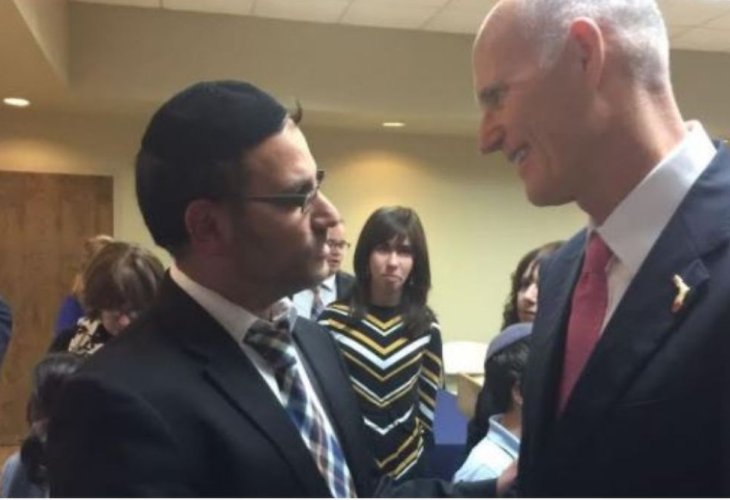 With Florida Governor Rick Scott
It was about ten years ago, when Avshalom Baskin was living in Miami. As someone who had begun working in Jewish outreach, he came to a non Jewish school to take Jewish children out of class, and learn a little Judaism with them.
With one of the boys, he wanted to learn the letters of the alef bet, but the child looked shaken.
“He told me that during the previous recess a boy pushed him for no reason,” Baskin says. “When he asked him, ‘What did I do to you?’ the boy answered, ‘Because you’re Jewish.’ The child told me it didn’t end there. ‘He told me we’ll meet in ten minutes in the yard. We’re going to fight and see who wins. I was so scared that before we even started, I said, Shema Yisrael…’”
“When I heard that, I got chills,” Baskin says. “We’re not talking about Russia under communism or World War II. We’re talking about Miami in 2012. That’s what Jewish kids are experiencing there.”
The Hidden Danger: Assimilation
Baskin encountered painful stories from many Jewish families who moved abroad, and each time he was shaken all over again.
“I’m originally Israeli,” he says. “I was born and raised in Jerusalem. As a young man I learned in Yeshivat Or Yisrael, and later I went to live for a short period with my grandmother in Miami Beach. In those days I studied at a yeshiva in Miami with Rabbi Yochanan Zweig, and he suggested a very special match for me, his niece. That’s how I married my wife, Shari, and moved to Miami Beach.”
As time passed in the United States, he became more and more aware of a major problem among Israelis who had left Israel and were raising families abroad.
“It’s truly heartbreaking, because in the US, private school tuition, including Jewish schools, is around 20,000 dollars per child per year. If a family that moved from Israel has an average of three school age children, they need more than 5,000 dollars a month just to pay tuition. For most families it’s simply impossible, so they compromise and send the children to non Jewish schools.
“The problem is even bigger because most people who do this barely see the danger. They assume that if they send the kids on Sundays to a Jewish afternoon program, they’ll pick up a few basics. When the kids are small, perhaps that sounds reasonable. But a few years later, when they grow up, they marry outside the Jewish people, and then it’s already too late to change anything.
“This hurt me personally,” he says. “I tried to speak with those families and explain how they were abandoning their children’s future. Sadly, the families, even the ones considered traditional, could not understand my arguments at all. Some even asked me, ‘What’s the problem if my son marries a non Jewish woman? He’ll still be Jewish.’”
“This is a very serious reality that people in Israel cannot even imagine,” Baskin adds. “In the US there’s a strong pull to marry non Jewish women, and many of those women are specifically looking for Jewish men. I know that in Florida, for example, there are schools where they officially teach students how Jews are smart and wealthy. Naturally, girls make every effort to marry Jewish boys.
“There’s another painful and very common phenomenon. Israelis sometimes arrive in the US without the paperwork needed to immigrate, so they find a simple solution: a fake marriage to an American non Jewish woman, so they can stay. However, those marriages that begin only for documents often become real. They live together and remain married and they don’t see a problem. If she’s a good, capable woman, why be racist and reject her?”
The Decision: To Open a School
From his earliest days trying to reach the Jewish population through outreach, Baskin discovered he had an ability not everyone has.
“Because I grew up in Israel, I came with the Israeli language and slang, enabling me to speak to Israelis who had moved abroad. On the other hand, because I speak English and understand American culture, I can also represent the local mentality. Being that I learned in prominent yeshivot, I can also speak with a halachic voice. I realized I could influence a very large audience, even without trying.”
Baskin began visiting non Jewish schools and pulling Jewish children out as a volunteer to learn with them during recess, with the permission of parents and the schools. He mainly taught them the letters of the alef bet, and that is how he discovered the group of Jewish children that existed in every school.
Along the way he heard more disturbing stories.
“In another case,” he remembers, “one child told me that during lunch recess a few ‘friends’ came over and shoved a sandwich with spaghetti and pieces of pork into his nose. They told him, ‘Smell it, smell it. If you eat it, we’ll give you twenty dollars.’ The boy told me he held himself back and didn’t touch the food, but that’s a real challenge.”
As time went on, Baskin understood how urgent it was to move Jewish children out of these institutions and into Jewish schools. Sometimes he succeeded, but not always. Sometimes parents could not afford it, and sometimes Jewish schools could not take in children from homes that barely knew anything about Judaism.
“I realized the only way I could create real change was to open a school myself for children from Israeli families living abroad,” Baskin says, then pauses to emphasize: “It wasn’t only my idea. I also had important partners, including Rabbi Kornfeld and Rabbi Zev Eretz, who helped with administration and with the significant funding needed.”
How did you find students for the school?
“It wasn’t easy at all. I would go to the supermarket or other stores, stand there, and try to meet Jews. I spoke to each person in the language that fit them. With some, the right approach was a sharp wake up call, to tell them they were causing unimaginable harm to their children, and that because of their choices, their children would not grow up as part of the Jewish people. In other cases I emphasized academics, because parents wanted high level education, and I explained how much we invested in that. And sometimes I spoke about values and character.”
“We were careful not to call our school ‘a school for Israelis who left Israel,’ because we knew it would scare off those who preferred to see themselves as Americans, with no connection to Israel. Anyone living in America knows that among Israelis abroad there’s a term, ‘Israeliyada,’ and they try to avoid it. So we walked a careful line and called our school ‘an institution for Sephardi communities.’
“We built a very unique staff as well. The administration was Haredi and so were the teachers. We created a place with no feeling of religious coercion, but with very strong Torah education.”
Eventually the school opened under the umbrella of Torah Umesorah, a major network operating institutions across the United States.
“That gave us funding and allowed us to charge reduced tuition, but it also demanded a lot of work, because we needed to satisfy many rabbis connected to the organization and meet the high expectations placed on us.”
The effort was exhausting, he says, but it paid off.
“After we brought in child after child and held gatherings and registration nights, we reached 36 enrolled students. That may sound small, but in Miami terms it’s like a school with 360 children in Jerusalem.”
The Everyday Impact
Running the school was both challenging and deeply moving.
“As a principal, it was hard for me to see what Jewish children were dealing with, but it was also a huge satisfaction to know they were finally in the right hands. For example, one day a boy came to me and asked, ‘Rabbi, you told us it’s forbidden to drink wine touched by a non Jew, and I wanted to ask: on Shabbat we went to eat at McDonald’s and brought wine for Kiddush. The waitress who served our table touched our wine. Should we have continued with Kiddush or not?’”
On the other hand, he heard many stories of children coming home and asking their parents questions like, “Why don’t we make Kiddush?” or “Why don’t we light Shabbat candles?” That caused awareness to seep in, and many families strengthened.
What is the school’s goal? Is it to make people religious?
“Of course, ultimately, our great aspiration is to connect people to their roots and help them become observant Jews. But I don’t want to miss the core point that made us begin in the first place, which is to protect Jews from assimilation. For me, my life mission is to connect these Jews to community, because the moment they are connected to a community and become part of it, assimilation is prevented almost automatically.”
How do you convince them to come closer?
“It’s painful to say, but unlike decades ago, when to bring a Jew closer you needed to answer deep questions about faith and belief, today we are hardly asked questions at all. People don’t even argue, because they know nothing about religion. We mainly focus on explaining why Judaism is good, and what it offers in this world that can draw them in and help them in their personal lives.”
Baskin stresses the work is not easy, but recently they reached a new peak of about 250 children who now learn in the Miami school.
“Now we’re working on building a new building,” he says with excitement. “Sometimes it feels like a dream. Who could have imagined we would merit this?”
Looking Ahead: A Nationwide Vision
“As time went on, we understood there was no reason to open a school and community in Miami and not in other places across the US. That is how I found myself founding the organization I Am Jewish, with branches in different communities across the country. Everywhere we work for one purpose: to reach Israelis living abroad, gather them into communities, and strengthen them. In some places we also operate institutions. This is also the place to say that we are looking for additional activists living in the US with the right background.”
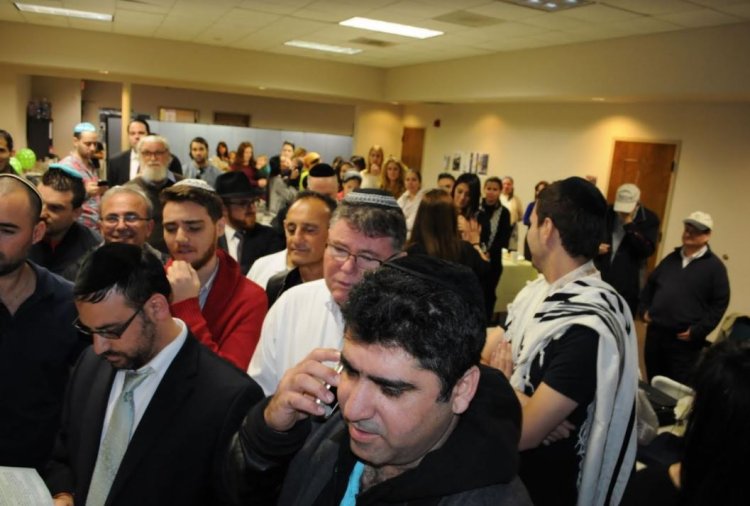
Orlando: Turning Pain Into a Community
One of the main places where he replicated success was Orlando, Florida.
“A few years ago I moved with my family to Orlando,” Baskin says, “and we discovered a large state constantly absorbing more and more residents, including Israeli Jews living abroad. Many Jews also come to vacation, because Orlando is very touristy. The neighborhood we lived in, receives 70 million tourists a year.
“The sad data is that among Jews living in Orlando there is 98 percent assimilation. In simple words, for a Jew to marry a Jewish woman you need an actual miracle. When we arrived, we found only 40 Shabbat observant families. That was a tremendous pain.”
But he also saw opportunity. “I believed that if such a large number of Israelis were coming to a place, it was impossible not to build a Jewish community there. It wasn’t easy, because unlike Miami, where there are kosher stores and strong institutions for children, in Orlando there are no kosher food stores. To buy meat or chicken you need to drive for hours. But we felt the need, and that is how we came.”
At first they relied on infrastructure built by an existing community, Chafetz Chaim of North America, but they wanted a community specifically for Israelis living abroad. They gathered families, and Baskin was appointed community rabbi.
“A short time after we moved, I was giving forty Torah classes a week.”
From Coffee and Cake to a Synagogue
Those classes were held in all kinds of unlikely places.
“Sometimes in malls or restaurants. Later we also directed families to the Jewish school. One idea we brought into the school was learning with the fathers who came in the morning to drop off their children. My wife baked impressive cakes, and I suggested they stay a few minutes to pray Shacharit and enjoy coffee and cake.
“That delay, which at first was ten minutes, quickly led to opening a synagogue there, and that is how the community grew.”
Over time, as he got to know local businesspeople, he began organizing community events such as birthdays, house warmings, or celebrations of business success. Families hosted community members, and he would share words of Torah at the event.
“The success was enormous and the community grew day by day. Today we have a large synagogue building, many community events, and we are also building a mikveh.”
Where do you see yourself in ten Years?
“I believe we’ll be across the entire United States. I’m not willing to settle for less, and I don’t see anything exaggerated about that goal.”

