

Magazine
Dan Shapira on Faith, Art, and Awakening: A Personal Journey Between Theater and Judaism
The actor opens up about roots, prayer, creativity, and the inner work of balancing heart, mind, and Jewish spirituality
- Avner Shaki
- | Updated
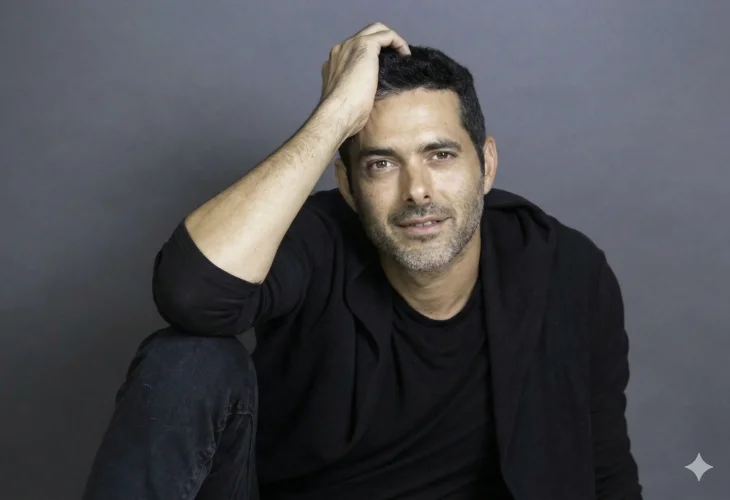 Dan Shapira (Photo: Yakir Shokron)
Dan Shapira is married and a father of two. He lives in Jaffa and is an actor.
A Spark of Nostalgia
“One of the things that accompanies us everywhere, even if we do not always pay attention to it, is our past. The way we were raised and how our personality was shaped. I believe we need to befriend, and sometimes even make peace with, our past and with the child we once were, because much of simple, genuine happiness is found there.
“I am an only child, and being an only child is a challenge, because I grew up in a reality where my parents loved only me and worried only about me. There was no division among siblings, no competition for attention. But when you step out into the world, it is not like that. I think it took me longer to mature in terms of truly seeing other people, really feeling them.
“Today it is one of the most important things in the world to me, to see people, to feel them, to understand what drives them, where they stand, what their perspective is, and what they need. Slowly, I hope that this is becoming my nature. I cannot neglect working on it, as it is not something that is rooted in me from the start. Discovering that you have the power to examine yourself and change things within yourself is enormous. It gives hope for life.”
A Spark of Awakening
“I feel that over the past decade, and especially over the last five years, I have been going through a kind of awakening, if that is the right word. It is difficult, truly a daily struggle, but I am willing to go on. I am willing to try, and sometimes even to fall, but not to give up. This is a long-distance run, not a 100-meter sprint.
“If we spoke about being an only child, perhaps it can be said that I am trying to find the Creator within myself and outside of myself, to truly feel Him. And the Creator is the most personal thing there is. He looks at me as deeply as possible and loves me as strongly as possible, as if I were His only child, even though He has so many children.
“To me, the Creator is love, light, infinity, and oneness. That oneness is deeply meaningful to me, and that is what I am trying to understand and internalize. It is hard to grasp, but if you really open your eyes and heart, you can feel Godliness in the world. Even in something as simple as a child’s smile, or a leaf falling onto the sidewalk. It is possible, and today I understand that it depends only on me. I cannot change what is outside; I can change myself.
“By the way, it is true that I have no siblings, but I have childhood friends who are truly like brothers to me. We are as close as siblings. And yes, I have a great hunger for a large family of my own. At the moment I have two children, Natan, five years old, and Benjamin, one year old. I very much hope, God willing, to expand the family. It is truly one of my greatest dreams.”
A Spark of Roots
“My strongest root today is my family, my wife Tamar and our children, and I am learning to nurture that root gently and devotedly. Marriage and children are also inner work: maintaining calm with the children, a smile, patience.
“One of the interesting things about my personal roots is that my father is of Lithuanian origin and my mother is Yemeni. In prayer, I can connect both to the Ashkenazi liturgy and to Sephardic or Yemeni prayer. The musical influences I listen to can come from Yemen, Morocco, Russia, France, or classical music. When I sing, I feel that there is something Ashkenazi in my voice, and at the same time something Eastern.
“As for music and theater, I learned everything from my dear father, Muli Shapira, who was for about forty years head of the culture department at Galei Tzahal. At home I grew up mainly on Israeli music: Yossi Banai, Arik Einstein, and others. I am one of those people who knows almost all the words to the songs of classic Israeli music by heart. Beyond that, I also received an education in drawing and sculpture, all from my father.
“At the same time, in my grandmother’s home, my mother’s mother, the wonderful Carmela, songs by Zohar Argov, Zion Golan, Daklon, Shoshana Damari and others were always playing.
“People often said to me, ‘You are half Ashkenazi? You look completely Mizrahi,’ and others say, ‘You are half Yemeni? You look completely Ashkenazi.’ Apparently, it is all in the eye of the beholder, and it only shows how much reality depends on how we see it.
“I pray in Jaffa at ‘Askila,’ which is a Chabad house, and in Tel Aviv at ‘Mima’al Mamash.’ There you find interesting combinations from all communities and shades of Israeli and Jewish society. Many young people, all singing, learning, talking and praying together. Our history is like that too: we were twelve tribes, each with a unique role, and together all the tribes create one people.”
A Spark of Inspiration
“There are many figures in Judaism from whom I draw inspiration, but I will speak about Rabbi Akiva. Perhaps I feel especially connected to him because he began learning at the age of forty, and I am now forty. I am not saying that I can intellectually grasp him, but like him, I too am blossoming later in my path, and not only in Torah. Until now I was quite a shepherd.
“Beyond that, ‘Love your fellow as yourself’ is a principle that accompanies me strongly. It is something every society truly needs, especially ours, and it needs to be understood deeply. We know that 24,000 students of Rabbi Akiva died in a plague, and some say that each of them thought he understood Rabbi Akiva best. Each one truly wanted the very best.
“I believe that in Israeli society everyone wants the best. Everyone feels they are fighting a just, sincere war. The problem is that everyone thinks they are right, and then, at some point, they miss the other person and fail to reach ‘love your fellow as yourself.’ I try to think differently and to activate compassion toward myself and toward others, because I understand that the world we live in, the world of action, is harsh. Often it is not simple at all. So is it any wonder that people develop such armor?
“I try to see beyond the armor, to see what is inside. And within myself too, I sometimes ask: what is under the armor? This does not mean that a person cannot stand firmly by their views, sometimes even forcefully, but the question is how they do it.”
A Spark of Learning
“The book that opened the world of Judaism to me is the Tanya. I discovered it a few years ago and I try to study it to this day, along with reading Chitat every day, which stands for Chumash, Tehillim, and Tanya. I also very much love Duties of the Heart by Rabbeinu Bachya and the writings of the Ramchal.
“Some people connect more easily to the study of halacha, which is very important, but instinctively I am drawn more to matters of the spirit. Recently I began hosting a program on Channel 20 called ‘The Chief Rabbi’s Question’ with Chief Rabbi David Lau. Through it I also learn halacha and connect more to that layer of Torah, and I gain an understanding of the connection between halacha and the spirituality behind it.”
A Spark of Action
“Thank God, recently I have been privileged to do several interesting things. In the past period, when the cultural world was largely shut down, I devoted much time to writing and personal creation. Next week I will begin rehearsals for a leading role in the final play written by the brilliant playwright Nissim Aloni. I play the character of Lot, who carries the pain and suffering of the Jewish people on his back. I am very excited to return to theater after a year-long break.
“One of the things that makes me happiest lately is my program on Hidabroot Channel with Rabbi Yonatan Gal'ed, ‘Being First.’ The show deals with awareness from a Jewish perspective: positive thinking, joy, trust, and more. Using classical sources, we discuss issues related to a person’s inner work, so they can ‘be first’ to themselves in the best way possible. The program also features the wonderful guitarist Ilan Malachi, and in every episode I sing a song in an original arrangement connected to the topic we discuss. We combine sacred songs, nigunim and piyyutim with Israeli songs in which we identify a deep and strong connection to the spiritual path.”
A Spark of Prayer
“I am constantly speaking with God. Today it has become part of my very essence in the world. I try that every action I take, every thought I think, and every word I speak will be connected to the higher source. I try. It does not mean I always succeed, but I always want to. I am in dialogue with that place.
“Today I believe that the physical reality as I see it is only a very small part of what exists. At the same time, the spiritual world can also be very deceptive. The search must be very precise. Personally, I found in Judaism the spiritual depth I was looking for.
“In recent years I pray three times a day, keep Shabbat, and study. In particular, I study the soul. I am currently participating in a very interesting year-long course by Rabbi Arad at the ‘Da’at’ Center, which teaches about the soul through the CBT method. Slowly I am realizing that everything is thoughts: how we interpret things based on what we experienced in the past, how we react to situations, how we conduct ourselves. This can be learned, and the tool can be calibrated. I am trying.”
A Spark of Consciousness
“People who have experienced near-death experiences testify that they experienced something very pleasant: a sense of unity, of being embraced by the universe. The brain may have stopped working, but consciousness continued to exist. There is a great deal of research on the subject, and I think consciousness is far broader than our brain. We will never be able to understand everything, but connecting to the understanding that we do not understand everything is already one step forward. Releasing control. Accepting change. Trusting. Believing.
“It is really not simple, but for me it is a good enough reason to get up in the morning. You cannot leave your soul aside even for a moment. If I neglect it and do not care for it, it starts to run wild, just like the body. If I do not exercise, the body reacts. The same is true for the mind.
“When you are governed by your emotions, you live in a stormy sea. I believe one can work on thoughts, and through that also repair the emotional world. And of course, this connects entirely to Judaism. Not only does it connect, in many ways it is Judaism: the work on character traits.
“At the same time, it is important for me to say that there are things where you must go with the heart. You cannot and should not always be like a computer. The heart also has an important role in our lives. Ultimately, the greatness and aspiration are to find the right balance.
“It is a journey: complex, moving, difficult, wonderful. The Holy One told Avraham to go without knowing exactly where, but with faith. For me, that is an excellent model, and I am happy to discover over the years that I am not alone. We are all walking the path, each in our own unique way.”

