

Magazine
Miri Michaeli on Faith, Journalism, and Legacy: Growing Up Jewish Behind the Iron Curtain
From Soviet Georgia to Israeli television, motherhood, Shabbat, and bringing quiet Judaism into the media
- Avner Shaki
- | Updated
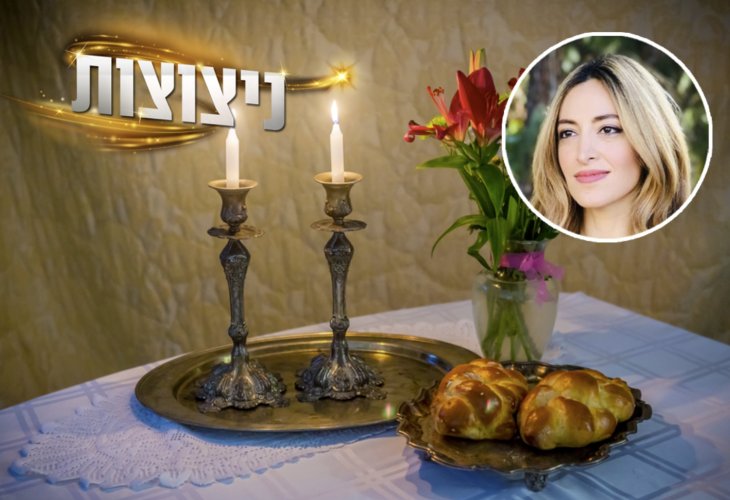 In the circle: Miri Michaeli (Photo: Or Oren)
Miri Michaeli is married and a mother of three. She is a journalist and lives in Tel Aviv.
A Spark of Roots
“One of the first things I remember from childhood is my parents’ stories about the self-sacrifice they showed for Judaism behind the Iron Curtain, in Georgia, back when it belonged to the Soviet Union. My father was a senior academic—an economist and a textile engineer—and on the outside he looked like the biggest Communist there was. But beneath the surface, he was a believing Jew and a very active Zionist.
“My parents were constantly trying to immigrate to Israel, and they did so the moment it became possible. Until then, life was extremely difficult from a Jewish standpoint. In the Soviet Union, any religious activity was forbidden. For example, kosher slaughter was illegal. And yet there were Jews — my parents among them, who risked their lives for it.
"Every Thursday night a certain person would knock on our basement door using a secret pre-arranged knock, and bring kosher meat for shabbat. A few years ago, I was at an event abroad and someone offered me chicken. It wasn’t kosher, so I told him I keep kosher and would never eat non-kosher meat — among other reasons because my grandparents literally risked their lives to keep kosher.
“In general, now that we live in Israel, it’s hard to believe how powerfully that generation was connected to the Land of Israel and to everything tied to Judaism. We’ve grown used to the good that the State of Israel brought with its founding, but things that are simplest for us today were once unimaginable. For example, every year at the Seder, when we say ‘Next year in rebuilt Jerusalem,’ my father gets emotional and actually cries like a child. That longing sits so deeply in him, at a level that’s hard to describe. I’m crying now as I talk about it; it’s in my blood. The distance from here to Georgia is only about a two-hour flight, but in those years the distance felt like millions of light-years.
“My mother tells a story with great emotion — that if an emissary from the Jewish Agency managed to reach their community before Passover and brought matzah, for them it was an unimaginable joy. As strange as it sounds, my mother says they would cut up the cardboard from the matzah package so every family could have a piece of even that. They were so moved just to hold a torn piece of cardboard with a few Hebrew letters on it — something that had come from the Land of Israel.”
A Spark of Nostalgia
“Very often I think about the religious shift my family went through when I was little. I was born into a traditional home. My parents immigrated from Georgia to Israel in 1975, and my brother, sister, and I were born here. In the early years we would have a Shabbat meal and then watch television. Later, my father said that in the diaspora they simply didn’t know what was forbidden and what was permitted. There were a few things that were very clear, like kosher meat, but a lot just wasn’t known. In the Soviet Union they worked hard to erase every Jewish marker.
“Slowly, over the years, and because my parents decided to enroll us in religious schools, the house changed religiously and there was more and more observance of Jewish law. When my brother started learning in a yeshiva high school, it became a very serious change, because he learned halacha properly.
“It happened in stages. First my father bought a hot plate, then the television went, then the radio, and so on. My parents ended up with two very religious kids — my brother, for example, lives in Elad and has ten children, and I’m what you’d call ‘somewhere on the spectrum.’ Still, honestly, it’s a miracle. In the ulpana where I studied, they emphasized halacha and not love, and many times it really pushed me away. But thank God, my love for the beauty of Judaism won in the end.”
A Spark of Doing
“The media world always felt magical to me. From a very young age I was drawn to it. In elementary school I wrote for a paper called Otiyot, and Uri Orbach was the perfect teacher for me.
“A little after my national service, when I was 22, I arrived at Channel 10 News as a researcher. My first investigation there was extremely challenging. I would work on it for hours and then vomit from how terrible I felt. From there I moved into morning shows, coordinating correspondents, I was a health reporter, then consumer affairs, and later I was appointed as Channel 10’s correspondent in Europe. We lived in London, my daughter was born, and afterward we decided to return to Israel. When we came back, I was a foreign affairs reporter and I also hosted programs.
“Toward the split of Channel 2 — when Keshet and Reshet separated, I received an offer to join Keshet, and I decided to go for it. It was very hard, because Channel 10 felt like a second home. Today, thank God, I’m a journalist and presenter on Keshet 12, alongside Niv Raskin on Morning News, and I also participate in other programs like Anashim.
“People sometimes ask me whether I bring my Jewish values to the screen, and I always say that I bring Judaism into the media naturally, because it’s simply part of me. For example, on a broadcast that fell on Tisha B’Av, I mentioned that I was fasting. Right afterward I received a flood of messages — from people I knew and people I didn’t, saying they would fast because I reminded them why we fast.”
A Spark of a Mitzvah
“I really love matchmaking which is of course a mitzvah, under the category of acts of kindness. Sometimes I think it’s the best thing you can do for another person. Thank God, I’ve made three matches so far.
A Spark of Shabbat
“My work environment — the media world, where I’ve been for twelve years, is very secular. Sometimes, when people hear I keep Shabbat, they look at me with this expression that says, ‘Weird… I thought she was normal.’
“But Shabbat is part of me, even when it isn’t easy. For example, when I was Channel 10’s Europe correspondent, events would sometimes begin and end on Shabbat, and I couldn’t deliver the reports the system was waiting for. It’s a very hard feeling. Still, I often tell my friends to try disconnecting from devices on Shabbat, because it lets you take a necessary pause. Thank God we have Shabbat. It’s absolutely a lifeline.”
A Spark of Prayer
“Prayer is something that is very present in my life. For example, before every broadcast I say a short prayer. I won’t share the exact content because it’s very personal, but generally, among other things I pray that I’ll say good and true things, that I won’t insult anyone, that my words will land on receptive ears, and that good will come out of them. In media, the tendency is to create storms, to say personal things about people, and avoiding all that is not easy at all.
“At the same time, prayer shows up most strongly for me in the context of motherhood. I look at my daughter and I simply say to God, thank you, thank you, thank you. Parenting is a place of enormous gratitude to God, in a way I never experienced before. Every moment I’m with my daughter — even when she annoys me, I think to myself what an incredible thing this is. And of course, I pray a lot that she succeeds in whatever she does.”
A Spark of Awakening
“I’m pregnant now, so I really feel God in every moment. A baby is the most divine thing I can think of. The moment you meet your baby for the first time can’t really be explained. I always feel God with me, but during pregnancy it’s much stronger.”
A Spark of Inspiration
“This past weekend I was in Germany, in a town called Tübingen. A friend of mine named Andrea got married, and we traveled to her wedding. The way I met her, and her life story, are very interesting and deeply inspiring — especially from a Jewish perspective, so I want to share it.
“Andrea lives in a community where all the members are descendants of Nazis — many of them descendants of people who held the highest and most horrific positions. After the war, many Nazis told their children they hadn’t known anything, hadn’t heard anything at the time, and had nothing to do with the Holocaust.
“Over the years, many of the children and grandchildren of those Nazis discovered the truth about their fathers and grandfathers. In response, they decided they wanted to fight antisemitism, help spread knowledge about the Holocaust, help Israelis in general, and Holocaust survivors in particular.
“A few years ago I made a report about this unique community, and I’m still in touch with parts of it. This past weekend we were at Andrea’s wedding, and it wasn’t simple to take in. It was a mind-blowing kind of closure. My husband is a descendant of Holocaust survivors, and who knows where his family encountered their families. In the middle of all of it, we were there with them: we made kiddush and kept Shabbat on German soil, with the descendants of those cursed people. It’s unbelievable how God turns things in the world.”

