

Magazine
Reflections from a Six-Day War Hero: "We Witnessed Heavenly Aid"
A firsthand account by the Southern Command leader of the Six Day War on strategy, deception, overwhelming odds, and the moments that changed Jewish history
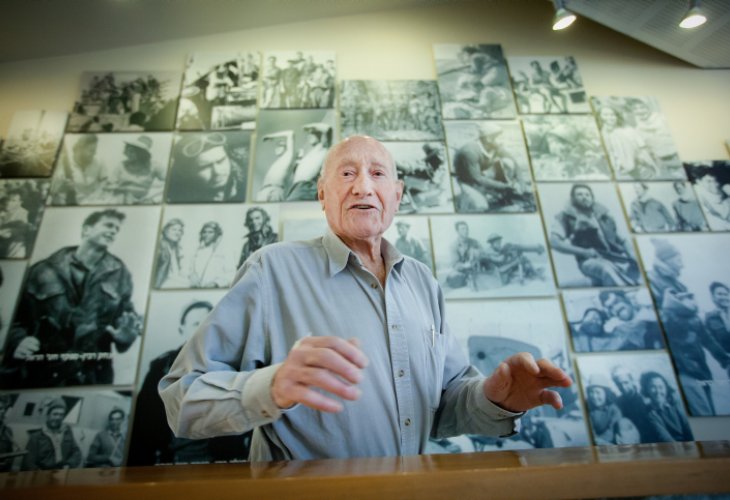 Shaike Gavish (Photo: Moshe Shai / Flash 90)
“The understanding was that we were living through moments that would be etched into the pages of history,” says Shmuel “Shayke” Gavish, Commander of the Southern Command during the Six Day War and the strategist of the Egyptian front that led the IDF to the banks of the Suez Canal within three days. He speaks about the war period itself, the chaos that preceded it, the victory achieved during it, and the deep sense of gratitude that followed.
From the senior command echelon of that war, not a single figure remains today. Gavish is the last surviving commander of the Six Day War generation, who by the grace of Heaven led a victory that became a global sensation. At the time, it appeared that the Jewish state was on the verge of being trampled under the military boots of the Egyptian army. Those same boots ultimately remained as scattered debris on the sands of Sinai, silent testimony to their owners’ flight back across the canal.
The Order That Changed Everything
“I remember very clearly the order I gave over the radio on July 5, 1967, at 8:15 in the morning. It was a short and sharp command: ‘Red Sheet.’ That was the signal for IDF forces to break through toward the Egyptian troops facing us in Sinai. The daily order sent to the commanders reflected how significant I believed this moment was, and how deeply I understood that it was a decisive hour for the Jewish people. I wrote to the soldiers then: ‘On this day you stand before the most exalted mission of our lives: the defense of our state… Commanders and soldiers, we will go into this campaign and we will win… Go forth and succeed, and may God be with you.’”
And the rest, as they say, is history.
One Against Three
“From the very beginning, it was clear to me that we needed to go to war,” Gavish notes, referring to the grueling waiting period. “Nasser moved massive forces to the western bank of the Suez Canal and ordered the UN forces separating Israel and Egypt to leave the area. I had no doubt what his ultimate plans were.” For that reason, Gavish and other senior IDF commanders urged an immediate military response in order to surprise the Egyptians. “What stopped us was the government, which tried diplomatic avenues to curb Nasser’s ambitions,” he says.
What did you do during those waiting days?
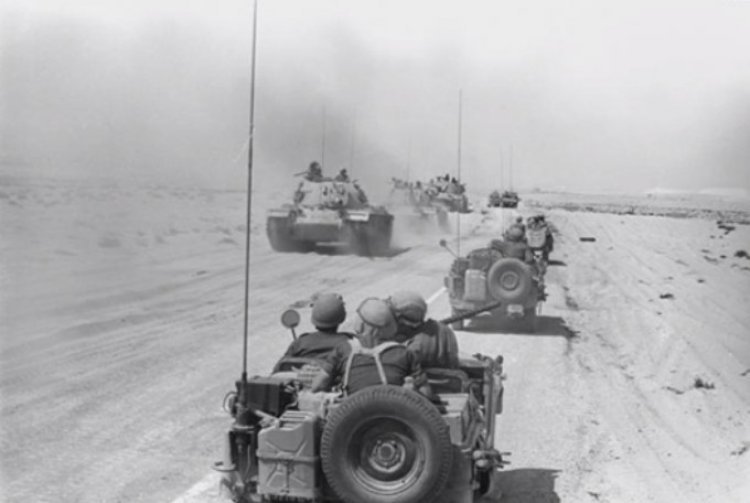
“It was an extremely difficult time for both the fighters and the command. Still, we continued preparing for war while facing an enormous force deployed in Sinai. One thing I vividly remember was establishing a deception unit to assist the course of battle, which we were already planning in depth despite the lack of governmental approval. In the dead of night, we painted silhouettes of tanks and artillery on wooden boards and mounted them on light IDF vehicles. Suddenly, these vehicles looked like heavy, threatening tanks and guns.
The next day, the disguised convoy traveled through major roads in southern Israel. Media photographers captured images of what appeared to be a large military force advancing toward the front. In reality, the entire convoy contained only three real tanks, brought in solely to leave tracks in the sandy ground of the staging area. The Egyptians swallowed the bait and rushed large forces to the area. More than one hundred tanks and about twenty percent of the entire Egyptian army were deployed there. Only after the war did they realize that the force they had confronted was an illusion.”
Beyond deception operations, preparations also meant operational planning.
“Indeed,” he replies. “During the waiting period, I developed an attack plan centered on fighting in the northern and central Sinai valleys, conquering the forward Sinai positions, destroying the forces in that sector, and then moving to a broader encirclement of the Egyptian army. The model was similar to the Soviet encirclements at Kharkiv and Stalingrad during World War II. I studied extensive material about the sieges conducted by the Red Army against the German Wehrmacht. Since it was clear that siege and the cutting of supply lines were what ultimately forced the Germans to surrender, I decided to base our battle plan on the same principle: encircle the Egyptians and deny them access to the canal.”
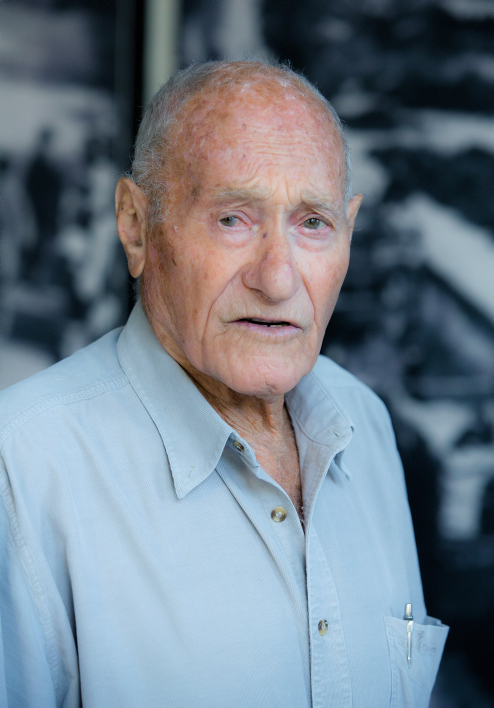 (Photo: Moshe Shai / Flash 90)
What did the battlefield picture look like at that stage?
“The Egyptians had an overwhelming advantage,” he says. “As commander of the Southern Front, I had under my command most of the IDF forces at the time, a total of three divisions.” While Gavish held most of the IDF’s strength, one additional division remained in Tel Aviv as a reserve.
“In raw numbers,” he continues, “Nasser brought seven divisions and a thousand tanks into Sinai, along with air force and artillery support. I, on the other hand, had only about four hundred tanks. They had more than double of everything. From the moment Nasser said, ‘If Rabin wants war, welcome,’ we focused on one goal. Not conquering Egypt, not even occupying Sinai, but destroying as much of the Egyptian army as possible. Still, it did not look simple at all. The Egyptian military power and their threats to throw the Jews into the sea created a genuine existential fear, and a sense of another Holocaust. There was real dread in the streets. Even within the General Staff there were serious doubts, as we had never faced such unfavorable force ratios. At that time, the Egyptian army was equipped with the most advanced tanks and aircraft available.”
Facing the Political Leadership
Gavish presented these grim assessments to Prime Minister Levi Eshkol during a tour of the front. “When he asked me about the brigade we were observing from southern Israel, I told him I estimated it to include about one hundred tanks and corresponding artillery. But Eshkol pressed further and asked, ‘How many soldiers are there?’ I answered that we estimated around seven thousand. He was surprised and wondered if that was really all the advantage they had. We smiled, and I hurried to explain that manpower mattered far less than the quality of their equipment. ‘The main threat is the tools they bring to battle,’ I told him. In reality, we had only thirty thousand soldiers facing an Egyptian force of about one hundred thirty thousand. But again, the decisive factor was armor and firepower, not infantry numbers.”
Winning and Surviving
In Gavish’s view, the Yom Kippur War was precisely the kind of war he wanted to avoid. “Our question then was how to defeat an army several times larger than ours and come out alive. In the Yom Kippur War, we did win, but we lost three thousand soldiers. It was a painful victory. In the Six Day War, I had only three hundred fallen in the southern front.”
How many casualties did you expect?
“Certainly not three hundred,” he states. “The expectation was tens of thousands, soldiers and civilians alike. When Moshe Dayan visited the command headquarters in the days before the war, he could not imagine fewer than tens of thousands of casualties. Although he held no official position at the time, he asked about our operational plans, and once I received political approval, I presented them to him. Dayan was an optimist and told me I would win the war, but he believed the price would be heavy. ‘About twenty thousand of your soldiers will die,’ he estimated. He also doubted we would reach the canal.”
That grim atmosphere also prevailed among the public. Tens of thousands of graves were dug across the country, and many open areas were prepared to receive the expected casualties. By great mercy, they were never needed.
With such dire data, why did the government hesitate to authorize a preemptive strike?
“There was deep fear within the government, and rightly so. They were many, and we were few. In addition, most of Israel’s allies pressured it not to initiate war. Even Ben Gurion, though no longer in office but still immensely influential, believed Israel should not strike first.”
Ben Gurion was so determined to prevent a first strike that he came to meet Gavish at the front. “He banged on the table and shouted, ‘We must wait for negotiations. Who appointed you to endanger the Jewish people with unnecessary wars?’ I replied, ‘My family lives here in Beersheba. Do you know how long it would take an Egyptian tank to step on the gas and reach them? Two hours. We have no Maginot Line, and no obstacles between us and the Egyptian army. We cannot afford negotiations or to wait for them to attack first.’ He looked at me intently and said, ‘You are taking on a great responsibility,’ and left in disagreement. About a week later, while I was already on the banks of the canal, I called him and offered to send a helicopter to bring him to the front to see the results of the war. He came, and was impressed, but did not admit his mistake.”
Understanding the Arab Strategy
“Our assumption in the field,” Gavish explains, “was that the Egyptians had previously received a request from Syria to join the war effort. The Syrians realized they could confront us over the diversion of the Jordan River waters, but could not wage a full war alone. Egypt agreed, partly due to its alliance with Syria, but mainly because it was bogged down in another war in Africa with no success. For Nasser, the Syrian proposal offered a way out of the African quagmire and an opportunity to present himself as leader of the Arab front against Israel, and as the man who would finally destroy the Jewish state.”
Red Sheet
In the days leading up to the war, Israel endured many upheavals, and national morale swung wildly. The lowest point came after Prime Minister Levi Eshkol’s faltering prewar speech, when part of the text was poorly prepared and he paused mid speech to ask his aide, “What does it say here?” Public pressure mounted, demanding the return of former minister Moshe Dayan to a senior role, as he was widely regarded as a brilliant general. The government yielded and offered him top positions. Dayan initially demanded command of the Southern Front, believing that was where the war would be decided. Gavish even received a dismissal notice, but at the last moment Dayan reversed course and accepted the position of Defense Minister, leaving Gavish in charge of the main front.
“For many years afterward,” Gavish recalls, “Rabin, who had ordered my dismissal until Dayan changed his mind, could not look me in the eye. I was very angry with him. Even though he was under pressure, I believe he could have refused and threatened to resign.” Despite this, Gavish praises the Chief of Staff who would later become prime minister. “He was not cut from the cloth of leaders, but he was extremely talented, a true genius.”
Internal struggles at the top quickly faded as the war approached.
Building the War Plan
“We built our battle picture on two pillars: the impact of the Air Force destroying the Arab air forces at the outset, and my method of encircling the Egyptians in Sinai. Our assessment was that coordinated use of air and ground forces would significantly improve our position against the Egyptians.”
Just before the ground offensive, a final dispute erupted between the air and ground branches. The Air Force requested a delay of several hours after the air strike before the ground assault. “The Air Force commander asked that we attack five or six hours later. He wanted the air strike at seven in the morning, with the ground front opening only at noon or one. I refused. ‘We also need the element of surprise,’ I told him. A compromise was reached: the ground attack would begin half an hour after the air strike.”
He adds, “At first glance, starting the war at seven in the morning seems strange. Israel usually prefers night attacks for surprise. But our intelligence discovered that Egyptian pilots ate breakfast between seven and eight, so we chose that moment to surprise them.”
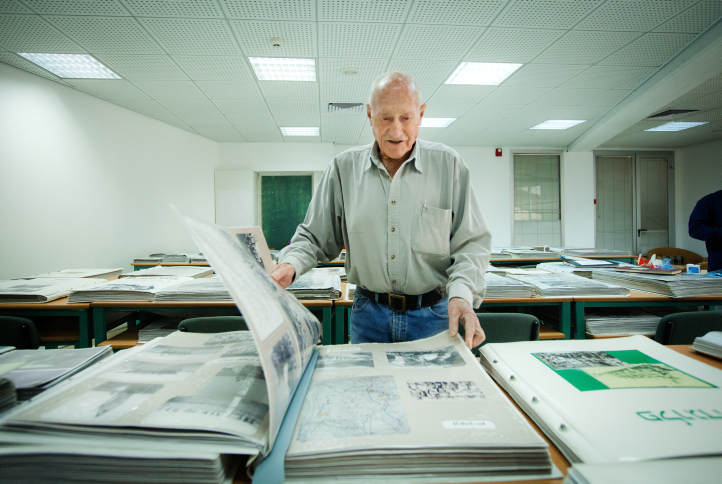 (Photo: Moshe Shai / Flash 90)
The Breakthrough
On the morning of the attack, tension in the General Staff rose sharply. Gavish arrived at Kerem Shalom in an armored personnel carrier and waited there with his team. “At exactly seven, we saw Air Force planes flying overhead toward Egypt. The air was charged with anticipation.” Precisely half an hour later, at 7:30 a.m., Gavish transmitted the command: “Red Sheet.” The ground war began, and tens of thousands of soldiers surged forward against the stunned Egyptian forces.
All three IDF divisions launched a full scale offensive along the route Gavish had planned and trained for during the waiting days. “We broke through central and northern Sinai up to El Arish, using all three divisions. Normally one would keep a third in reserve, but given our numerical inferiority, there was no choice but to commit everything and trust in God.”
By great miracle and abundant divine mercy, the plan worked. After four days of fighting, Gavish’s forces stood on the banks of the Suez Canal, with the Egyptian army encircled in between. “We had one division in the south, one in the north, and one in the center, with the Egyptian army trapped in the middle.”
When the war ended in a manner no one in Israel or the world had imagined, the man who commanded the southern front knew that without the extraordinary help from Heaven that the Jewish people experienced in those days, the IDF could never have achieved such a resounding victory. “We saw help from above at every step,” he concludes.

