

Magazine
From Mumbai to Motherhood: A Journey of Faith, Loss, and Family
Immigration, grief, renewal, and blessing shape Chana Amar’s extraordinary life story, tracing her path from a secular childhood to deep faith and the building of a united, resilient family of seventeen children.
- Miriam Salomon
- | Updated
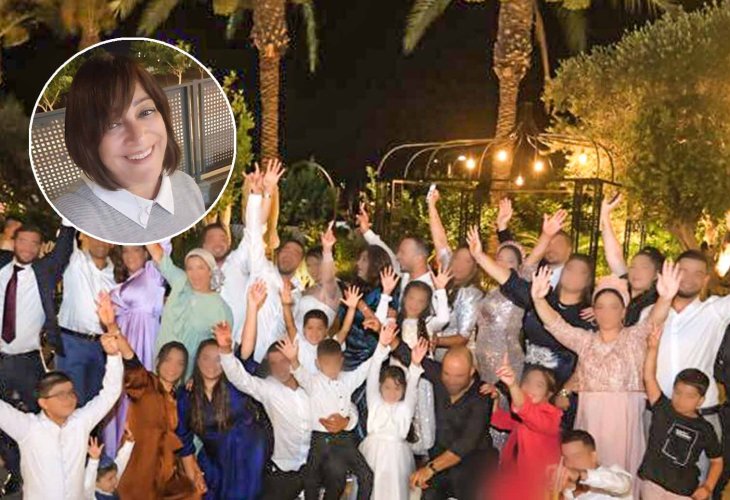 Chana with her children (Inset: Chana Amar)
The first turning point in the life of Chana Amar came when she was just three years old, when her family immigrated to Israel from Bombay, India. Fortunately, she was the youngest child and remembers little of the move. What left a deeper imprint on her than distant India was the scorching heat of Dimona and the gray immigrant housing where they settled.
“Our financial situation was not easy,” she recalls. “We bought food day by day, simply to survive. Very quickly, the children in our home left their educational frameworks and did not complete their studies, going out to work to bring a few more coins home. Two of my sisters worked at the Kitan textile factories, and my brother found work at the Dead Sea Works. Life continued, with difficulty but also with simplicity.”
When Chana was thirteen, close to finishing eighth grade, a quiet revolution swept through her small neighborhood. “I have no idea how it began,” she says, “but suddenly I noticed that all my friends had enrolled in high school in Netivot. It was as if a wave swept through my Moroccan friends. One after another, they decided to go study at a Haredi boarding school in Netivot in the northern Negev.”
Did the idea of studying in Netivot appeal to you as well?
“Very much,” Chana smiles. “Not because of religion, but simply because I wanted to go with my friends. To my disappointment, my father rejected the idea completely. I grew up in a secular home. Unlike my friends, who came from traditional families that kept Shabbat and kosher, in our home nothing was observed. Studying at a religious high school felt entirely foreign to my reality.”
Without her friends, Chana continued alone to tenth grade at the state religious high school in her city. Then her friends returned home for their first Shabbat break, transformed. They wore opaque stockings, long sleeves, long skirts. “I rode my bicycle as I always did on Shabbat and called out excitedly for them to join me, but they brushed me off. I was deeply hurt. I felt so lonely, and in my innocence I did not understand what separated us.”
The loneliness grew. Each day after school felt emptier. Chana again begged her father to let her go to Netivot. But another blow soon followed: her father fell ill with tuberculosis, and his condition was serious. “He was deeply attached to me and said he could not bear the thought of me leaving home. He kept saying he would not survive without me.”
Still, the social isolation was unbearable. During the Chanukah break, Chana pleaded again. Her mother remained gentle and quiet, not intervening. But to her surprise, her older brother, completely secular like the rest of the family, approached their father and tried to persuade him. “He argued that because of our financial situation all the siblings had left school early, and maybe if I went to Netivot, something would come of me. ‘Send her for education, not for religion,’ he told my father. Somehow, his words, together with my tears, softened my father’s resistance, and he agreed.”
Netivot of Light
A new transformation began. After Chanukah, Chana did not return to her former school. She was invited to an interview and entrance exam at the Haredi high school. “The first times I arrived, I wore short sleeves and no stockings and did not even understand what was wrong. They received me warmly but explained that if I were accepted, I would need to dress modestly. That did not frighten me. When the acceptance came, I danced with joy.”
The new school felt like home. “I loved the studies, and at the same time I began to grow spiritually. But there was one great challenge: my father could not let go. He called the public phone at the dormitory every day. Everyone already knew the call: ‘Chana Baruch, phone!’ He begged me to return home. But for me, this was the beginning of a new life. I had discovered a path I could not abandon. I began keeping Shabbat, observing kashrut, strengthening daily. I was close with my dorm counselor, the house mother encouraged me, the teachers gave me real guidance, and I remain in touch with some of them to this day.”
Returning home for Shabbat became increasingly difficult due to challenges with kashrut and observance. Chana often stayed with families or with her house mother instead. Her sister once said reproachfully, “You’re in a religious place and this is how you honor your parents?” Chana did not know how to answer. “It was hard to fight at home over Shabbat and kashrut, and I could not give up what I had gained.”
Farewell and Consolation
Midway through ninth grade, tragedy struck. Her beloved father passed away. “I will never forget that day. It was Tu BiShvat, a Friday, and report cards were being distributed. A cleaner ran to tell me there was an urgent call. My brother said only, ‘Chana, come home immediately.’ I sensed disaster. The house mother sent me home with an escort. When I arrived, it was too late.”
Shiva passed in deep grief and guilt. “I felt unbearable remorse that I had not been by my father’s side in his final months.”
When she returned to school, her teacher tried to comfort her. She handed Chana her report card. “She told me I had received the best grades in the class and the only perfect score in religious studies. When I shared my guilt, she said gently: ‘In Heaven, your father is receiving great joy from you. Every mitzvah you perform elevates him.’ That was the only thing that truly comforted me.”
On the Path to Teaching
Chana continued her studies, strengthened further, and was supported by families who hosted her on Shabbat and holidays. A family in Bnei Brak became especially close. “I helped with their children and home, and felt truly part of their family. To this day, we remain connected.”
After finishing twelfth grade successfully, she studied at a teachers’ seminary in Bnei Brak, later becoming a dorm counselor herself. Years later, her daughter Avigail studied in the same seminary in Netivot. “It felt like closing a circle. The place that gave me so much was now shaping my daughter. It was deeply moving.”
Marriage and Trials
At twenty-two, Chana married, but the marriage lasted only four months. Under rabbinic guidance, the couple separated. She was pregnant and returned to live with her mother’s secular family. “Keeping kashrut and Shabbat there was incredibly challenging. Making kiddush alone in my room while the family watched television was painful.”
Her daughter’s birth brought both tears and comfort. “Caring for the baby gave me strength and purpose.”
During this time, she received immense support from her former teacher and a family from Vizhnitz.
New Life
After a year and a half, Chana was introduced to a baal teshuvah from the Or HaChaim Yeshiva. With rabbinic blessing, she agreed. “At twenty-four, I married again. I had fears, but trusted that Hashem was leading me to something better. We built a home near the yeshiva in Jerusalem. The Elbaz family became our guiding light in everything.”
A Family Puzzle
Her husband brought two young children, she had one daughter, and together they were blessed with fourteen more children. “I never imagined we would have such a large family, but Hashem gave us both blessing and strength.”
Only years later did she learn that when the match was proposed, Rav Ben Zion Abba Shaul had whispered, “May they be blessed with many children.”
Raising the family was demanding but joyful. “We prayed constantly for success, unity, and that no child would lack anything. The children learned responsibility, helped each other, and we invested deeply in shared family experiences. We worked hard to unite all the children from both marriages into one cohesive family. And with Hashem’s help, we succeeded.”
A Cradle in the Studio
Today, Chana works as an event photographer. “I thought I would be a teacher, but life led elsewhere. My husband began working in photography, and when issues arose about photographing women, he suggested I join him and photograph the women myself. We became the first couple to offer such a service.”
She learned the craft from him. “At first I was devastated. I had invested so much in teaching. But gradually I connected to photography. Today I love it deeply.” For fourteen years she has run a home studio called Studio 2000.
How did you manage work alongside raising such a large family?
“The studio was near home, and there was always a cradle there. I never sent my babies to childcare before eighteen months. My husband helped immensely at home. After events, we would clean together, then sit on the balcony with coffee and share the day. Those moments are engraved in my heart. That is why it was so hard to continue working after he passed away.”
And Again, Farewell
Chana’s husband passed away nearly nine years ago. “I understood this was another difficult test. During that time, I met Rebbetzin Reizy Rothenberg of the Zeh LaZeh organization, who supports widows and orphans worldwide. Her support has been invaluable.”
One of her greatest challenges was keeping the family stable. “The boys struggled deeply and left good yeshivot. But I never gave up. I prayed, took on personal commitments, and thank G-d, my children stabilized and grew stronger. Today they are respectful, loving, and united.”
She regularly organizes family gatherings. “What matters most is that all our children and grandchildren feel one family.”
From a Mother’s Experience
Do you have advice for mothers raising large families?
“First, do not take everything too heavily,” Chana smiles. “Be responsible but not anxious. Believe that parents are only Hashem’s messengers. The children are a trust placed in our hands. With Hashem’s help, may we always merit true Jewish joy.”

