

Magazine
Breaking the Silence: A Mother’s Story of Depression, Loss, and Mental Health Awareness
After losing her daughter to severe depression, actress Tsofia Lax speaks out to raise awareness, challenge stigma, and call for compassion, support, and change in mental health care
- Tamar Schneider
- | Updated
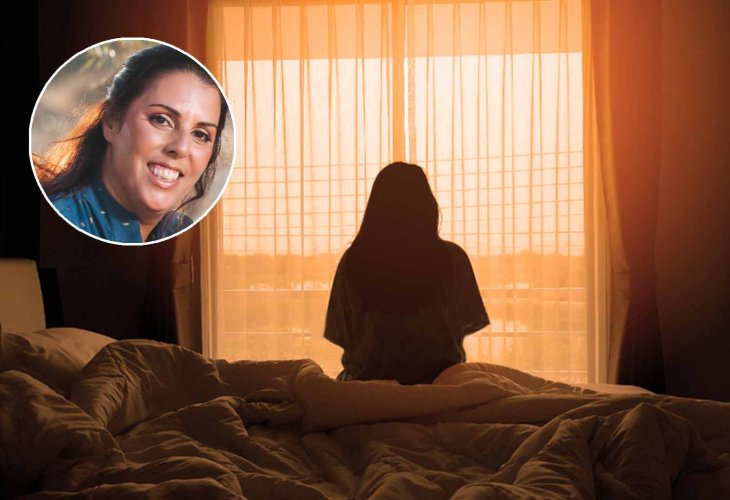 Inset: Tzofia Lex (Illustrative photo: Shutterstock)
Three years ago, it seemed like just another ordinary day when Tsofia Lax, an actress and theater creator, received a text message from her 22-year-old daughter, Oria. “She wrote that she wouldn’t be available for a while,” Tsofia recalls. “She said she was going through a personal process and asked for some quiet time, without anyone around. She added, ‘Everything is okay, don’t worry.’”
Of course they worried. They didn’t sleep that night, but felt it was best to wait patiently. A week later, Oria’s voice was heard on the phone. “She told us she had been hospitalized in a closed psychiatric ward at the Mazor Mental Health Center in Acre and asked us to come get her out.” In that moment, Oria’s depression was revealed. “I felt as if the sky had fallen on me,” Tsofia says.
For the next two unbearable years, the family did everything they could for her. Her condition rose and fell but never reached stability. Then came the most devastating moment of all, when Oria took her own life. On the second night of Chanukah that year, her light was extinguished. From that moment, her mother understood she would break the wall of silence surrounding mental illness. “It’s time to raise awareness of the inner world of those struggling with mental health,” she says.
Everything Falls Apart
Tsofia remembers clearly the day it all began. “It came as a complete shock,” she says. “Oria was working at Horesha School in Acre, a school for children with communication disorders and autism. The children would pull at her, drool on her, and she would wrap them in love. She was happy there, and completely devoted to them. We never imagined what she was going through inside. Later she told me, ‘You think you’re a good actress? Look at me. I was depressed for so long and managed to hide it from you.’”
The first moments of realization were overwhelming. “My whole body hurt. My heart hurt. My soul hurt. I felt intense anxiety and deep confusion, a sense that everything was collapsing. There was also fear of losing my daughter, and waves of guilt. How didn’t I see it? How didn’t I know? What did I do wrong?”
How did she get there?
“I still don’t have a clear answer,” Tsofia admits. “Her adolescence was completely ordinary. There was stubbornness, rebellion, difficulty with school frameworks, but socially she was very involved. We didn’t see any warning signs, and even if there were some, we wouldn’t have known how to interpret them. Who even thinks in the direction of such an illness? It’s possible she experienced a trauma we don’t know about, or events that weren’t necessarily extreme but were experienced very intensely by her sensitive soul. Some people have very sensitive emotional ‘sensors.’ Everything is felt at a much higher volume. They don’t always have the resilience to cope. Maybe that was her story too.”
From that point on, Oria’s parents lived on the Acre-Ofra road. “After a while we could drive it with our eyes closed,” Tsofia says painfully. “It was a two-and-a-half-year journey of learning and confronting depression. We mobilized every ounce of physical and emotional strength to be there for her. The hospital tried to bring Oria to balance, but it only worked for short periods. This was her personal experience. There are of course individuals with depression who do return to daily life.”
Life during that time felt like a ship tossed at sea. “There’s a fierce internal battle,” Tsofia explains. “Once someone falls into anxiety and that black pit, it’s very hard to climb out. In a certain sense, the pit offers something. It embraces the person and convinces them they belong there. The illness also has side effects. The person pushes away those closest to them and doesn’t want contact. They feel misunderstood and disconnected from the world. Sometimes families are left alone, rejected by the one they’re trying to help. Escaping this requires immense inner strength and a lot of outside support. Today, most treatment is medication-based, but that’s not enough. Medication dulls the pain and gives some rest, but at the same time emotional resilience must be strengthened, and there is still a long way to go.”
Adding to the daily struggle was Oria’s request that they keep her condition secret. “She didn’t agree that we talk to others about it,” Tsofia sighs. “We respected her wish, but there was so much loneliness, exactly when we needed support most. Even the energy required to keep the secret drained us. People would ask me, ‘So what is your eldest daughter doing?’ and I’d say, ‘She’s up north.’ If it were up to me, I would have told the truth.”
Living With Guilt
“I quickly understood that guilt wouldn’t lead anywhere,” Tsofia says. “So I worked on separating my story from hers. It may sound strange, but she had her own path, her own way of perceiving the world, her own capacity to deal with trauma and crisis. Every person is built differently. Some have strong inner resilience, others less. Besides, Oria herself told us it wouldn’t have helped if we had known earlier. She wasn’t ready for treatment then.”
The Other Children at Home
“My amazing mother accompanied us and helped throughout,” Tsofia says. “The older children helped with the younger ones, and wherever we could bring in outside support, we did. Still, it wasn’t easy for them. The constant anxiety for Oria’s safety affected everyone, and the process of loss began already with the first hospitalization. We spoke about what was happening, but the fear of what might come next was always present. Keeping everything secret made it even harder.”
Like Cancer of the Soul
About a year and a half after Oria’s hospitalization, her condition seemed to improve and she returned to her apartment. Then came her first suicide attempt. “It was terribly deceptive,” Tsofia says. “Since the first hospitalization, Oria had been very open with us, and it seemed she was on the right path. She was in a coma for four days and then returned to life. That’s when we understood we had no control over the illness or how to fight it. Not us, not the doctors, and in some ways not even her. She was deeply trapped in depression, and unable to manage herself.”
She wanted to recover. “Very much,” Tsofia says. “She had plans for the future. Later she moved to a rehabilitation village, an advanced stage of healing. Residents worked during the day and took part in activities and therapies in the afternoon. But then severe epileptic-like seizures began several times a day. Extensive testing showed her brain function was normal. The seizures were psychiatric, not neurological. It was a severe deterioration.”
After that attempt, extended family and close friends were brought into the picture. The circle around Oria grew, along with a larger embrace. She continued to say she was fighting for her life, but seemed unable to find the strength to escape the darkness. “She once told me that when she’s in that black hole, she sees no one,” Tsofia says. “That’s probably where she was when she hurt herself.”
A Path From Above
Oria’s light went out suddenly. “I can’t even revisit those moments,” Tsofia says. “It’s pure trauma.”
Afterward, conflicting voices lived inside her. “There’s a voice that can’t accept it, because it wasn’t a solution. It didn’t help her or the family. It was a one-way path that caused pain for everyone. At the same time, there’s also a voice that doesn’t rush to judge. I wasn’t in that unbearable place and I can’t know her suffering. As her mother, I believe I must continue to embrace her even after her death. Oria fought like a lioness. Her soul was torn. Depression is like cancer. Cancer eats away at the body, depression eats away at the soul.”
She describes layers of grief. “There’s the daily struggle, of simply getting up in the morning. Sometimes I think, ‘I have nothing today, I can go visit Oria,’ and then reality crashes in again. Most days are okay, but they always require strength. Then there’s denial, acceptance, and awareness. Sometimes I avoid it, sometimes I let it be. I speak to Oria constantly. There’s also the practical layer. Life continues. There are children who need strength, and I need strength to support them.”
Above all of this is what Tsofia calls “the umbrella.” “It’s the force from above,” she says. “God carries us through this path. Only He knows why and we lean on Him. This is our journey. We try to build life forces and joy, to accept God’s will, even when it hurts unbearably. We were chosen to pass through this experience. From here, we grow.”
An Embrace After Death
Even during the shiva, Tsofia knew what her next step would be. “It was important to act for Oria’s soul, to embrace her even after she was gone,” she says. Years earlier, Tsofia had founded a project called “For You,” an annual event offering support and pampering for women living with chronic or invisible illnesses. After Oria’s death, the family decided the project would be dedicated to her memory. “Depression is also a chronic illness,” Tsofia notes.
Since then, similar support evenings have spread to other cities across Israel. “Giving in her memory keeps expanding,” she says.
Tsofia has also begun lecturing publicly. “I decided to tell our personal story to raise awareness,” she explains. “Too many families hide and lie, sometimes even to their children. It’s exhausting and unnecessary. I want people to embrace mental illness the way we embrace cancer. We need more support organizations and accessible care. Waiting seven months for a psychiatrist is simply not acceptable.”
Does speaking about it risk encouraging it?
“The people who come to my lectures are already touched by the issue,” she says. “I speak about depression, not about its tragic outcome. After lectures, people come to me and share. Many parents want to know how to recognize distress and get help. Awareness is low, fear is high. I emphasize that this is my personal story. I also challenge the harmful idea that people are ‘faking’ depression. That perception is devastating. Even if someone gains something from withdrawing, it still reflects deep distress.”
“There is a cry among those struggling with mental illness,” she concludes. “A cry for compassion. A request to lower the volume, to embrace more and fight less. The world has become harsh and aggressive. Something needs to shift toward a more humane place. I feel this is part of the healing the world must move toward, even if it passes through deep pain.”

