

Magazine
Women of Moral Courage: From Shifra and Pu’ah to Today’s Women of Iron
From biblical midwives to modern heroines, Jewish women model courage, sacrifice, and moral clarity
- Rachel Wigman
- | Updated
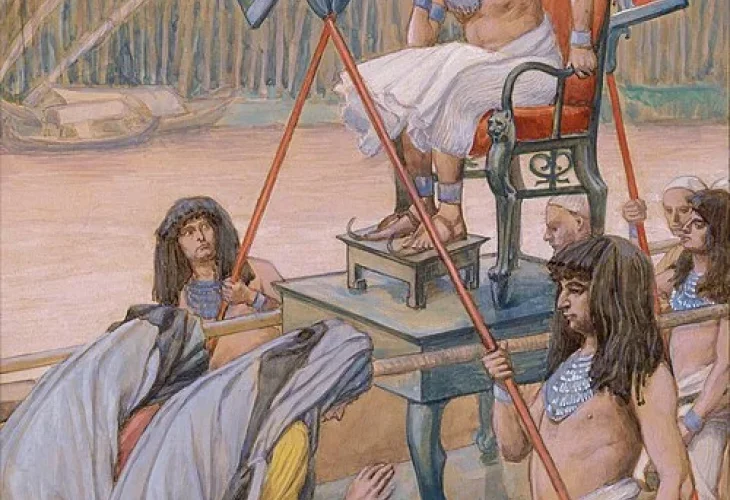
This past Shabbat, in synagogues around the world, we read the first portion of the book of Exodus. It is the portion in which the ancient Israelites are enslaved to the Egyptians, the portion in which the consummate leader, Moses, is born, and the portion in which the groundwork is laid for the redemption which will come in a few weeks’ time. It is also the portion that contains two short and rather cryptic passages.
The first passage, which is found in Exodus 1:15-21, tells the story of two midwives, Shifra and Pu’ah, who were commanded by the pharaoh to kill all baby boys as they are born to the Israelite women. The women are described in the text as God-fearing, and they refused to do as they were instructed. As a result, the verse says, somewhat ambiguously, “He made for them houses.” In an essay first published in 2015, the late Rabbi Jonathan Sacks described this incident as “the first recorded instance in history of civil disobedience: refusing to obey an order, given by the most powerful man in the most powerful empire of the ancient world, simply because it was immoral, unethical, inhuman.”[1] In fact, the text itself leaves ambiguous if these women were even Israelite—they are described in such a way that can either be understood as, “Hebrew midwives,” or, more broadly, “the midwives of the Hebrews.” Framed in that context, these two women may have been Egyptians who defied their pharaoh in an incredible act of moral courage. And they paid for it, too: Rashbam, a twelfth century Tosafist, in his commentary on the Bible explains the phrase, “He made for them houses,” as Pharaoh arresting the midwives and placing them under guard so that he could watch their moves.
The next passage that I’d like to highlight comes later in the portion, in Exodus 4:24-26. At this point in the story, Moses, who had spent sixty years away from Egypt and was lately working as a shepherd for his father in law in Midian, was on his way back to Egypt with his wife, Tziporah, and their two children. The verse describes, “And it was on the way, at the inn, that God encountered him, and He tried to kill [Moses]. Tziporah took the knife and cut off the foreskin of her son, threw it down at [Moses’] feet, and said, ‘You are a bridegroom of blood to me.’ So He let him go, and she said, “A bridegroom of blood, because of circumcision.’” Leaving aside what Tziporah meant by her words, her actions represent a different dimension of moral courage. While the midwives stood up for basic human decency, Tziporah showed strength in acting, in the face of fear, by the moral code through which she chose to live her life. Thus, the midwives represent those who will stand up for objective morality, and Tziporah becomes the example of those willing to sacrifice for the more subjective, more personal morality.
The Shifra and Puah Legacy
It’s not surprising that these paradigmatic figures are women. It is also not surprising that their heirs walk among us today. In fact, on the evening of December 23, 2025, in the Nefesh B’Nefesh offices in Jerusalem, hundreds of people gathered together to honor eighteen women who stood out as these models of moral courage and virtue. It was the inaugural Women of Iron awards, highlighting eighteen incredible women who “rescued, uplifted, inspired, sanctified, defended, advocated, and comforted us”[1] since war broke out on October 7, 2023. Some of these women were volunteer medics who put on their vests and drove straight into danger on that dark day. Others serve in the military; one of whom, a mother of ten, saved countless people from the Nova festival. Still others lost their husbands in the war; they turned their pain into purpose, like the one who created an organization in her husband’s memory where women can borrow dresses for events free of charge. She only asks that if someone wants to pay, they make a donation to charity in her husband’s memory. Personally, I was there for my aunt, Laura Ben-David, of blessed memory, who was taken from us this summer and was the source of inspiration for the entire evening.
That evening, and the stories from this past week’s Torah portion, struck me as particularly poignant for a few reasons: First and foremost, these are our Jewish heroines. The ones who can stand up in the face of darkness, the ones who have the fortitude and strength to do what is right, to be ready and willing to sacrifice—that is how we live well. Second, and perhaps more importantly, is that these stories are more important than ever in today’s world. The loss of moral clarity, which has come into sharp focus after October 7, makes it ever more pressing that we stand as beacons of virtue and integrity. In a world that can no longer distinguish between right and wrong, it is imperative that we follow the models of Shifra, Pu’ah, and Tziporah, that we stand with our Sisters of Iron, and that we carry on with the strength that it takes, even in the face of so much wrong, to always do what is right.
[1]https://jewishlifephotos.com/women-of-iron/

