

Magazine
A Week Without Smartphones: What Happens When Teenagers Disconnect
Dr. Hananel Rosenberg reveals groundbreaking research on smartphone deprivation, teen psychology, family dynamics, and the hidden emotional cost of constant connectivity
- Hidabroot
- | Updated
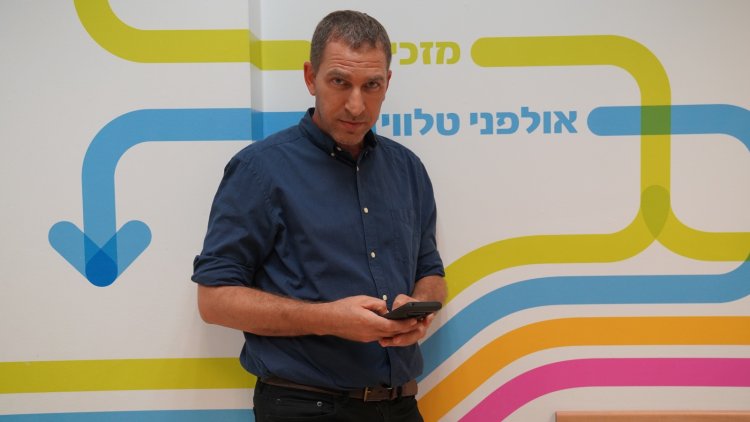
 (Pictured: Dr. Hanan'el Rosenberg)
The smartphone has become an inseparable part of our lives, and today everyone is aware of that. We also all know that we are paying a heavy price for it.
Dr. Hananel Rosenberg is not only aware of this reality, but he has been closely tracking and researching the issue for the past 17 years. He teaches and conducts research at the School of Communication at Ariel University and at Herzog College for Teacher Training. His research focuses on the psychological and social effects of smartphones, as well as social networks and digital media as a whole.
“When I first began working in this field,” he explains, “the main discussion was about the internet, which allows a person to be accessible anywhere and at any time. Then came social apps, which enabled not only access everywhere, but access to every person. The final and most significant revolution, in my view, is the smartphone, because it enables access not only from person to person, but at every moment and in every place.
“When someone holds a smartphone, they know they are connected within any human space they are in. This is the greatest change imaginable, and a real shift in human consciousness. In my opinion, only now, years after smartphones began to penetrate our lives, are we beginning to truly understand the effects of this revolution, both positive and negative.”
 Dr. Hananel Rosenberg
Turning Research Into Action
What happens when people try to disconnect from their smartphones? This question occupied Dr. Rosenberg for a long time, especially with regard to children and teenagers.
“Today, the average age at which children in Israel receive their first smartphone is nine, which is roughly third grade,” he notes. “And that’s just the average, meaning that for half the class, the phone arrives even earlier. We’re talking about a generation that was born and raised into the online world, which makes it all the more fascinating to understand how the digital space affects them at this specific age.
“Children and adolescents at these ages undergo extremely significant changes. This is precisely the stage at which they acquire social, cognitive, and psychological skills. These are critical years for their development, so it stands to reason that something as massive and powerful as the smartphone would have a very strong impact on them.”
This understanding led Dr. Rosenberg, together with his research partner Prof. Menachem Blondheim of the Hebrew University, to conduct a first-of-its-kind study. They wanted to examine what happens when 100 teenagers wake up in the morning without their smartphones.
“When we approached this study, we encountered a major challenge,” he explains. “It’s very difficult to research the effects or the magnitude of the role smartphones play in our lives.
“I’ll explain why. If, for example, I want to study how violent content affects children, I can check who was exposed to such content, for how long, and compare them to others with similar characteristics who were not exposed. But smartphones change all the rules of research. They’re not something people use for a few hours a day — they are a medium that accompanies a person every moment of their life, and they do so almost invisibly. We use them alongside other activities, so we’re usually not even aware of how profoundly they influence our lives.
“That’s why we decided to do the opposite, and adopt a research method commonly used in addiction studies, known as the ‘deprivation method.’ The idea is simple: if you want to understand how a substance affects someone who is dependent on it, you remove it and create a sense of deprivation. Then you can see how the absence manifests itself. We felt this was the most accurate way to approach a study like ours.”
 Prof. Menachem Blundheim
How was the study conducted? How were the participants selected, and how did you ensure they met the conditions?
“We had many deliberations about that,” Dr. Rosenberg says. “At the first stage, we decided to focus specifically on teenagers — high school students, and began recruiting participants. From the outset, it was clear that if participation were purely voluntary, those who agreed would likely be teenagers who didn’t have much trouble disconnecting from their smartphones in the first place. We offered significant financial compensation, funded by several research grants.
“We then reached out through various contacts. In the end, recruiting participants was easier than we expected — both because of the compensation and perhaps because of the challenge itself.
“We gathered 100 teenagers — boys and girls, religious and secular, light and heavy users, from the periphery and from central Israel, essentially from all segments of society. We were almost ready to begin, but then we encountered another major obstacle. When we presented the study to the ethics committee, its members argued that it was unacceptable to force teenagers to disconnect from their smartphones, as it may cause them social or emotional distress, and they might continue the experiment just to avoid losing the money. The committee therefore required us to pay them the full amount regardless of whether they completed the study.
“I remember thinking at that moment that everything we had built was collapsing. I said to Prof. Blondheim, ‘It’s over. Why would anyone stick with the study if they get the money anyway?’ I estimated that only about 50% would make it to the end. Surprisingly, 98 out of the 100 participants completed the study and managed to disconnect from their smartphones for an entire week.”
The Diaries Tell the Story
Dr. Rosenberg adds that they also discovered something unexpected along the way: “The parents were actually partners in the experiment. We required the teenagers to hand their phones over to their parents and have the parents sign that they wouldn’t return them. I naïvely assumed parents would be thrilled to finally have their kids without phones. But it turned out that it was no less difficult for the parents than for the children. They had grown used to their child being constantly available and continuously occupied.”
How did you document the findings of such a study?
“That was another big dilemma,” he says. “We debated how to collect the data. In the end, we decided not to present participants with specific questions, so as not to plant ideas about what they should be thinking or feeling. Instead, we gave them blank journals and asked them to write freely throughout the week — where they felt the absence, and how they experienced the lack of the smartphone in their lives.
“I have to say that at the end of that week, it was fascinating to sit and read 98 diaries one after another. I came away feeling that our relationship — and especially teenagers’ relationship with the smartphone is captivating, even mysterious.”
What actually appeared in the diaries? Can you share examples?
For example, Einat writes: “Yesterday, at exactly 11:45 p.m., I turned off my phone and gave it to my mom to keep for seven days. Unbelievable how much convincing I had to do to get her to let me participate in the experiment! I had to explain over and over that this was something I really wanted to do and that nothing bad would happen…”
Netta writes: “I dreamed last night that I arrived somewhere and there were lots of friends there. I found out that one passed her driving test, one got engaged, and one had cancer — and I learned about everything late because I didn’t have a phone. I felt very frustrated… Apparently it’s really hard for me not to know what’s happening around me at every moment.”
After several days, Ayelet writes: “Ugh! Ugh! Ugh! Ugh! Ugh! Ugh! I’m already fed up! I want my phone back!!! But it’s not going to make me break — I’m sure of that. I have enough self-control not to go to my dad’s closet and take the phone. Still, the curiosity is almost overwhelming. I really want — even just for one second to see my WhatsApp messages, to see who was looking for me.”
“Like Amputating a Limb”
“Overall,” Dr. Rosenberg says, “the diaries were characterized by a dual, split experience. On the one hand, many teenagers reported difficulty and negative feelings, especially physical ones. Some described phantom sensations such as feeling vibrations in their pocket or hearing notification sounds that weren’t there. Some compared the experience to losing a limb and described using ‘prosthetics.’ For example, one participant carried an old device in her pocket just to feel its presence, while others used a wristwatch or ring simply to have something to fidget with.”
“At the same time, those very same participants often reported strong positive feelings. Some described a sense of release, of freedom. One teenager beautifully described how at first he felt that all his friends were ‘inside’ the smartphone world and he was left outside, until at some point he realized: ‘It’s not that I’m in prison and they’re free. It’s exactly the opposite — I’m the one who’s free, and they’re the ones who are chained.’ He wasn’t alone. Many participants reported similar positive experiences.
“There was also a lot of discussion about changes in the family space, which is particularly interesting. We tend to think of smartphones as something used outside the home — on the street or on the way to work. But the absence of the smartphone revealed to teenagers just how much it shapes family relationships as well. Some described riding in the car with their parents and suddenly listening to stories from their father, because they were without a phone. Others mentioned babysitting younger siblings in the bath and suddenly being able to talk to them and really listen.
“Somewhat amusingly, in the family context there were also teenagers who suddenly noticed how addicted their parents themselves were, how absorbed they were in their devices, and how difficult it was to talk to them. This was something they hadn’t been aware of before.”
How do you analyze such a study scientifically?
“That’s a good question. We decided to reflect the teenagers’ voices directly in the book — to place the diaries themselves at the center, letting them speak for themselves and reveal all the layers of how deeply smartphones are embedded in daily life.
“We mentioned earlier that this was a ‘deprivation study.’ There was actually an American researcher in the 1940s who did something similar. He took advantage of a newspaper strike in New York to examine how people managed without newspapers. Through deprivation, he discovered that people coped relatively easily with the functional aspects, and they managed without news updates. What was hardest for them was sitting with their morning coffee or cigarette without a newspaper.
“This illustrated that the newspaper wasn’t just a functional tool, but was deeply woven into their lives. We see the same with smartphones. Some people find it hard to get out of bed without immediately reaching for their phone, or they need it nearby even without using it, just to feel its presence. Some scroll endlessly without really reading anything. It’s very similar to a child’s transitional object such as a teddy bear or blanket. Smartphones give us an extremely strong sense of connectedness.”
Do you think this can be defined as addiction?
“That’s a question we asked ourselves as well. The answer is no, at least not clinically. In psychiatric manuals, addiction to screens or smartphones does not exist as a formal diagnosis.
“Moreover, the solution isn’t the same as with other addictions. When someone is addicted to something else, we try to help them completely abstain. With smartphones, that’s unrealistic because they’ve become part of our living environment. This is a very complex issue. It’s not a simple addiction, and every parent or individual has to carefully consider what’s right for them and for their children.”
In ultra-Orthodox society, smartphones are largely kept out, and you don’t see nine-year-olds with phones. Doesn’t that indicate that there’s still hope?
“The ultra-Orthodox community is a remarkable phenomenon. They achieved something almost unimaginable, and whenever I present it internationally, researchers are astonished. From the very beginning, this community managed to bring cellular companies to their knees and say: ‘If you want to adapt technology to our moral climate, you need to provide what we ask for.’ And they largely succeeded.
“It’s true that smartphones are now partially penetrating the ultra-Orthodox world as well, and more people from that sector are online. But there is still a very significant delay in the age at which children receive their first smartphone. There is still a reality in which children grow up without intense digital saturation.
“So yes, there is hope. We won’t be able to remove smartphones entirely from our lives, but if we make an effort and thoughtfully consider what’s right for us and for our children, the results can certainly be positive.”

