

Magazine
The Orphan Who Refused the Convent
Rabbi Prof. Pinchas Doron-Spalter's astonishing journey from Holocaust orphanages to a life of Torah, faith, and authorship
- Hidabroot
- | Updated
 Professor Pinchas Shepaltor-Doron
“Maybe you’ll come with us to the convent?” the nun asked the 12-year-old orphan, who had already forgotten what a mother’s love felt like, gazing at him with pity.
“Look at your worn clothes and your frail body. It’s obvious that proper food hasn’t passed your lips for many days. If you come with us, we will take care of all your needs and you will live a life of comfort from now on, eat as much as you like, and sleep on clean pillows in your own room. I promise you will never experience hardship again.”
“And that boy was me,” Rabbi Prof. Pinchas Doron-Spalter smiles at me, through veiled eyes in which deep sorrow still lingers. Even today, in thousands of words that have yet to find their proper expression, those eyes seek to tell the same story: the story of a small child, barely six years old, who lost his beloved mother far too early and was forced to grow up in orphanages — almost the only Jewish child among 200 non-Jewish children.
“I won’t lie to you,” Rabbi Doron recalls. “When I stood there in front of the nun and heard her offer, for a moment it truly tempted me. But I didn’t answer right away. I told her I needed to think about it and that I would give her an answer in three days.”
The nun did not give up. Three days later she returned and repeated the same offer. But suddenly, images from his childhood in the cheder where he had studied, and of his teacher Reb Zelig, rose from the depths of his memory and brought him back to himself.
“At moments, your offer really did appeal to me, and I almost forgot everything I had learned until the age of six. But there is one thing I still remember: I am a Jew, and a Jew I will remain,” he said firmly — and left at once, leaving the nun stunned and speechless.
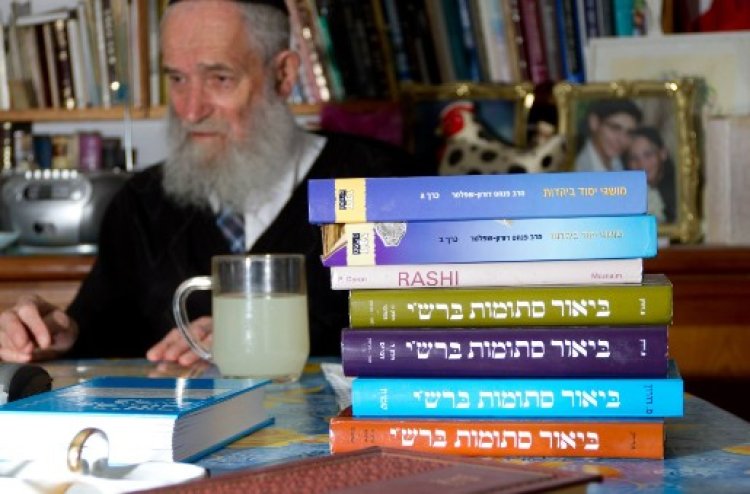
I turn my head toward his overflowing library, adorned with dozens of sacred books — 18 of them authored by him: commentaries on Rashi, a commentary on Psalms, foundational concepts in Judaism, Pilulei Pinchas — an explanation of weekday and Shabbat prayers, and much more.
With the rabbi’s permission, I take one of the books he wrote and leaf through its pages. Illuminated letters leap out at me, drawing me inward into a deep, inexhaustible wisdom where layers of meaning are woven together.
It was clear to me that only someone who had undergone a life journey rich with insight, someone endowed with a phenomenal ability to study Torah, to understand it, and to know it from within could write such books. And yet, when I compliment him on being a Torah scholar, the rabbi’s ears perk up in surprise. “A Torah scholar? Me? Not at all! There are far greater and wiser people than I,” he says. Then, as if to spare
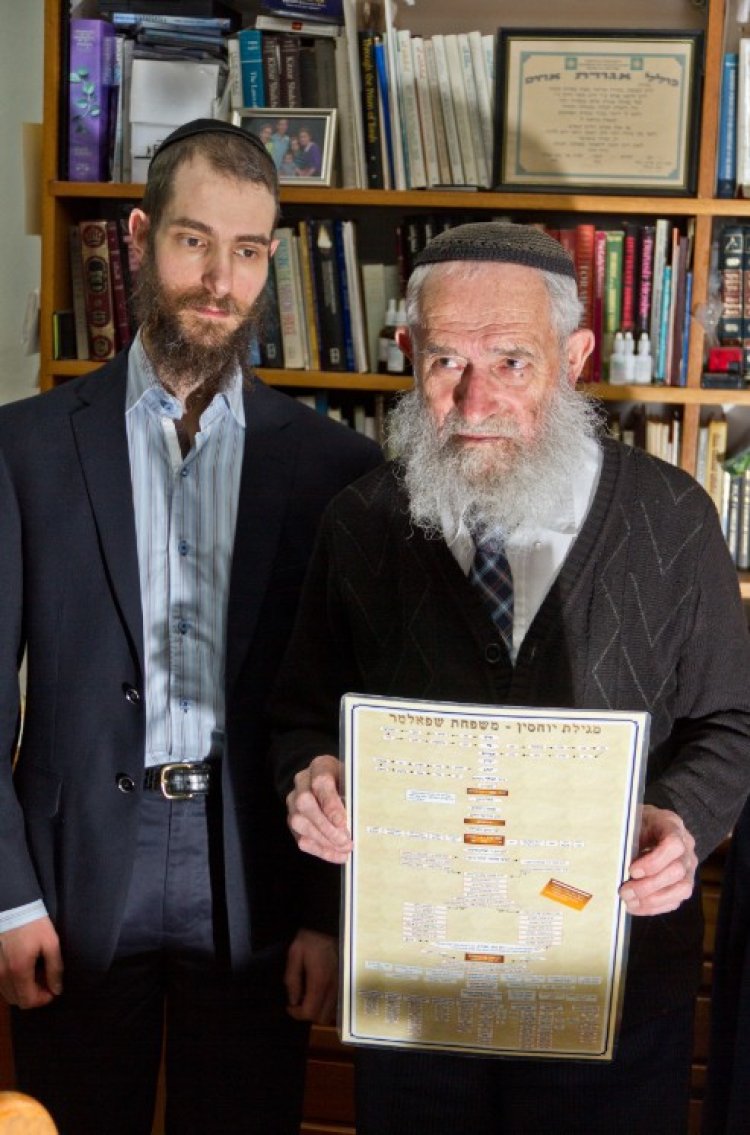 Rabbi Doron holds a family tree from Adam to his family members
But his efforts to conceal his greatness are in vain. I already know that sitting before me is none other than the “child prodigy of Lancut.” At just five and a half years old, he delivered his first Torah discourse in the Great Synagogue of Lancut, standing on a tall lectern before accomplished scholars. Even then, little Pinchas revealed himself as a true prodigy — able, unlike other children his age, to absorb Talmud with Rashi and Tosafot, retaining everything like a sealed cistern that loses not a drop.
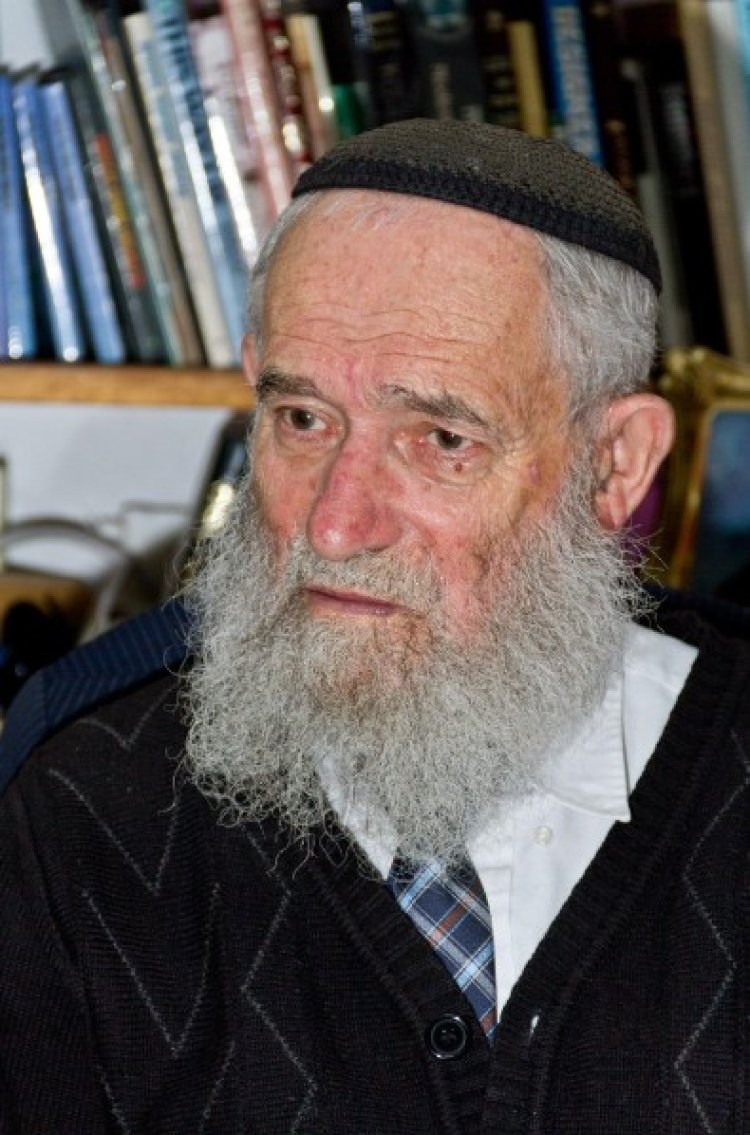 Prof. Pinchas Doron-Spalter
His Mother Believed the Nazi Deception
The extraordinary life story of Rabbi Prof. Doron-Spalter begins in the distant Polish town of Lancut, where he was born. “When the war broke out, just two weeks after the Nazis conquered Poland with their characteristic arrogance and brutality, they published a proclamation ordering the Jews to leave the country within 24 hours, without delay,” Rabbi Doron recalls. “Panic spread immediately. First, because we didn’t know where to flee, and second, because we had nothing. Jews were forbidden to use trains.
“The dilemma was immense, but in the end, with indescribable inner strength, my parents gathered their few belongings into a small bundle. They hired a wagon with a horse and set out toward the Russian border — what was called ‘Western Ukraine.’ In truth, it was part of Poland, but the Russians used that name to erase Poland from the map.”
One of the most significant Nazi decrees at the time forbade Jews from carrying valuables such as money, jewelry, and the like. Yet before setting out, with remarkable courage and faith, his mother decided to hide some of her jewelry on the thin body of little Pinchas, who was only six.
“This was an unimaginably dangerous act. Had we been caught, they would have shot us all on the spot without questions. But God willed it otherwise and performed a miracle for us. During their thorough search, the Nazis ‘forgot’ to search me. God truly blinded their eyes.”
From there, Rabbi Doron recounts a chilling story that leaves no doubt in my heart: the hand of Divine Providence was present, guiding and saving them every step of the way. After the search, the family continued toward the San River, the border they had to cross to reach the Russian side.
“In the middle of the river, the non-Jew steering our boat tried to overturn it, to drown us and flee with the money. But by God’s mercy, another open miracle occurred, and the man slipped, fell into the river, and drowned. Our boat reached its destination safely — the Jewish community of Lubaczów in Ukraine.”
Only days after arriving, the Germans announced — out of sheer cruelty, that the border would be temporarily reopened so that those who had fled hastily could return home to pack properly. “My righteous mother, like many other women, believed the announcement and returned to the Polish border. That’s when the horrific truth emerged: it was a Nazi plot to carry out ‘clean work’ — to fill trains bound for Auschwitz without dirtying their hands.
“My mother was sent to Auschwitz along with thousands of women, without us having a chance to say goodbye. We were left motherless,” the rabbi concludes, his eyes dry and hollow, as though even tears have long been exhausted.
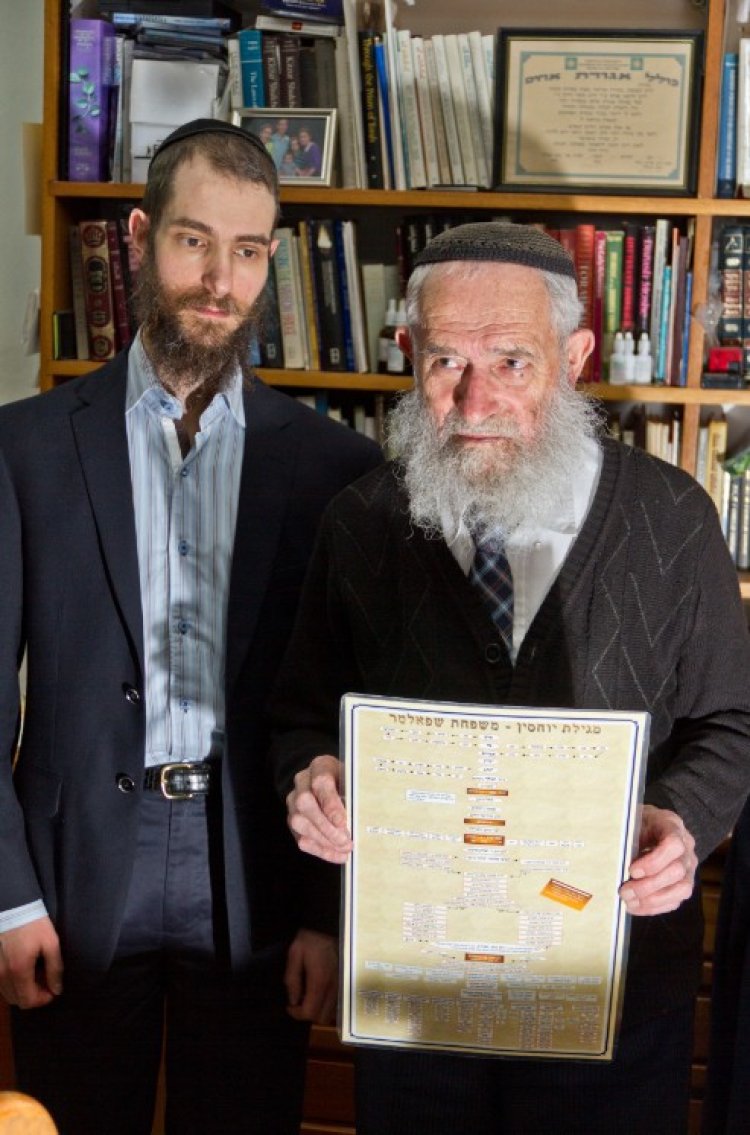 Rabbi Doron holds a family tree from Adam to his family members
“The Russians Accused Us of Espionage and Sent Us to Siberia”
Silence again strikes his heart like a faithful hammer, filling it with questions that were never answered: the questions of a small, innocent child who cannot understand why his mother left, why she never returned, and whether she ever would.
What is your strongest memory of your mother? What kind of woman was she?
The rabbi takes a deep breath, longing welling in his eyes. “M-m-my mother,” his voice trembles. “She was a great righteous woman. Not for nothing, among her eight siblings she was called ‘the saint.’ Her name was Liba. Before the war she ran a small notions shop, from which we barely survived. My father, of blessed memory — Rabbi Moshe Spalter, was a great Torah scholar who devoted himself to teaching Torah to the community.
“I remember how my brother Shmuel and I would bring him the meals our mother prepared, to the study hall where he learned. To this day I can smell the cocoa and pastries she baked especially for him.”
For nine long months, the brothers and their father lived in Lubaczów, surviving on the kindness of generous Jews. “Shmuel and I ‘ate days’ — meaning that we ate each day in a different home,” Rabbi Doron explains. “My father, however, was honored as a community rabbi, and meals were brought to him.”
Then, suddenly, another blow struck. Russian soldiers suspected the refugees of spying for the Germans. “The accusation was beyond anything we could imagine. We couldn’t believe it — us, broken and destitute people who had lost everything, were accused of espionage. Our pleas were useless. With complete indifference, the Russians loaded us onto freight cars and sent us to a forced labor camp in frozen Siberia.”
Who can describe the trauma a small child endures in such a situation? Who can supply him with the inner strength needed to survive? Who can understand the purity of his whispered prayer — Mama? Who can promise him, truthfully, that everything will be all right?
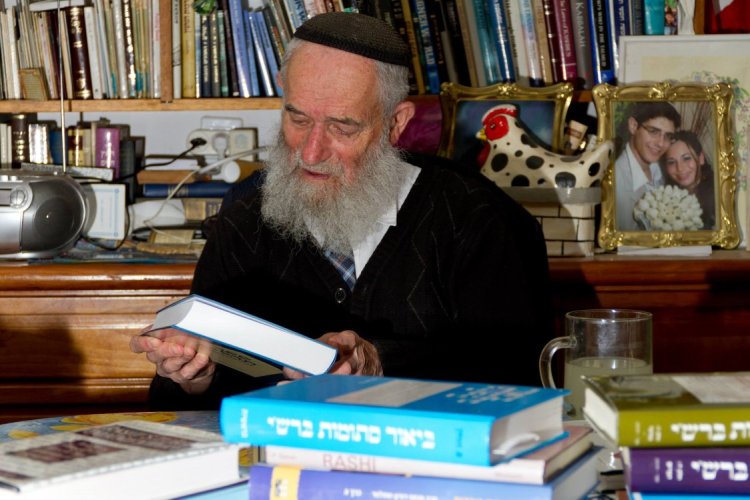 Flipping through books he wrote at home on his desk
Children Became “Mushroom Experts” to Support Their Ailing Father
In the Siberian labor camp, adults and boys aged 15 and up were forced to cut massive trees for the Russian army. The brutal labor, combined with inhuman living conditions and constant hunger, was devastating. To maintain appearances, the Russians even set up a “store” and a makeshift school.
Rabbi Doron’s father, already weak and ill, struggled terribly. Eventually the camp supervisor excused him from heavy labor and assigned him to sweeping streets. But this job provided almost no food. “So we children went into the forests to find food,” Rabbi Doron recalls. “We gathered berries — blackberries, blueberries, currants, cranberries, strawberries, and learned to identify edible mushrooms. We traded them for flour, sugar, and sometimes bread.”
How did two small children manage this alone?
The rabbi smiles. “That you should ask God. We knew that if we didn’t learn quickly, our chances of survival were zero. So we learned.”
They survived and supported their father for two full years, until the Russians finally released them.
Orphanages, Escape, and a Miraculous Reunion
The family headed toward Tomsk, hoping to find a Jewish community. Tragically, their father contracted tuberculosis and was hospitalized. The boys were sent to a Polish orphanage, while their father remained in Russia.
“Only after the war did we receive an anonymous letter informing us that our father had died in a hospital in Tambov.”
At the orphanage, they endured hunger, beatings, and loneliness. After two years, the Russians realized they were Polish and transferred them to a Polish orphanage. When they learned their father would never return, they decided to escape — but only Pinchas, younger than 13, was allowed to leave.
He traveled with Russian soldiers, hitching rides, even jumping between train roofs. After a grueling journey, he reached Lancut — but found only two surviving families.
Eventually he was sent to a so-called Jewish orphanage in Krakow, Gordonia. There he fell ill with diphtheria and was hospitalized — where the nun made her offer. And there, unexpectedly, he met a cousin. “You’re Pinchas Doron-Spalter? We’re cousins. Your mother was my mother’s sister.”
That meeting saved him. His cousin urged him to flee Gordonia and live as a Torah-observant Jew.
From England to Torah and Beyond
Months later, Rabbi Dr. Solomon Schonfeld organized the first transport of Jewish orphans to England. Pinchas was among them. There he learned that his brother Shmuel had survived and been adopted by their uncle.
He later joined Yeshivat Torat Emet, celebrated his bar mitzvah there, and studied alongside future Torah giants. Health issues led him briefly to physical labor in Israel, then to military service, teaching, marriage, and six children.
A year in New York became 36 years. He taught for decades at the City University of New York, studied in kollel, and received rabbinic ordination. Encouraged by the Lubavitcher Rebbe, he published his first book.
Tragedy struck again and he lost his wife, then his 13-year-old son. “What can one do?” he says quietly. “This is God’s will. Our role is to lift our eyes heavenward and say thank you to Father.”
His daily schedule begins at 4 a.m. with prayer and Torah study. “The Torah is my taste of life,” he says. “It brings me back to Lancut, to my mother’s embrace. God saved me so many times, and this is how I thank Him, for His kindness that overwhelmed me.”

