

Magazine
The Last Shoemakers of Israel: Vanishing Craftsmanship and a Timeless Lesson
From Bnei Brak to Jerusalem, a journey through fading workshops, quiet faith, and the message that still burns: as long as the candle is lit, it’s never too late to repair
- Avraham Yisrael Friedman / Yom Liyom
- | Updated
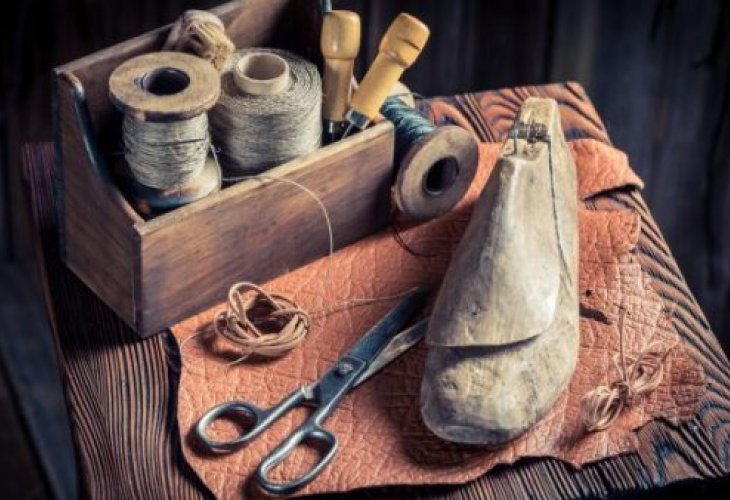 (Illustration: Shutterstock)
Eli Bizarov, the shoemaker on Rabbi Akiva Street in Bnei Brak, is a genuinely lovable Jew. Anyone who has met him, as I have, can testify to that. His words are always sprinkled with humor, the kind that naturally pulls a small smile onto your face.
“About a decade ago,” he tells me, “MK Gafni came to me. He’s a person too, isn’t he?”
It is the eve of Passover in Bnei Brak. Outside, the city roars with the dizzying noise of holiday commerce. Shops are packed, streets are crowded, and the pressure of preparations hangs in the air. Inside Eli’s tiny workshop, the rhythm is no calmer. Customers stream in one after another.
“I need the insole fixed,” one says. “It doesn’t match the shoe.”
Another asks him to repair the Velcro on a toddler’s shoe that tore. And while he is at it, Eli will also fix backpacks and whatever else people bring through the door. In a season where every home is racing toward order, even a shoemaker becomes part of the great Passover machinery.
It turns out that unlike what we might imagine, the shoemaker’s shop is not a quiet place at all.
A Profession That Is Disappearing
Eli has been a shoemaker for about twenty years, and he sees the shift clearly.
“Today it’s a spoiled generation,” he says, looking at me with a faintly wistful gaze. “Fewer people come to me than they used to.”
Does he think the profession has a future?
“Look, in this generation the trade is already shrinking in the marketplace. In the next generation, it seems it won’t exist at all.”
He speaks simply, without drama, as though stating a fact of life. Yet behind his words sits something heavier: an entire world of craftsmanship fading quietly into history.
Shoes, Heat, and a Torah View of the World
The shoemaker of Bnei Brak is not only a technician. Like many Jews of the old school, he cannot help but see meaning in the everyday.
“Without shoes, how many meters can you walk, tell me? When it’s forty degrees outside, your feet can get burned, God forbid. And you see that birds live without shoes, and horses gallop without shoes. Everything is the work of the Creator, who thought about His creatures, so that even in summer they won’t get scorched, and even in winter their thick skin will protect them from the cold out in the street.”
Bizarov, who immigrated from Bukhara, has been in the trade since his father’s home. He smiles as he shares a familiar line, half joke, half truth.
“Whoever works as a shoemaker goes straight to Gan Eden. That’s what they say. Because he absorbs a lot of insults from customers.”
Then he adds softly, with a sigh that holds decades inside it: “It’ll be good.”
Is it hard work to be a shoemaker?
“Everything is hard in this world. Nothing is easy.
Have any tzaddikim repaired shoes by you?
“Tzaddikim?” he answers, like a Jew, with a question. “All of Bnei Brak are tzaddikim.”
Beit Shean: A Veteran Shoemaker in a Modern World
In Beit Shean, in the colorful Rasco shopping center, there is another shoemaker whose presence feels almost like a living memory. In a room decorated with pictures of Rabbi Mordechai Sharabi, of blessed memory, sits Rabbi Yehuda Amsalem, the local shoemaker. An elderly man with steady hands, he looks slightly out of place in the modern setting around him, and yet the space feels anchored because he is there.
“He has high quality merchandise,” says his acquaintance Rabbi Yaakov Avraham, the first native born resident of Beit Shean. “He’s a veteran craftsman. I remember him from childhood.”
Then Avraham insists on adding one more name. If you write about shoemakers in Beit Shean, he says, you are not allowed to skip Yachya, the shoemaker from the early days of the state, the one from the city’s “round center.” Yachya did not only stitch shoes. He also distributed new shoes to the poor and to those with limited means.
“He was something special,” Avraham repeats, and you can hear how deeply that kindness lives in him even now.
Integrity That Once Defined the Trade
Rabbi Yehuda Amsalem has held this profession for sixty years, long before he immigrated to Israel. He learned the trade as a ten year old child in Morocco from the shoemaker Rabbi Yosef Azulai, of blessed memory.
“He was the shoemaker, with a capital S,” Rabbi Yehuda says as he sharpens a heel on the grinder. “It was a special era. Not like today, unfortunately, when there are intrigues and dishonesty. Back in Morocco, everything was conducted in the spirit of ‘Be wholehearted with Hashem your God,’ with clean integrity. No tricks. That was a time.”
Then he gives an example that is really a philosophy.
“People come to me with torn shoes. Sometimes I can glue a shoe with a basic glue and the customer pays twenty shekels, but after two days the glue can open. On the other hand, if he pays another ten shekels, thirty shekels, he’ll get a stable, strong glue.”
He leans forward slightly.
“I don’t hide anything from the customer. I tell him clearly: if you want the twenty shekel glue, it can end up costing you, and it’s a shame to invest in it. The customer has to know all the options in front of him. I won’t tell him to spend a shekel without knowing what he’s spending it on and whether it’s worth it. It’s entirely his choice.”
This is not only good business. It is derech eretz. It is a way of treating people with dignity.
From Necessity to Skill
His father, Rabbi Eliyahu, of blessed memory, was a tailor. The son did not dream of this life, but necessity pushed him into manual labor to support a home threatened by poverty.
For about twenty years Rabbi Yehuda worked as a shoemaker in the religious kibbutz Sde Eliyahu near Beit Shean. People there still remember him.
“He was a very professional shoemaker,” they told us. “The children loved him too. They would come to his workshop to hear stories from the past.”
When machines took over and it no longer made economic sense to produce shoes by hand, Rabbi Yehuda opened his own business. In the evenings he would still go and work for a few hours with Yachya, the shoemaker remembered so warmly by the city.
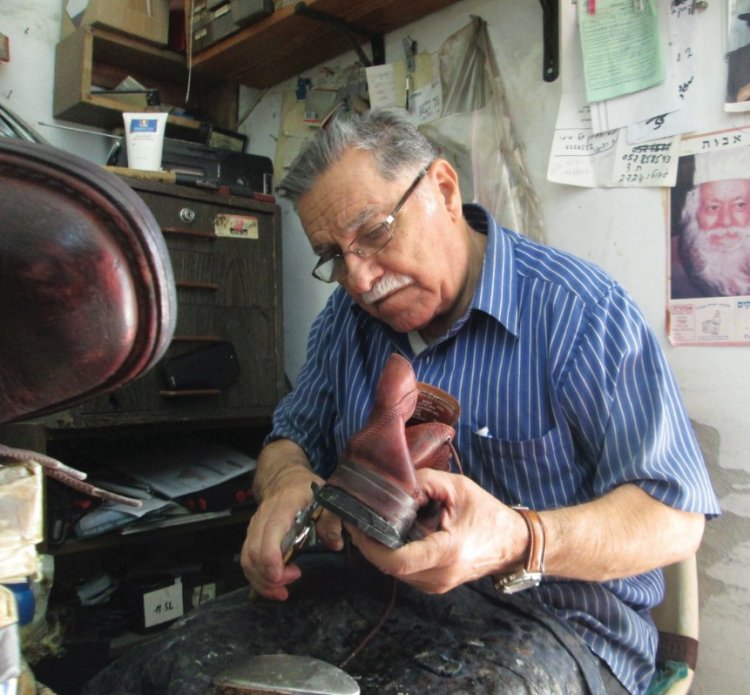 The shoemaker from Beit Shean, Rabbi Yaakov Amsalem
When Craft Becomes a Relic
Rabbi Yehuda belongs to the rare group of shoemakers who actually knew how to make shoes, not only repair them. He once produced shoes and sandals by hand, a skill that shoemakers today almost never practice.
“I’m aware that this craft has almost disappeared from the world,” he admits. “To compare, it’s like a doctor. Every doctor specializes. You can hardly find a true general doctor who became deeply expert in everything.”
Then he credits his teacher, and the mercy of Heaven.
“Thanks to the investment of my teacher, and with Heavenly help, I learned this. He had a method. He made a round table, and every day a different student would be attached to him. One day we did heels, another day soles. He was a righteous Jew. He supported needy families. People came to him, and he didn’t hold back his hand from his pocket.”
Tools, Leather, and the Loss of Knowledge
When asked about the tools of his trade, Rabbi Yehuda lists them carefully, one by one.
An anvil and a hammer, “between the hammer and the anvil.” Large shears for cutting insoles. A fast moving grinder for smoothing the sides of the shoe. A sewing machine designed specifically for shoes.
And the leather itself?
“To be honest, that’s a difficult question,” he says. “In Morocco we could know exactly where the leather came from and from which animals. Today we have no information on the subject. I don’t think anyone can really get information about it.”
Fewer Customers, More Gratitude
Yes, fewer people come today than in the past.
“That’s true,” Rabbi Yehuda says, and there is pain in his voice. “Once, everything was craftsmanship. We did everything by hand. Today the era of craftsmanship is over. Everything is industrial.”
He pauses, then adds something that is both sobering and simple.
“When I used to produce shoes, each day I could make at most two pairs. Today a machine can produce a thousand pairs.”
And yet, he insists he is not complaining. “The Holy One, blessed be He, is the One who sustains and provides for all, and from His hand comes all our livelihood.”
Over the years, he began selling shoes too, but not because customers stopped coming.
“It happened by chance,” he says. His son suggested expanding the business and promised to take part. Rabbi Yehuda agreed. Within half a year, the son left the business and went to the beit midrash.
“And you should know,” Rabbi Yehuda says, “since then I have been full of praise and gratitude to the Creator. I have no words.”
Then, quietly, he shares what weighs on him about our times.
“It’s not the generation we once were. Once we had basic decency, as it says, ‘Derech eretz precedes Torah.’ Today people think they’re smart and sophisticated, but they’re foolish. Everything is calculated. Any word you say, people answer immediately, ‘He has an agenda.’ A little derech eretz wouldn’t hurt us.”
Jerusalem: The Quiet Sadness of a Forgotten Shop
In Jerusalem, on Ein Yaakov Street in Meah Shearim, the atmosphere shifts. The old Jerusalem market is still alive, but the simple craftsmen are barely visible. They sit at the entrances of their shops, idle, more like men waiting for mercy than merchants.
A shabby piece of plywood announces the “Express Expert Shoemaker.” He sits outside, warming himself in the sun. His tiny shop holds far more than shoes: belts, assorted items, even a cart priced at eighty shekels waiting for someone to take it. Yet passersby do not stop. They move on.
When we arrive with photographer Yonatan Sindel to ask how he is doing, the shoemaker immediately tries to sell him a film camera for 150 shekels.
Yonatan smiles sadly. “In our time,” he says, “a camera like that has no use. It sells for ten shekels in stores.”
This is the world of the Meah Shearim shoemaker in 5776.
Jerusalem: The Righteous Shoemaker of the Bucharim Market
Not far away, in the legendary Bucharim market, near the place of the “hidden jeweler” Rabbi Reuven Chakshur, under a modest sign that reads “The Shoemaker,” we meet Rabbi Nissim Borochov, who once described his work with quiet generosity.
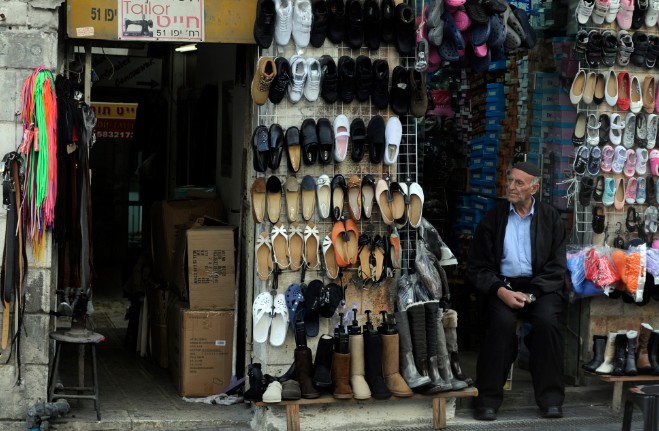 (Illustration: Flash90)
He spoke about yeshiva students who came to repair their shoes. He would quote a high price, then take less when they paid, because one who learns Torah deserves it cheaper. He described mothers arriving with torn shoes, and how he would fix them without settling the payment right away.
“Some asked me to write down the debt,” he said, “and I would. And always before Yom Kippur, everyone would come to pay down to the last coin. It never happened that Yom Kippur passed and someone still owed me money. That’s how the Torah public is. Fortunate are they and fortunate is their portion.”
Even he, like the others, feels the ache of a trade becoming unnecessary. People repair less. They buy new instead. And the heart tightens.
As Long As the Candle Burns
It is impossible to speak about shoemakers without drawing from their craft a message for the soul.
Many have heard the famous story attributed to Rabbi Yisrael Salanter, founder of the Mussar movement. He once came to a shoemaker late at night, when the candle was already fading.
“Why are you working so late, when even your candle is about to go out?” Rabbi Yisrael asked.
“As long as the candle is still burning,” the shoemaker replied, “it is still possible to act and repair.”
That sentence clung to Rabbi Yisrael. He repeated it again and again: as long as the candle is still burning, it is still possible to repair.
And later he taught his students: if that is true of a physical candle, how much more so of the Divine candle, “The candle of Hashem is the soul of man.” As long as a person lives and his soul still burns, he can still repair, still grow, still draw closer.
The shoemakers of Bnei Brak, Beit Shean, and Jerusalem may be repairing soles and straps. But in their quiet persistence, and in the fading glow of a disappearing craft, they remind us of something larger.
As long as the candle is still burning, it is still possible to repair.

