

World News
“Gestapo” Enters Mainstream U.S. Politics as ICE Debate Explodes
Holocaust language once treated as taboo is now deployed by lawmakers and protesters following a fatal ICE shooting and nationwide immigration enforcement backlash
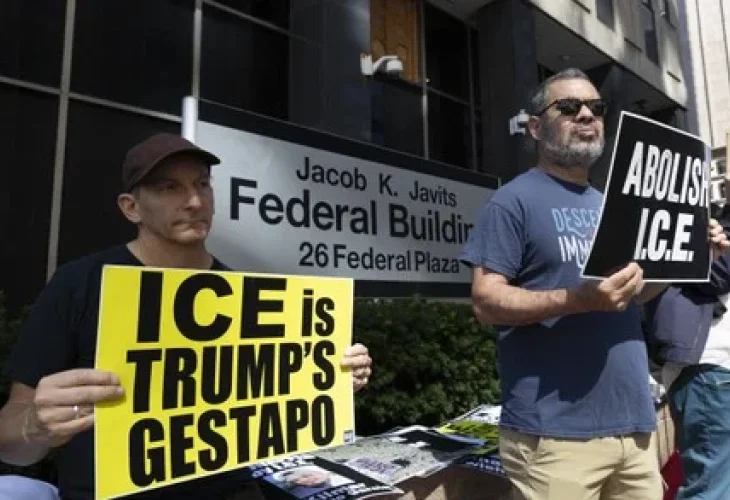 Ice Protestors (Shutterstock)
The term “Gestapo” has surged into American political discourse in recent days, as Democratic lawmakers and protesters compare U.S. Immigration and Customs Enforcement to Nazi Germany’s secret police.
The language shift unfolded after the fatal ICE shooting in Minneapolis and a widening debate over immigration enforcement, prompting a level of Holocaust-era rhetoric that was long considered off-limits in U.S. politics, particularly within Jewish communal norms.
The escalation followed the killing of Renee Nicole Good, a U.S. citizen, who was shot by an ICE agent in south Minneapolis last week during a confrontation while on a federal enforcement operation. Federal officials said the agent acted in self-defense, while local and state leaders disputed that account and called for ICE to leave the city. The incident ignited protests across the country and intensified political pressure on the agency.
As the debate heated up, several Democratic officials explicitly invoked Nazi Germany. New Jersey state Sen. Britnee Timberlake said the federal government’s direction to ICE was “wrong.” “What the federal government is directing ICE to carry out is wrong,” Timberlake said. “I do believe, and look for a day in the future where history will speak for itself, and that those who are carrying out these illegal acts will find themselves in the same position as those who carried out the illegal acts in Nazi Germany through the Nuremberg trials.”
Massachusetts Rep. Jim McGovern wrote on X that Trump was using ICE “like a secret police force,” accusing the agency of “Gestapo-like tactics.” Oregon Sen. Jeff Merkley described masked federal agents as instruments of “fascism,” while Minnesota Gov. Tim Walz has previously referred to ICE as “Donald Trump’s modern-day Gestapo.”
The rhetoric has not been confined to elected officials. Tens of thousands of demonstrators protested federal immigration policies over the weekend, with signs reading “Stop Trump’s Gestapo.” The word “Gestapo” trended on X as posts referenced the “ICE Gestapo,” and in Belton, Texas, protesters outside the Bell County Courthouse held placards equating ICE with Nazi-era policing.
The Trump administration has forcefully rejected the comparisons. Tricia McLaughlin, an assistant secretary at the Department of Homeland Security, called the language “gross,” saying, “From comparisons to the modern-day Nazi Gestapo to glorifying rioters, the vilification of ICE must stop.” On Friday, the White House marked National Law Enforcement Appreciation Day by publishing a list of “57 times Democrats have recklessly, deliberately stoked hatred and division” against ICE and other law enforcement agencies, accusing critics of branding agents as Nazis and inciting violence.
Historians note that the term “Gestapo” carries a specific historical weight. Daniel H. Magilow, a professor of German at the University of Tennessee, has pointed out that the Gestapo’s original role was to investigate political crimes and enforce racial laws in Nazi Germany and across occupied Europe. He has argued that modern comparisons are less about precise historical judgment than about contemporary fears of authoritarianism.
As the immigration debate continues, the rapid normalization of Holocaust language marks a shift in American political culture. Once treated as taboo, terms associated with Nazi Germany are now circulating freely in mainstream discourse, reshaping how historical memory is invoked in contemporary battles.

