

Magazine
"My Husband Was Trapped in a Burning Tank, Just Two Weeks After I Gave Birth"
Two weeks after giving birth, Ori Suissa’s husband Elazar was critically wounded in Gaza. In a heartfelt testimony, she describes the difficult journey of recovery and how faith, prayer, and inner strength helped their family endure and grow through the pain.
- Moriah Luz
- | Updated
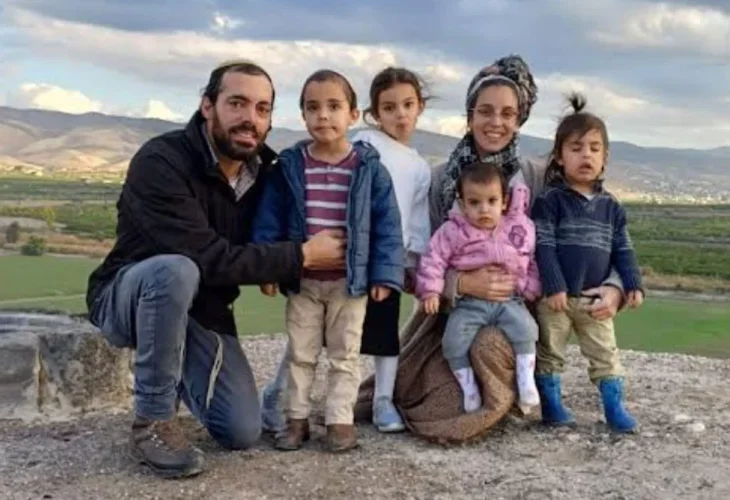 The Suissa family today
"An hour and a half earlier, I had just spoken to him. So when they called to inform me about the injury, I couldn’t process what I was hearing," says Ori Suissa, whose husband Elazar was seriously wounded in Gaza about a year and a half ago.
Elazar was called to combat on October 7th, just hours after the outbreak of the “Iron Swords” war. He served as a tank commander in Brigade 7, whose soldiers were among the first to enter the Gaza Strip. On the morning of the fifth night of Chanukah, Elazar joined a convoy of armored vehicles moving from Israeli territory into Khan Yunis. At one point, the tank he was in fell behind the others. Militants who noticed the lone tank took advantage, emerged from a tunnel, and fired an RPG at it. The tank, filled with ammunition, burst into flames.
Elazar, with remarkable presence of mind, immediately moved the turret, allowing the driver to open a small window above his head to breathe and continue driving toward a safer location. The three other crew members managed to escape the burning tank, but Elazar himself was trapped in his seat and unable to get out. The temperature inside rose to extreme levels, and he lost consciousness. Rescue attempts continued for long minutes, with additional teams arriving, until he was finally extracted by his comrades.
A doctor who examined Elazar in the field struggled to find a clear pulse. "They placed him on a stretcher and began running toward a vehicle to evacuate him," Ori recalls. "During the rush, the soldiers encountered an obstacle and fell together with the stretcher. From the impact, Elazar injured his head and suffered a strong blow to his shoulder. They lifted the stretcher again and continued running. Just before he was evacuated, he was examined once more, and this time the medic managed to find a pulse. We don’t know for certain, but it’s possible that the shock of the fall caused his body to react and his pulse to return."
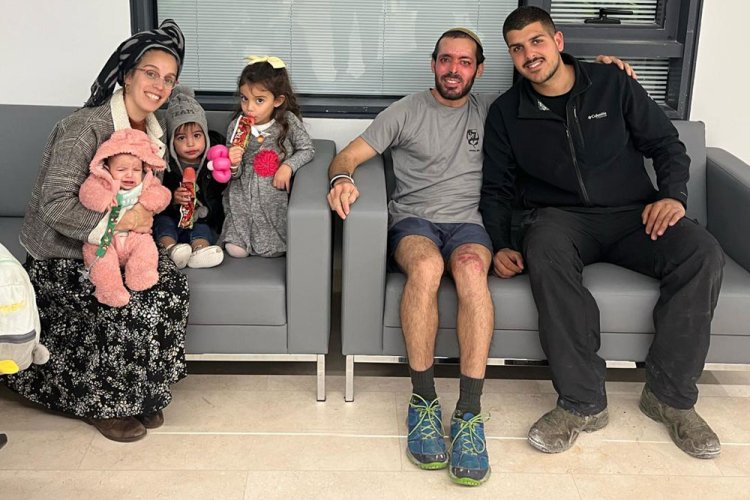 Elazar with Ofek Albez, the soldier who saved his life
"If Necessary, I’ll Give Birth Without Him"
Elazar was transported in critical condition to Soroka Hospital, and from there began a long journey of treatments and surgeries that continues to this day.
What condition was Elazar in when you received the news?
"Elazar had managed to fight for a month and a half before the injury. During that time, he was hardly home and rarely available by phone. I knew he was in a dangerous place, and the fear was certainly present, but I tried to distract myself. I was also very busy with the children, which left little time to dwell on it."
Ori describes the weeks before the injury: "Two weeks before he was wounded, our fourth daughter was born, and our eldest was four and a half. The question of whether he would make it to the birth occupied me, but over time I learned to let go. I understood that my husband was on a mission for the Jewish people, and if necessary, I would give birth without him. Thank God, he made it home on the day of the birth and was able to be present. He stayed for a few days afterward, then returned to reserve duty."
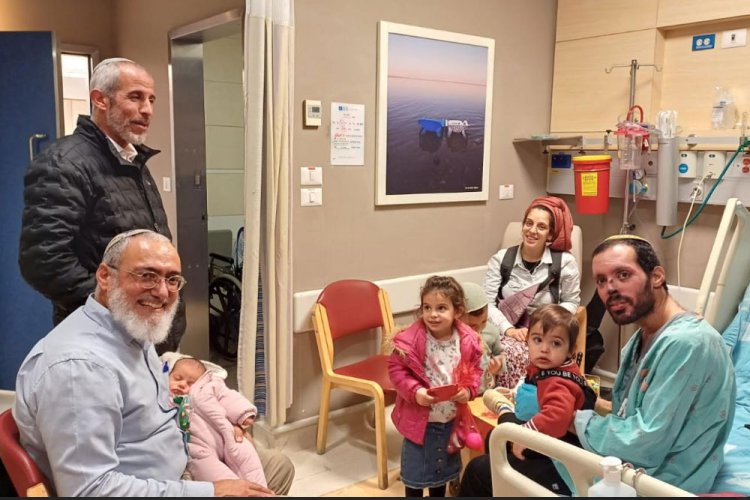 During a visit from his family at the hospital
"It’s Not Easy, But We Clearly See the Miracle"
Ori received the news of the injury while at her parents’ home, shortly after speaking with Elazar by phone. A military vehicle took her to Soroka Hospital. "Before I entered the room, a nurse and doctor prepared me. They explained that Elazar had suffered severe burns on his face and parts of his body. Beyond the external burns, he had inhaled toxic smoke from the burning ammunition, causing internal burns to sensitive organs such as the lungs and stomach, and his corneas were also damaged. At that stage, he was sedated and on a ventilator."
When did Elazar regain consciousness?
"After five days, they began reducing the sedation. When Elazar woke up, the first thing he asked was about the well-being of his fellow soldiers," Ori says. She adds that he remembers everything from the incident up until the moment he lost consciousness.
Because Soroka was overwhelmed with wounded soldiers, Elazar was transferred to Hadassah Ein Kerem Hospital about three days after regaining consciousness.
How did you experience the hospitalization period?
"It was extremely difficult. Elazar’s injuries were severe, both externally and internally, and their consequences still accompany us today. But alongside the hardship, we also saw tangible recovery."
Ori continues: "Elazar describes it as seeing the morning blessings come to life. ‘Opening the Eyes’ when he regained consciousness, and later, when his corneas miraculously healed and he could see again. It took time for his digestive system to recover, so the blessing of ‘Who Created’ took on new meaning. Later he began moving and walking again – ‘Uplifting the Bent.’ It was a powerful lesson in witnessing the miracle of the human body."
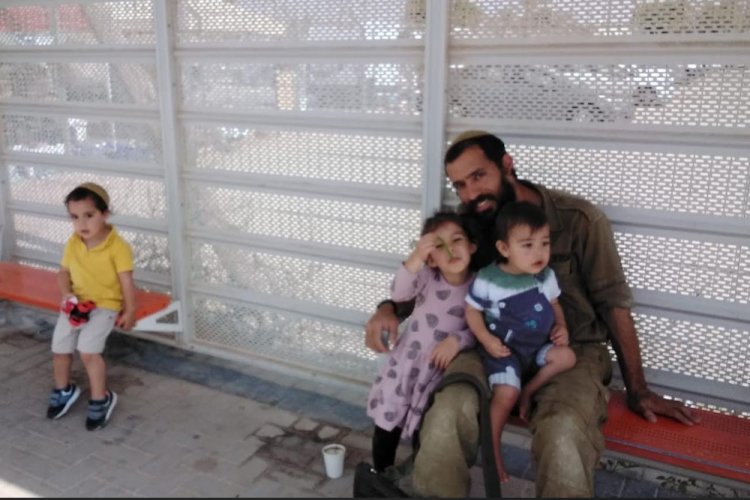 Elazar with his children before the injury
How did the children cope with the injury? Did they understand what happened?
"In the first week, the children were surrounded by relatives and wrapped in warmth. They didn’t fully understand what was happening. Later, when I wanted to explain, I consulted my father, who is an educator. He told me: ‘Speak to their hearts, not to their intellect.’ So I gathered them and explained simply that Daddy was hurt in the tank and needed the doctor, and that I needed to be near him. They accepted it naturally."
At that stage, the children did not visit Elazar because the injuries were too difficult to see. After about a month and a half, as his condition improved, Ori brought them to visit. "They missed him terribly. At first, it was hard, but slowly they began to look. By the end, they struggled to leave."
Living With Injury
"Before the injury, Elazar was the one who knew how to handle everything. His injury disrupted the sense of stability at home. Suddenly, he couldn’t do many things. That’s not easy for him or for us."
Ori describes another challenge: "Some of the burns were still open when he returned home, so we had to be extremely careful about infection. The children missed him and wanted to jump on him, and I constantly had to stop them."
She emphasizes that recovery doesn’t end at discharge. "There’s an assumption that once someone is home, they’re ‘fine.’ That’s far from the truth. Only in recent months has Elazar begun to return to himself in terms of daily functioning."
What gives you strength?
"First of all, Elazar himself. His determination is extraordinary. Another source of strength is the sense of belonging to something greater. During hospitalization, many visitors came. I once asked Elazar whether it bothered him that people saw him in such a state. He said: ‘They’re not visiting Elazar personally. They’re visiting what I represent; an IDF soldier wounded in battle.’ That perspective strengthened us deeply."
Ori shares another moment that stayed with her: "Shortly after Elazar woke from anesthesia, his yeshiva study partner came to visit. They began speaking words of Torah, and I saw how, before my eyes, Elazar became clearer and stronger. Torah lifted him. That moment gave me tremendous strength. It felt like moving from survival to meaning."
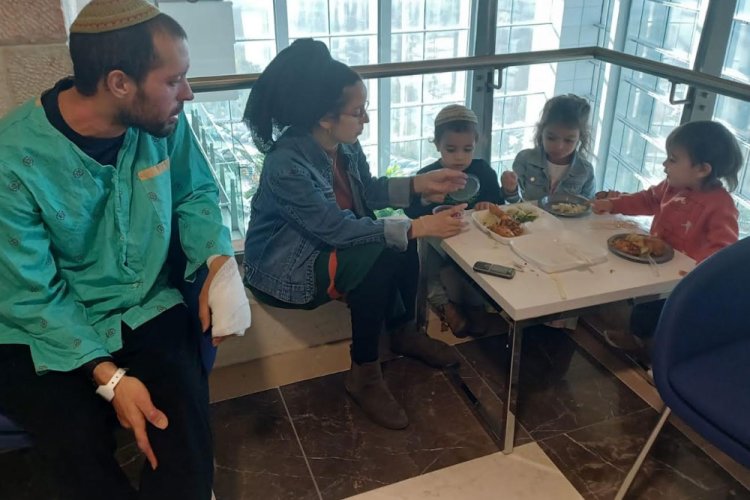 Family visit at the hospital
What is Elazar's condition today?
"Today, his condition is better, thank God. Three months after the injury, he moved to day rehabilitation. He’s had several surgeries and will likely need more. His lungs currently function at about forty percent, and probably won’t return to full capacity. But we believe that with effort, time, and prayers, his functioning can improve significantly."
A Meaning That Guides Them
Ori concludes with a reflection that accompanies them throughout the journey: "Elazar often speaks about the idea of ‘birth pangs of redemption.’ A pang is painful, but it leads to something new. He compares it to childbirth: after the pain, a new soul emerges. That idea deeply resonated with us."
She adds: "Treating burns requires reopening the wound so new skin can grow. Without that pain, healing cannot happen. During the most difficult treatments, this understanding held Elazar up. The belief that through pain, we are moving toward something better."

