

Personal Stories
Helen Keller’s Story and the Forgotten Woman Who Made It Possible
How compassion, patience, and one unexpected act of kindness changed two lives forever
- Nechama Prilich
- | Updated
Little Helen was born in the United States in the 1790s. From her earliest days, she lived in a world sealed off from sound, sight, and speech. She never turned when her mother called her name, because she was deaf. She never managed to say “Dad” or “Mom,” because she was also mute. When she held her doll in her hands, she could not delight in its painted smile or its light colored hair, because she was blind.
What she could do, in the grip of unbearable frustration, was scream, bark, and hurl the doll at anyone who tried to approach her.
Communication had been taken from her entirely.
As an infant, Helen had contracted meningitis, a devastating illness that left her with profound and irreversible disabilities. Her parents, helpless and heartbroken, searched desperately for some cure, some relief, some miracle for their beloved child. But because of her limitations, Helen grew into a child who was difficult, unruly, and impossible to control.
This was long before the great medical breakthroughs of the twentieth century. For children with such severe disabilities, solutions were nearly nonexistent.
Watching their daughter trapped in darkness and silence, her parents made a painful decision. Hoping to ease her suffering, they removed restrictions and boundaries from her life. They allowed her to do whatever she wished. Yet freedom did not bring comfort. Her loneliness was crushing. Her world remained dark, without sunrise, and silent to the point of madness.
Her needs, expressed through groans, howls, and broken sounds, were misunderstood. Helen frequently collapsed into violent tantrums, throwing herself onto the floor and screaming uncontrollably. Her father searched in vain for any institution or educational framework that could help a child like her. He refused the pleas of acquaintances who urged him to lock her away so she would not harm herself or the family. He ignored the well-meaning advice of friends who suggested committing her to a closed psychiatric ward.
When Helen turned six, the situation at home reached its breaking point.
In despair, her father made one final attempt. He turned to Alexander Graham Bell, who was known for his work with deaf children.
Bell listened carefully to the hopeless story and offered a last suggestion: contact the Perkins Institute for the Blind in Boston, Massachusetts.
A Last Hope
As an experiment, the institute agreed to send a young instructor, a teacher whose own future was still uncertain. Her name was Anne Sullivan. Trained at Perkins, she was sent with no guarantees. If nothing changed, they reasoned, it could hardly make matters worse.
Anne was sent to answer an impossible question: could a girl who was blind, deaf, and mute learn anything at all?
When twenty-two-year-old Anne first met eight-year-old Helen, the child greeted her by hurling objects and glaring with the fury of a wild animal.
Anne chose not to see the bleak present. Instead, she fixed her gaze on a future she believed could exist. In that moment, she decided she would turn this tormented child into a joyful, educated girl, and transform overwhelming darkness into light.
A Teacher Who Refused to Leave
Anne was originally expected to stay for only a few years. Instead, she remained with Helen until the day she died.
For forty-six years, she taught her, accompanied her, challenged her, and helped her rise. When others urged Anne to leave and build her own life, she refused. The director of the institute, astonished by her success, asked her to return and even suggested she open a school for deaf-blind children to help many more.
Anne declined. “Helen still needs me,” she said. “And she can reach even greater heights.”
She believed, without hesitation or doubt, that Helen could become an educated, dignified, and knowledgeable woman. And she was right.
Using teaching methods she created herself, Anne taught Helen to communicate despite the fact that she could not see, hear, or speak.
Learning Language Through Touch
Their first breakthrough came through Helen’s doll.
One of Helen’s hands rested on the doll, while her other hand touched Anne’s face. Her fingers explored Anne’s chin, nose, and cheek, learning the movements of speech. When Helen finally understood how the word “doll” was formed, she asked for a drink.
As the cup touched her lips, her other hand traced Anne’s face as she pronounced the word “water.”
Slowly, painstakingly, word by word, Helen began to learn.
Day by day, her understanding of the world expanded. Her curiosity grew rapidly. She learned Braille, and by the age of thirteen was writing in several languages. When she entered higher education, Anne translated every lecture and text by tapping letters into Helen’s palm.
Helen thrived.
Out of deep love for her teacher, she began learning to speak again by touching Anne’s chin, lips, nose, and cheek as she spoke.
Anne’s vision of Helen’s future was not mistaken. She simply could not have imagined how high Helen would soar.
Helen Keller’s Extraordinary Legacy
Helen Keller went on to lecture around the world. She wrote many books, including her autobiography The Story of My Life, which was translated into numerous languages and sold thousands of copies. She became a leading social activist, addressed lawmakers, championed human rights, and met presidents who honored her achievements.
In 1953, following her visit to Israel, Beit Helen Keller was established in Tel Aviv as a center for the advancement of the deaf. Her story became one of the most powerful and enduring inspirational narratives in history.
Behind it stood one woman: Anne Sullivan. Her relentless devotion and unshakable belief in human potential earned her the title “the miracle worker.”
But the story does not end there.
Who Was Anne Sullivan Really?
One day, Dr. Mayfield toured the Tewksbury Institute for children with disabilities. As he was leaving, he accidentally bumped into an elderly cleaning woman. To ease the awkward moment, he struck up a conversation.
“How long have you worked here?” he asked.
“Since the day the institute opened.”
“What can you tell me about this place?”
“I cannot tell you much,” she replied, “but I can show you something.”
She led him to the basement, the oldest part of the building, where small barred cells stood behind rusted iron gates. Pointing to one of the cages, she said, “This is where they kept Annie Sullivan.”
The Forgotten Child in the Cage
“Annie was a girl no one could reach,” the woman explained. “She was violent and uncontrollable. She bit, screamed, and threw food at anyone who tried to help her, doctors and nurses included.
“I was only a few years older than she was. I saw her misery and wanted desperately to help. But I told myself, what could I possibly do? If trained professionals failed, what could a cleaning woman offer?
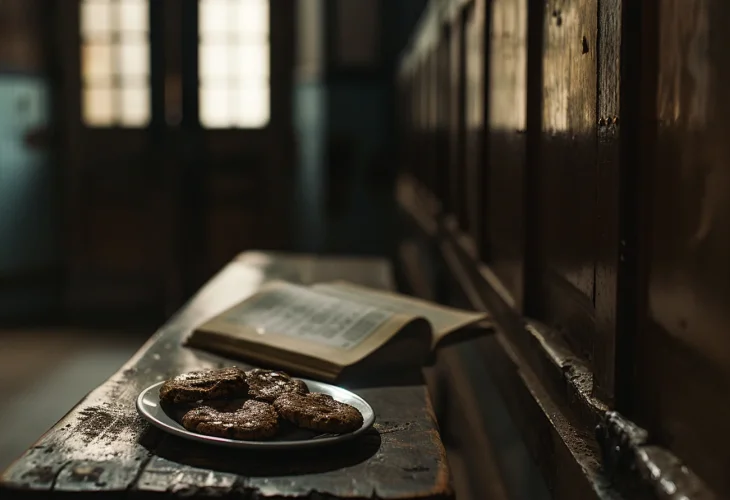
“One day, after finishing my work, I went home and baked brownies just for her. The next day I approached her cage and said, ‘Annie, I baked these for you. I’ll leave them here, and when you want, you can take them.’
“I ran away, afraid she would throw them at me like everything else. But she did not. She came closer and ate them.
“The next times, she welcomed me. One day, I even made her laugh.”
The doctors noticed the change. They realized this woman was the first person to reach Annie. They asked her to help calm Annie before any treatment. Over time, they discovered Annie was visually impaired. Eventually, she was transferred to the Perkins Institute for the Blind, where she was rehabilitated and trained as a teacher.
Years later, she returned to Tewksbury to work with disabled children.
One day, the director told her about a desperate father and a child named Helen Keller.
The Circle Completed
Annie, now Anne Sullivan, accepted the mission that became her life’s purpose. She took a child destined to live behind bars for life and transformed her into a woman of global influence.
When Helen Keller was once asked who had the greatest influence on her life, she answered without hesitation, “Anne Sullivan.”
But Anne corrected her. “No, Helen. The person who had the greatest influence on both of our lives was the cleaning woman at the Tewksbury Institute.”
Perhaps true revolutions do not begin with impressive titles or advanced research institutions. Perhaps they begin with a warm heart, quiet courage, and a plate of cookies.

