

Israel News
Trump Administration to Announce Gaza Phase Two Despite Unmet Preconditions
U.S. outlines 15-member Palestinian technocratic body for Gaza as Israel warns rebuilding cannot begin while Hamas stays armed and Ran Gvili unrecovered
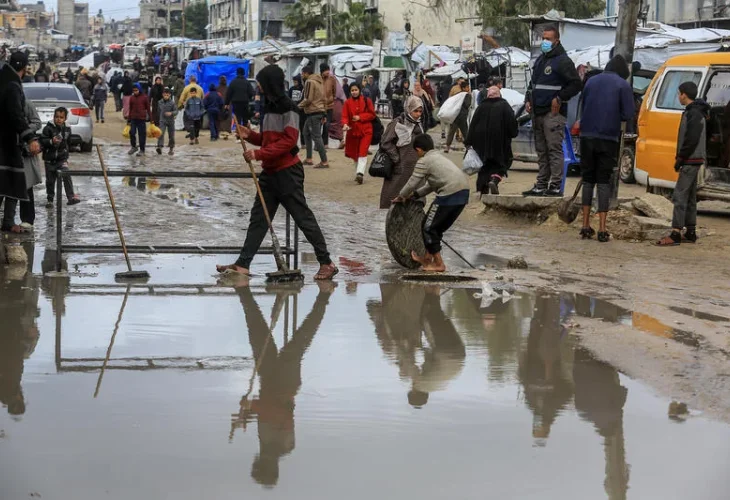 Gaza (Flash90)
The Trump administration is expected to announce on Wednesday that the United States is moving to Phase Two of its plan for Gaza, including the appointment of 15 members to a temporary Palestinian technocratic body that would oversee civilian affairs in the territory, according to U.S. officials cited by The Wall Street Journal.
The decision follows relative stability in the ceasefire, which has largely held despite isolated violations, and the return by Hamas of all hostages except the body of Israeli soldier Ran Gvili. U.S. officials told the newspaper that conditions now allow a shift from halting the fighting to establishing a framework for governance and beginning preparations for reconstruction.
Phase Two is intended to move Gaza from emergency wartime management toward civilian administration. But the transition is already disputed. Hamas has not agreed to disarm, one of the core conditions of the U.S. plan unveiled last October, and Israel has made clear that reconstruction cannot begin while Gvili remains in Hamas custody.
About two weeks ago, Donald Trump met with Gvili’s family at his Mar-a-Lago estate in Florida and pledged to bring him home. However, Trump did not promise to delay the move to Phase Two until Hamas returns the body, and U.S. officials now say the administration intends to proceed regardless.
Under the plan, the new body, formally called the National Committee for the Administration of Gaza (NCAG), would be made up of Palestinian technocrats responsible for day-to-day civilian management. The committee would handle everyday civilian needs such as sanitation, infrastructure, education, health care, and economic coordination. It would not govern Gaza or control security, and would operate under outside supervision.
U.S. officials said Nickolay Mladenov, the former United Nations special coordinator for Middle East peace and a former Bulgarian foreign minister, will be appointed as the senior representative of a Trump-led Peace Council and will oversee implementation of the plan. Mladenov is expected to act as a liaison between the Palestinian technocratic board and the Peace Council, which is expected to include about 12 members.
While the technocratic committee would manage civilian affairs, it would not control security or armed forces. The administration has not said who would be responsible for maintaining security in Gaza during Phase Two. They have discused a possible International Stabilization Force of foreign troops, but have not said when or if such a force would be deployed during Phase Two, leaving a central element of the transition unresolved.
Speaking to reporters on Sunday, Trump said the council would be composed of “the most important leaders of the most important countries,” without naming which governments would participate. The forthcoming announcement is also expected to outline how the administration plans to stabilize Gaza and make it safe for residents before advancing longer-term development ideas that Trump has previously described as turning the territory into a prosperous Middle Eastern “Riviera.” Trump’s Middle East envoy Steve Witkoff and the president’s son-in-law Jared Kushner led development of the proposal.
Hamas has said it would dissolve its current civil government once the technocratic committee assumes its duties, but it has also made clear that it does not intend to give up its weapons. Senior U.S. officials told the Journal that Hamas’ continued military strength has slowed reconstruction efforts and complicated attempts to establish a governing structure independent of the group.
Several key elements of Phase Two remain undefined. The technocratic committee is expected to oversee civilian affairs, but there is no announced timeline for a proposed International Stabilization Force, which would be made up of foreign troops intended to help maintain order. Officials say details will be released later. Behind the scenes, potential contributors have expressed concern about being perceived as an occupying force and about the risk posed by Hamas, which remains heavily armed.
As a result, Phase Two is being launched more as a political and administrative step than a fully operational transition. Its success will depend on unresolved questions of security, disarmament, and the fate of Ran Gvili, issues that remain open even as the plan moves forward.

