

Magazine
Discovering the Echoes of Jewish Morocco
Through the vibrant streets, ancient synagogues, and sacred tombs, discover the pulsating history and enduring legacy of Jewish Morocco. Rabbi Shlomo Ben Yosef takes us on a visual journey igniting memories and emotions of what was once the Golden Age of Jewish Africa.
- Rabbi Shlomo Ben Yosef / BaKehila
- | Updated
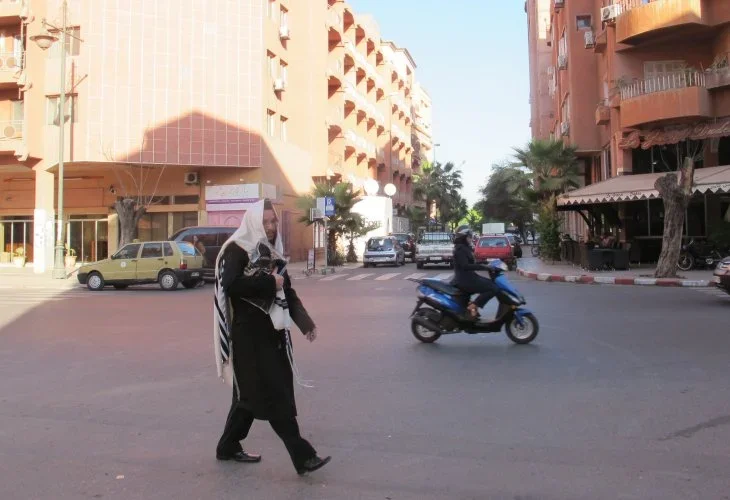
The bright sun illuminates the rooftops of Marrakesh with a dazzling orange hue. Hundreds of mopeds swarm the streets, alongside leisurely horse-drawn carriages. A lone traffic officer attempts to create order amid the chaos, further complicated by an elderly woman begging for coins. Ancient walls, elegant gates, and green expanses blend into a vivid tapestry of old and new. The city buzzes with ringing sounds and a whirlwind of scents, creating a dizzying atmosphere. Under the oppressive heat, my pace slows.
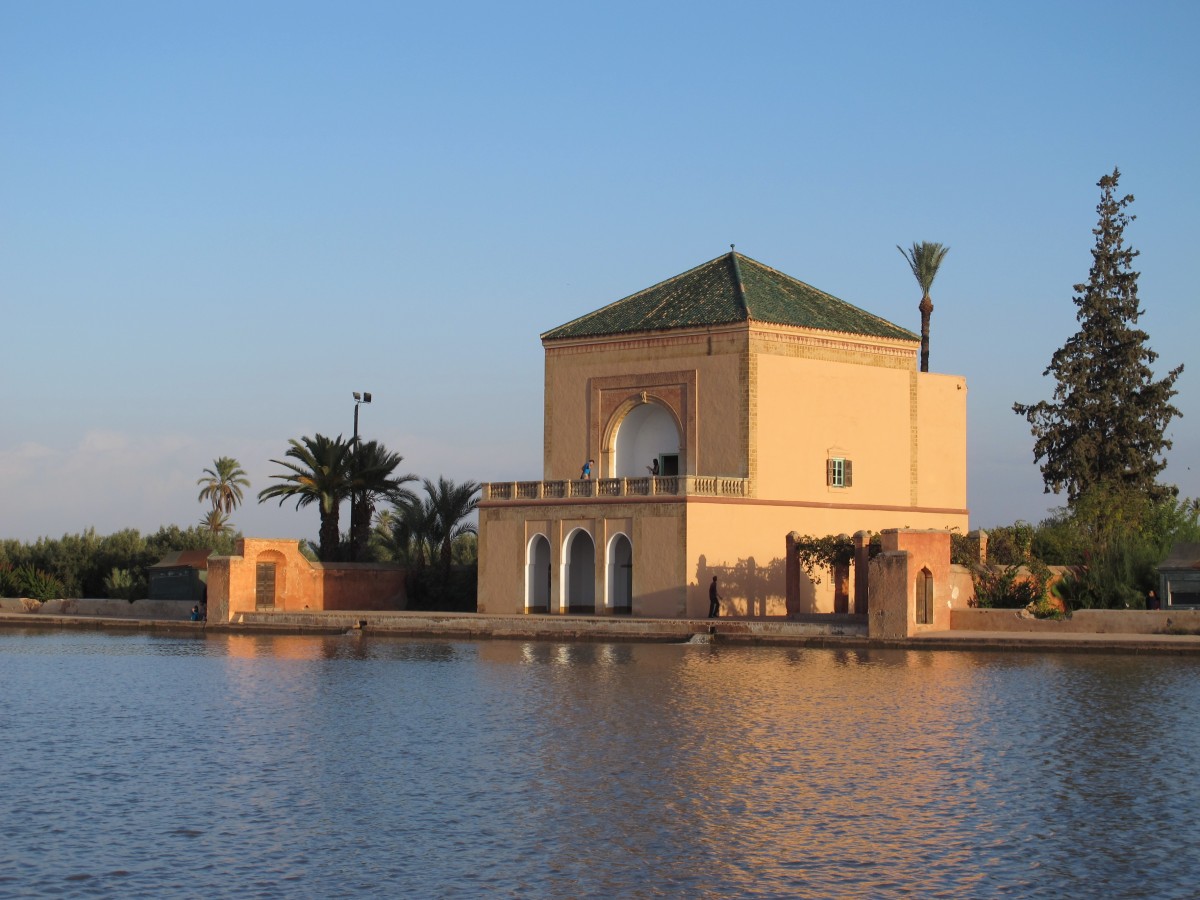 Gardens of Menara in Marrakesh, a Maimouna celebration site (Photo: Aharon Kliger)
I find myself in a bustling marketplace. A sharp turn, and I am suddenly surrounded by ten men in jalabiyas, seemingly angry. I am not the cause of their dispute, but they block my path. The shouting crescendos. My Moroccan is poor, but I catch words like Pakistan and Iran. My hands and feet tremble. What do they want?
Suddenly, silence. The elder turns to me and asks, “Wain inta?” Where are you from? The situation grows tense. As a visibly Jewish man standing in the midst of the crowd, it feels as though all eyes wait to hear my story. I choose not to hide. “Min Jerusalem,” I say confidently. From Jerusalem.
A sigh of relief ripples through the circle. Cameras click. We are still welcome here, in what was once a cradle of Western Jewish culture. Performing snakes climb over my head, monkeys jump nearby. They all seem ready to roll out a red carpet. Calls in broken Hebrew greet me: “Good morning, good evening, welcome.” A young man from the Sahara beckons me, squeezing fresh orange juice as hundreds watch.
 (Photo: Aharon Kliger)
Casablanca: Where the Walls Whisper
Two months ago, during a planned visit organized by the Center for Research of Moroccan Jewry, I embarked with my friend Aharon Kliger on a short journey through Morocco. Our goal was to discover what remains of Jewish life, explore memories, and visit the many saints’ tombs scattered across the vast landscapes. A call to my friend Youssef, a medical student fluent in Hebrew, and the journey began.
Casablanca airport greets us with a modest gray atmosphere. We are led to a side office. Tourists and citizens alike shorten the visa line by slipping tips to the clerk. A giant portrait of the king hangs above, while a small sign warns against bribery. A French Jew visiting his mother translates this as merely a suggestion. Such is Morocco, where money smooths the way. Smiling, helpful, courteous, everyone waits with outstretched hands. The more generous you are, the more honor you receive.
After passing border control, the cultural distance strikes immediately. People sit in unfamiliar postures, waiting for their loved ones. The reception hall, unlike anything we know, is adorned with arches of vivid colors. Its serenity contrasts sharply with the vibrant hues around.
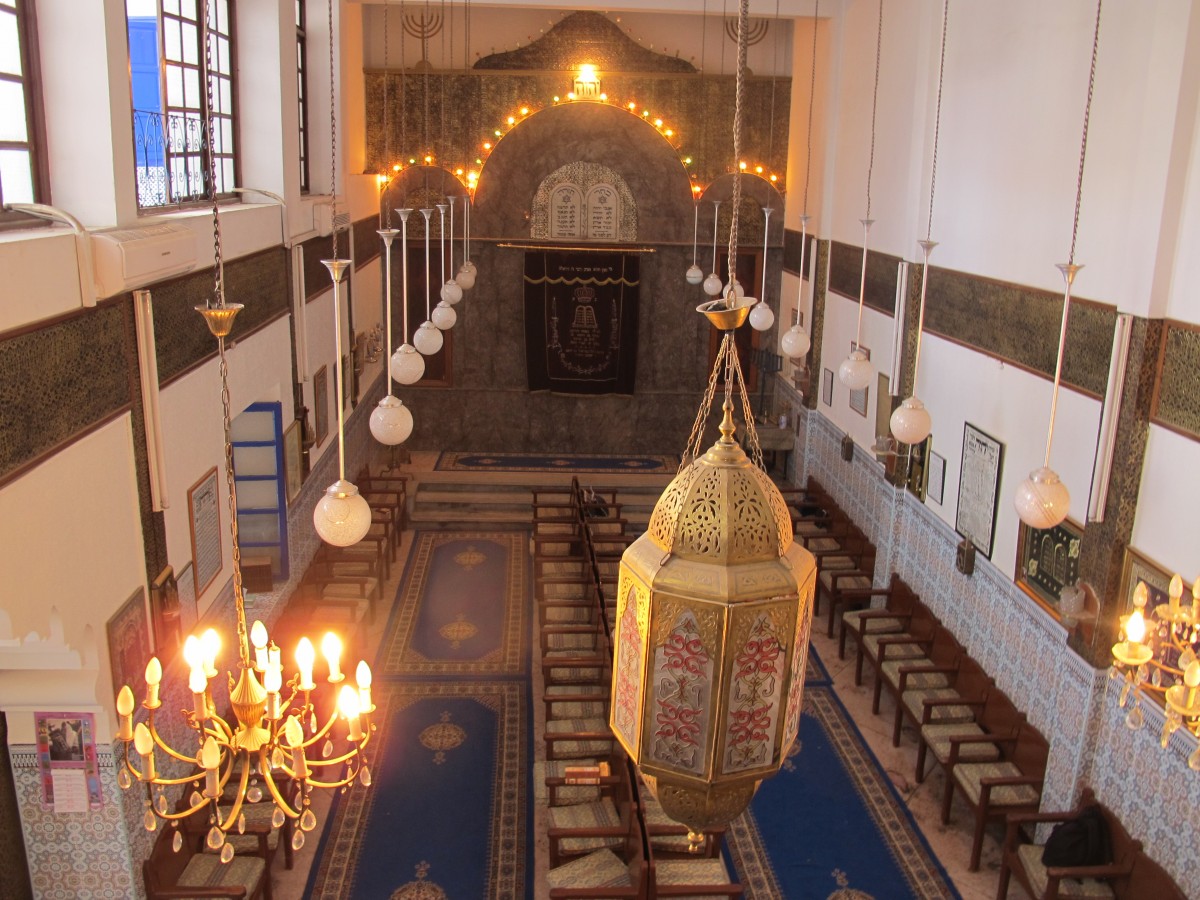 Ancient Synagogue 'Salat El Azama' (Photo: Aharon Kliger)
On a friend’s advice, we take the train from Casablanca to Marrakesh to connect more deeply with the scenery and local life. The station feels reminiscent of Eastern Europe. Elderly women, burdened with baskets of clucking chickens, stand alongside young Berber teens eager to see the big city, and neatly dressed students with branded backpacks. The train arrives with a whistle. The rear carriage doors are open, young people hanging onto the rails. Without guidance, passengers board the cars seemingly divided by social class. We join the VIP section, reserved for the upper class, at a cheaper fare than a bus ride to Bnei Brak.
An hour into the journey, I step out for air and encounter a well-dressed businessman deep in a transatlantic phone call. His gray hair hints at experience. Our eyes meet; he quickly ends the call. In broken Hebrew, he asks, “What brings you here? Who are you? I’m also Jewish. I have grandchildren in Israel, Australia, and England who look like you. But what are you doing here?”
We speak, as Jews do when meeting in the middle of nowhere. I offer him to put on tefillin. His face tightens. He whispers, “I’m here with my wife. I’m embarrassed to put on tefillin in front of her.”
Moved, he calls his son in Manchester, explaining in French that he met a fellow Jew on the train, then hands me the phone. I hear a painful story: a French Jewish man, widowed, who remarried a non-Jewish woman. Since then, his religious family in France sits shiva for him daily, though they maintain a distant connection. The son pleads, “Perhaps you can do something. Maybe here, far from home, his Jewish spark will return.”
I speak with the man, take his name for prayer, and hope.
Moments before our stop, I put on my suit and take the gartel from my bag. A young man nearby awakens, kisses the gartel, and scolds me in English for daring to disgrace tefillin. I gesture that it is a belt, then show him the tefillin to calm him.
Curious, I ask how a Moroccan student knows about tefillin. He answers, “I was born in Agadir. My home was across from the Jewish cemetery. I loved watching Jews pray and put on tefillin. Know this,” he adds quietly. “Morocco is a land for Moroccans and Jews, with equal rights. The mark you have left here will never be erased.”
Marrakesh: The City of Spirit and Memory
Marrakesh, Morocco’s most fascinating city, rests at the foothills of the mountains. Its landscapes, warm hues, and atmosphere form Morocco’s calling card. Surrounded by palm groves and lush gardens, a desert oasis between the Atlas and the Sahara, it blends mountain coolness with desert heat.
All the world’s scents and flavors mingle here. Endless bustle paired with Oriental calm. Vendors calling, horse-drawn carriages, richly dressed men. A city defined by atmosphere.
Have you ever seen a true urban heart that beats without pause? Marrakesh has one: Jemaa El-Fnaa, in the heart of the old city. Once a site of executions, its name translates roughly as “Assembly of the Dead.” From this square flow the lifeblood of the surrounding streets. Thousands move continuously: pedestrians, donkeys, buses, mopeds, taxis, bicycles. Crossing the street is chaos, yet no one seems harmed.
This extraordinary city rises from reddish-pink stone. Among Jews it was known as the City of Learning. The greatest sages of Moroccan Jewry emerged here, spreading Torah throughout the kingdom. Scholars taught that those seeking depth would find it in Marrakesh.
Its medina forms the ancient core. Within it lies the mellah, the Jewish quarter, a city within a city, governed by rabbinic leadership. In 1492, waves of expelled Spanish Jews arrived here. The Sultan welcomed them and ordered the construction of the mellah. Once, its homes gleamed in blue and white. Today, only one green gate remains, named for Rabbi Chaim Ben Attar.
The synagogue Salat El Azama, meaning “The Separated Ones,” dates back to that era. Its name tells the story: when the Spanish exiles were rejected from the local synagogue due to different customs, they established their own. Their influence became vast in law, poetry, leadership, and learning. Among them was Rabbi Yitzchak Delouya, who debated halachic matters with Rabbi Yosef Karo and founded a distinguished rabbinic dynasty.
We enter through iron gates into a spacious, light-filled courtyard once home to a grand yeshiva. Thousands studied here. Five morning minyanim once operated daily. Today, the rooms house elderly individuals supported by the community. Still, a daily minyan preserves the embers of its past.
Once again, a tip is expected, this time for the guard. Inside, the synagogue is orderly, serene. The few congregants gather slowly. The cantor begins “Petichat Eliyahu” in Moroccan melody, filling the air with sweetness.
Nearby, we meet Yitzhak Ohayon, the last Jew in the mellah. He urges us to join the minyan the next morning. Signing a postcard, he declares, “Since the synagogue was founded, the sound of prayer here has never ceased.”
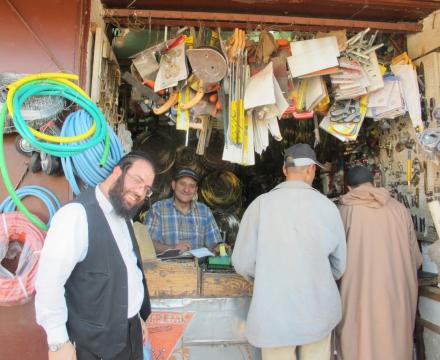 The last Jew in the mellah (Photo: Aharon Kliger)
Mountains, Tombs, and Echoes of Holiness
Youssef guides us through winding alleys. We encounter a centuries-old bakery, a hammam lit only by small holes in its dome. “Seventy years ago,” he says, “forty thousand Jews lived here.”
We reach the Marrakesh cemetery, vast beyond its walls. For hours we pray at the graves of the righteous.
A Jew in a white kippah weeps by his mother’s grave. He begins Kaddish. The words rise among the tombs. Standing there, we sense the weight of generations.
We drive toward the Atlas Mountains. In Tougana, we reach the tomb of Rabbi Daniel the Protector Ashkenazi, a shaliach from Eretz Yisrael who settled here centuries ago. The surrounding structures testify to the devotion that once flourished here.
Nearby, the tomb of Rabbi Habib Mizrahi rests among rocky terrain. Though the village lacks electricity and water, the tomb has been lovingly restored. Respect fills the air as its guardian unlocks the gates.
Further on, in remote villages and rugged roads, we visit the resting places of Rabbi David Laskar and Rabbi David Moshe, whose stories echo through tradition. Everywhere we go, locals recognize our purpose: ziyara. They bow, kiss their fingers, and ask that we remember them for blessing.
A steep turn leads us toward the village of Moulai-Egi. Through rugged terrain and a primordial landscape, we ascend to the grave of Rabbi David Laskar, situated at the edge of an ancient cemetery within a well-maintained mausoleum, accompanied by pavilions and a synagogue.
Another hour’s drive brings us into a village near the main road. We turn off toward the grave of Rabbi David Moshe, located between Timzourine and Tamaright. The village guard’s family welcomes us warmly and guides us inside. According to tradition, Rabbi David Moshe lived in Jerusalem about eight hundred years ago and was renowned as an exceptional Torah scholar and preacher. During his travels as a shaliach derabbanan, he was deeply respected. Upon reaching the Atlas region, he performed many miracles and saved countless people from a plague. Near his tomb lies a large Jewish cemetery.
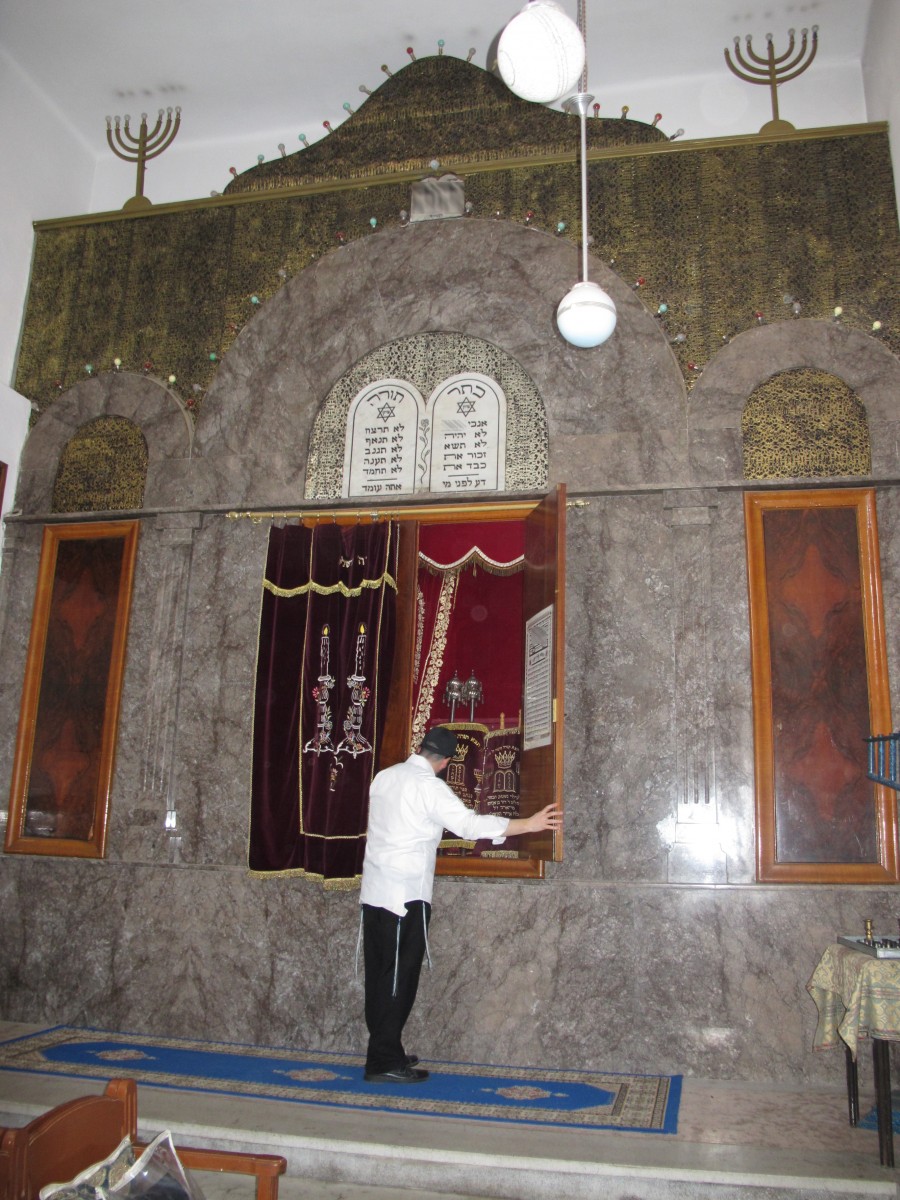 Opening the Ark in Synagogue (Photo: Aharon Kliger)
An Unusual Tenth Man for Mincha: Ouarzazate
Hours later, as we near the mountain peaks, the landscape changes dramatically, revealing the fringes of the Sahara. A vast, monotonous plain stretches before us. Occasionally, flashes from oncoming headlights signal police checkpoints and speed controls, yet the officers who stop us are friendly, saluting and clearing our way.
At the edge of a remote village, we pause to recover from the long drive. A local man runs toward us with a tray of steaming tea and small cups. Moroccan hospitality is renowned: every guest is welcomed with tea and traditional sweets. Tea drinking here is a cultural art, its preparation and mint infusion refined through generations. Indeed, the average Moroccan drinks numerous glasses daily, heavily sweetened.
We initially decline politely, but soon accept the family’s invitation to enter their home. The houses along the street are now connected to communication lines. Our host explains proudly that King Mohammed VI has worked to ensure that even remote areas are connected, helping to combat poverty and corruption.
 Rabbi Yahya Ben Baruch's Tomb (Photo: Aharon Kliger)
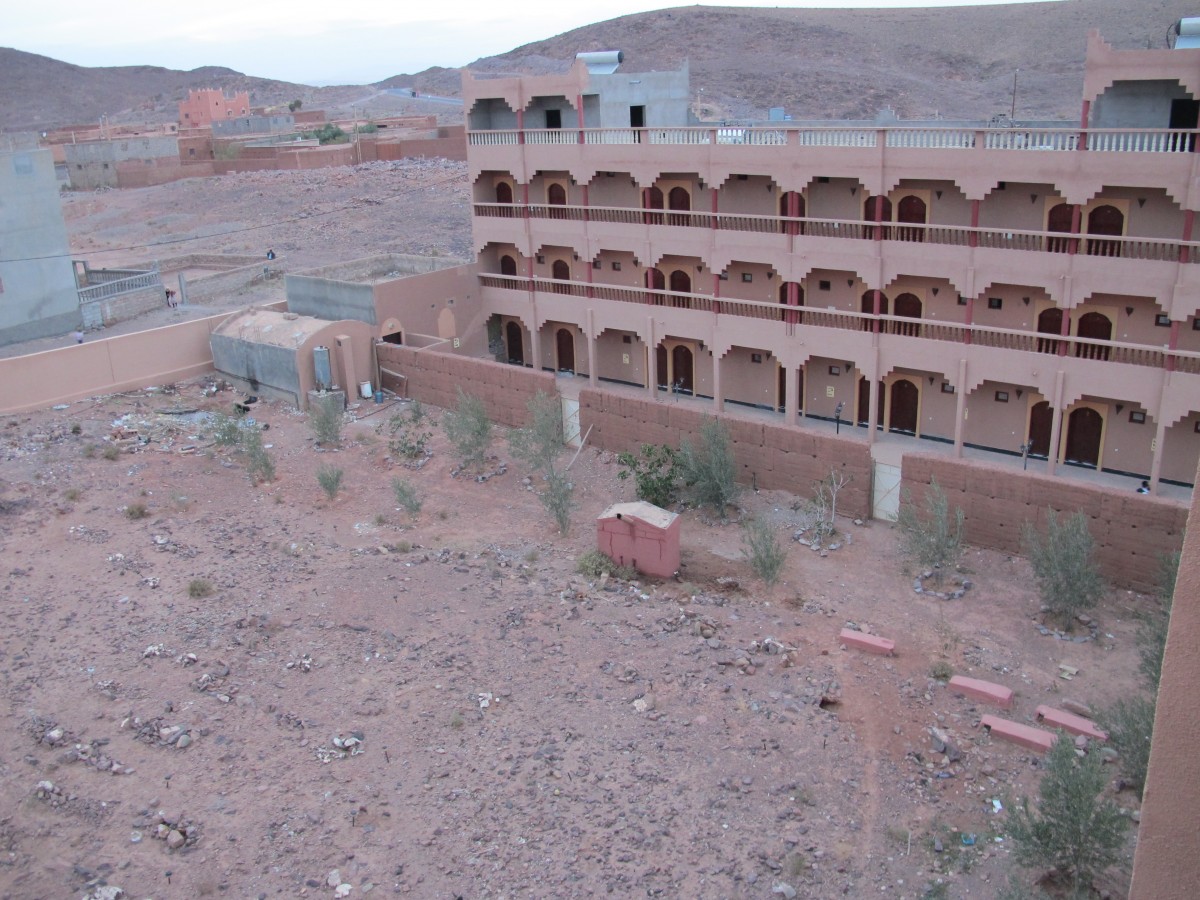
On the outskirts of Ouarzazate, near the former settlement of Tifiltawat, lies the tomb of Rabbi Yahya Ben Baruch. A group of devoted young men sit immersed in learning halacha.
“Thank Hashem, we have a minyan for Mincha,” they announce joyfully. “For days, we were missing a tenth man.”
Inside the adjacent synagogue, a quiet and heartfelt prayer unfolds. A deep, uplifting stillness fills the space, broken only by the murmurs of the groundskeeper as he communicates softly with his imposing dog.
Psalms at a UNESCO World Heritage Site
Psalms are recited at a location declared a UNESCO World Heritage Site: Ait Ben Haddou, a fortified village near the Ouarzazate riverbed, along the ancient caravan route between the Sahara, Marrakesh, and the Atlantic coast. Its core perches atop a hill, composed of tightly packed adobe homes encircled by towering walls and corner watchtowers.
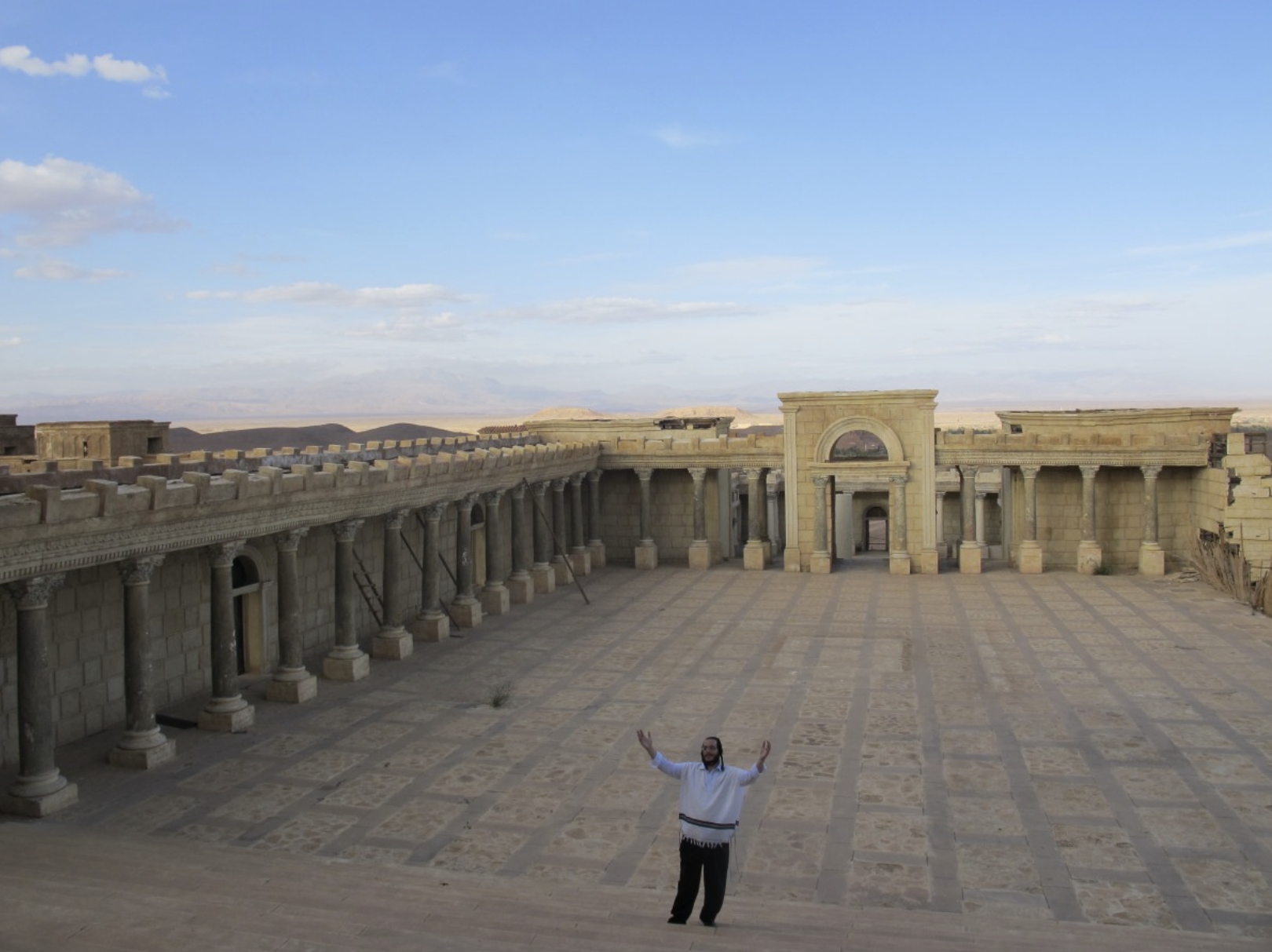
We hurry onward before sunset along a dirt path toward a massive structure: a near life-size model of the Holy Temple, built seventeen years ago for a production and now abandoned. A Moroccan man who lives there opens its immense doors for a few dirhams. We move from hall to hall, climbing and descending like dwarfs, breath taken even by this faint echo of the splendor that once filled the House of God.
“May the Holy Temple be rebuilt speedily in our days,” the heart whispers. Our feet seem to join in a quiet dance of yearning. From such distance from Jerusalem, the longing for complete redemption and the coming of Mashiach only deepens.
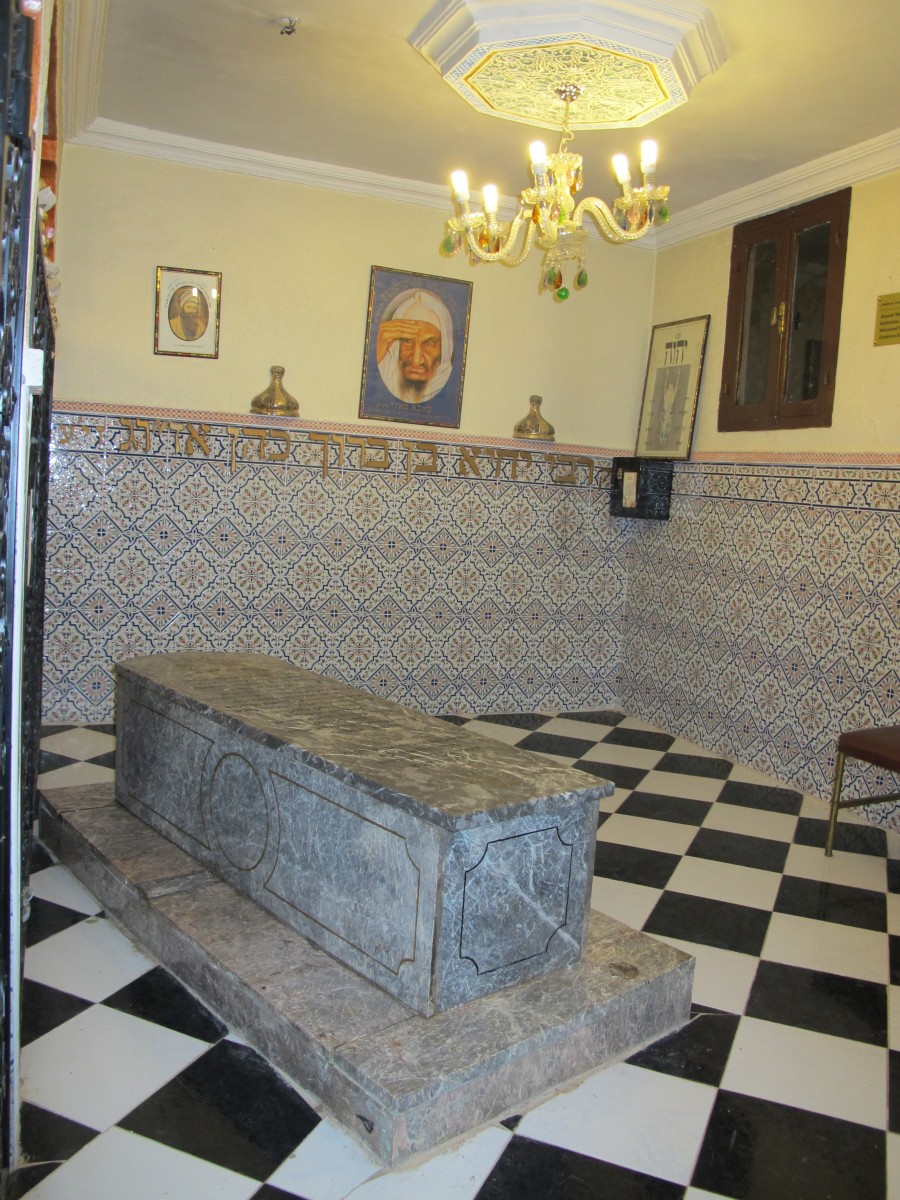 Rabbi Yahya Ben Baruch's Tomb (Photo: Aharon Kliger)
The depth of the experience propels us further, into the Sahara. We disconnect from the physical world, tasting spiritual elevation and drawing closer to the Creator. Along the way, the words of writer Eliyahu Kitov rise vividly in memory, no longer abstract but alive after three days immersed in this radically different atmosphere:
“How beautiful is the desert, where every sky and cloud above, every grain of sand below, every thorn and thistle, all sing praise to the Supreme God. Every whisper, every echo, is a song.How pleasant are the desert’s caves and hollow spaces, where the entire world disappears and only Divine radiance remains.
How sweet is the desert’s thirst, when it transforms into yearning for the living God. My soul thirsts for Hashem, my flesh longs for Him, until the soul is satisfied as with marrow and fatness, lips overflowing with praise.
How joyful are the desert’s darkness and cold nights, where God reveals Himself and night shines like day. The darkness does not obscure, and night itself becomes light.”

