

Israel News
Wing of Zion Flight, U.S. Base Drawdown Signal Preparations Toward Iran
Wing of Zion makes brief practice flight as U.S. personnel are advised to leave major base in Qatar
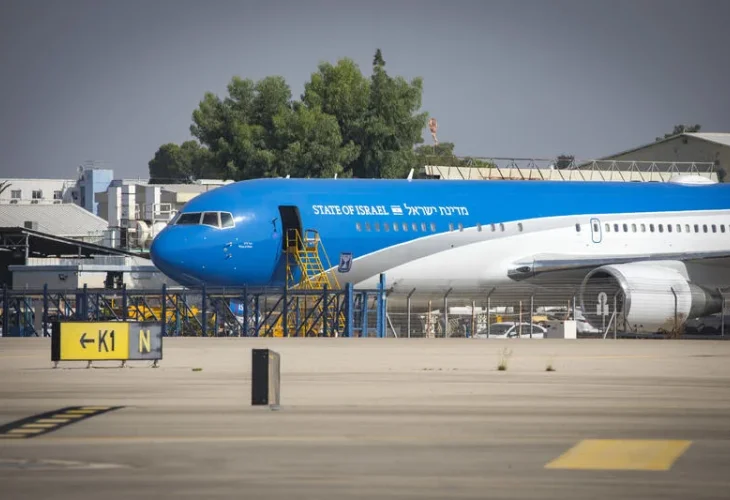 Wing of Zion Plane (Knaf Tzion) (Olivier Fitoussi/Flash90)
The “Wing of Zion” aircraft, used to transport Israel’s state leadership, departed Israel today, left the country’s airspace, and landed in Crete after a flight of just over an hour and a half. Several hours later, following a brief stop on the Greek island, the plane began its return to Israel.
Israeli officials familiar with the matter said the flight was a scheduled training and maintenance exercise. According to those officials, it was carried out “as part of the aircraft’s annual maintenance program,” and its rapid return to Israel supported that explanation.
Still, the timing drew attention. This is not the first time the Wing of Zion aircraft has been moved out of Israel during volatile security periods. On June 13, hours before the launch of Operation Am Kelavi against Iran, the aircraft was taken beyond Israel’s borders due to assessments it could become a strategic target in a potential Iranian response. A similar step was taken during Israel’s October 2024 strike on Iran.
The aircraft’s movement coincided with signs of shifting American military posture in the region. According to Reuters, some personnel stationed at the U.S. military’s Al Udeid Air Base in Qatar, the largest American base in the Middle East housing around 10,000 troops, were advised to leave the facility by Wednesday evening. Three diplomats told Reuters the move was precautionary. One diplomat stressed, “It’s a posture change and not an ordered evacuation.”
A senior Iranian official told Reuters earlier that Tehran had warned several regional states that U.S. military bases on their territory would be targeted if Washington launched an attack on Iran. The warning reportedly included countries such as Saudi Arabia, the United Arab Emirates, and Turkey. Iran previously fired missiles at Al Udeid following U.S. strikes during the June conflict.
European officials, speaking to the Washington Post, said they assess that any American strike would likely focus on the leadership and power centers of Iran’s Islamic Revolutionary Guard Corps and the Basij militia. According to those officials, “there are no indications of a strike against nuclear facilities.” They added that Tehran believes U.S. President Donald Trump faces political pressure at home and is continuing to signal openness to negotiations in an effort to buy time.
Israeli security officials share the assessment that the United States is moving closer to military action against Iran. According to those evaluations, a potential operation would likely be multi-layered, combining airstrikes against strategic regime targets, significant cyber operations aimed at disrupting command and control systems, and psychological or information efforts intended to further inflame unrest inside Iran.
Iran, for its part, has publicly signaled readiness. Majid Mousavi, commander of the IRGC’s Air and Space Force, said Wednesday, “Our forces are at the highest level of readiness to confront any aggression.” He claimed Iran’s missile production now exceeds levels seen before last June’s fighting and said all damage sustained since then had been repaired.
The central question, Israeli officials say, is not whether Washington will act, but how far it is prepared to go. A limited strike could be designed to pressure Tehran back to negotiations, while a broader campaign would aim to significantly weaken the regime’s grip on power.

