

Magazine
Ezra Yachin: The Fighter Who Never Laid Down His Spirit
At ninety seven, former Lehi fighter Ezra Yachin is still on a mission. Wounded in battle, sustained by faith, and driven by love for Jerusalem, he shares the untold story of courage, sacrifice, and survival.
- Tamar Schneider
- | Updated
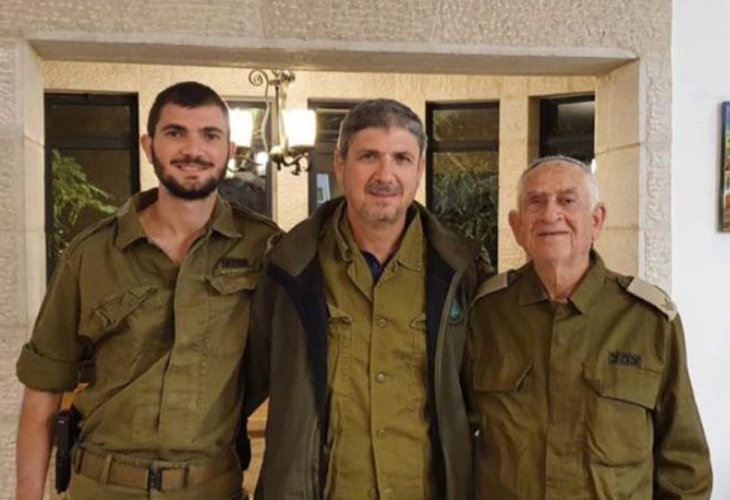 Ezra Yachin with his son Michael and grandson Saar (Photo: Private Collection)
At ninety seven, Ezra Yachin is as sharp and energetic as ever, and holds the distinction of being Israel’s oldest reserve soldier. Each day he travels from his home in Jerusalem’s Beit Hanina neighborhood to lecture across the country. His talks weave together his personal story with the story of Jewish life and resistance before the founding of the State of Israel, and audiences often sit captivated for hours.
“For five years, I lived in the valley of the shadow of death,” he says quietly. “My life was in constant danger. Even when shrapnel pierced my head, my only concern was Jerusalem.”
The Cries of “Itbach el Yahud”
Ezra Yachin was born in Jaffa in 1928. His family moved to Jerusalem during the violent unrest of 1929.
“We arrived right in the middle of the riots,” he recalls.
As a small child, he narrowly escaped a massacre. A stone thrown from above struck one of the attackers near their home on the edge of the Katamon neighborhood, causing the others to scatter in panic. Later, when looters returned, a woman persuaded them to move on by saying, “This is a poor neighborhood. Go to Rehavia instead.”
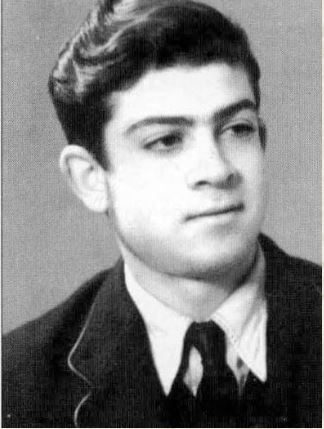 Ezra Yachin in his youth (Photo: The Lehi Heritage Memorial Association)
The fear never truly left. Yachin remembers his mother crying quietly at night. After the family moved to Mahane Yehuda, he met children who had lost parents in the massacres.
“The girl across the street lived with her grandmother,” he says. “Her mother was murdered in Hebron.”
Such stories were common among his friends. Many had witnessed horrific violence against their families.
By the time he was almost sixteen, Ezra could no longer remain on the sidelines.
“The more I saw, the stronger my desire to fight became.”
He longed to join Etzel or Lehi, but did not know how. He worked as a postal courier while searching for connections. After eight long months, he finally managed to enter the underground.
At first, he felt disappointed. He had dreamed of active operations, but his initial task was copying letters meant for the British. Only later did he understand that this was critical intelligence work.
Over time, he became a fighter, taking part in actions against the British, an empire many believed could never be challenged.
“Very few believed we could stand up to such power,” he says. “Even the mainstream Jewish leadership preferred the status quo under British rule.”
Fighters from Etzel and Lehi were branded criminals. The British called them the Stern Gang. Yachin does not shy away from the truth.
“The British were ruthless,” he says. “They even sank ships filled with Holocaust survivors.”
A Mother’s Tears and a Son’s Resolve
He never told his parents directly that he had joined the underground. But his mother sensed the truth.
“She cried bitterly,” he remembers. Her fear came from personal experience. As a young woman in Egypt, she had seen British soldiers fire machine guns at demonstrators.
Yet even in her fear, she prayed for him every time he left the house. Yachin believes those prayers saved his life again and again.
Facing Death with Faith
Captured underground fighters often faced brutal punishment.
Yachin speaks of Eliahu Hakim and Eliahu Bet Zouri, who were executed for assassinating Lord Moyne. They walked to the gallows with dignity and calm, so much so that even their hangman was shaken by their composure.
He tells of Moshe Barazani and Meir Feinstein, who sang before their execution, astonishing a British soldier who could not comprehend such courage.
“We had few weapons and little experience,” Yachin says, “but we had spirit. And that spirit allowed us to challenge the impossible.”
He recalls the murder of sixteen year old Alexander Rubowitz under British torture, a tragedy that later led to shocking revelations from Roy Farran, exposing the cruelty within the British ranks.
At Death’s Door
Yachin survived countless life threatening missions.
In one operation aimed at assassinating General MacMillan, an informant’s mistake nearly led to disaster when the British uncovered their explosives. Surrounded and hunted, the fighters escaped by what Yachin describes as sheer miracle.
In another incident, the group prepared for a final stand as British soldiers closed in. At the last possible moment, something delayed the troops just outside their hiding place, sparing their lives in a way no one could explain.
Remembering Jerusalem
When the United Nations voted on November 29 to approve the Partition Plan, celebrations erupted across the Jewish world. Yachin could not share in the joy.
“The plan did not include Jerusalem,” he says. “How could we celebrate?”
This pain helped shape the Lehi emblem, which declared loyalty to Jerusalem above all.
Arab rejection of the plan quickly led to violent attacks. Jerusalem came under heavy bombardment. Ironically, the city’s stone buildings, once mandated by British governor Ronald Storrs for aesthetic reasons, provided protection against the shells.
In those desperate days, Etzel, Lehi, and Haganah forces united to defend the city. Yachin remembers marching into battle, deeply moved by Holocaust survivor children who lined the streets to bless them with tears and hope.
During the fighting, Yachin suffered a serious head wound. Still, his thoughts remained with Jerusalem, not with himself.
The greatest blow came when he heard that Israel’s leaders had agreed to a ceasefire instead of continuing toward full liberation of the city.
Nineteen years passed before Jerusalem was finally reunited during the Six Day War.
Living on the Frontlines
Today, Ezra Yachin lives in Beit Hanina, a neighborhood many consider complex and challenging. He dismisses the concern.
“Show me a place in Israel without Arabs,” he says simply. “I have always lived on the frontlines.”
What pains him most is not where he lives, but what he sees as Israel’s willingness to surrender land.
“Our connection to Jerusalem is our essence,” he says. “Its future can change, if we truly will it.”

