

Magazine
Meidad Tasa: Balancing Torah, Music, and Faith
Singer and Torah scholar Meidad Tasa shares his journey of early fame, deep faith, personal loss, and the values that guide his life, music, and family today
- Avner Shaki
- | Updated
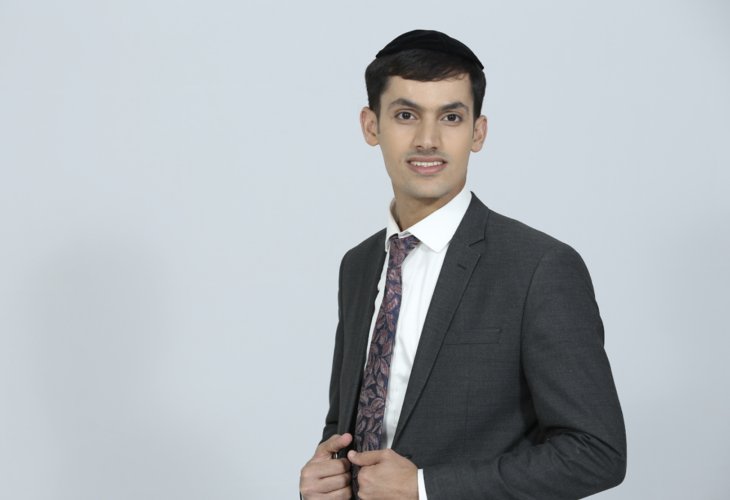 Meidad Tasa (Photo by Eyal Levy)
Meydad Tasa is married, and a father who lives in Petah Tikva. He is a kollel student, singer, and songwriter.
A Child Prodigy
“I started performing on stage at a very young age, just a few months before my bar mitzvah. At family events I was singing at the age of seven. I tried to run away from it, but without success. People often ask me what it felt like to be a successful singer at such a young age, but honestly, I didn’t think much about it. It didn’t feel strange to me either, because I got used to it very quickly. And in general, I didn’t realize how famous I was — I simply didn’t internalize it.
“At the same time, as the years passed, I understood that I couldn’t live like everyone else. For example, I didn’t go on trips to crowded places or to the beach, because I don’t like attracting attention. When I’m not on stage, I don’t allow myself to feel like a singer.
“Beyond that, when it happens, even the people who are with me enjoy it less. People gather around us, and it’s uncomfortable. Only recently have I opened up a bit more about this. I realized that I simply want to live normally, and not to be closed off all the time. When I do go out and people approach me, sometimes I just say that it’s not a good time and that I need privacy. It’s not easy for me to say that, but sometimes it’s absolutely the right thing.”
The Right Balance
“When I was 13, my parents and I were looking for a yeshiva for me. One of their friends, who knew that finding a good yeshiva for a boy who is also a singer isn’t so simple, recommended Yeshivat ‘Or HaChaim’ of Rabbi Elbaz. That friend took me to the yeshiva. The rabbi got to know me a bit, welcomed me with a smile, and asked me to sing two songs.
“After I finished singing, the rabbi told me that he too had once been destined to be a child prodigy, but in the end he chose Torah. I felt very good in the yeshiva, and ultimately I learned there for ten years — from age 13 until 23, until my wedding. Even today, in the kollel where I study, we are a group of friends from ‘Or HaChaim.’ The rabbi allowed and even encouraged me to combine Torah and music, but he always made it clear that Torah comes first. Thank God, this is the path I follow.”
“Bring Some Cash”
“A few years ago, the owner of a large event hall invited me to perform at his son’s bar mitzvah. There were many artists there, including Lior Narkis, who during my performance placed 800 shekels on me as a tip. By the end of the evening, I left with 3,800 shekels in tips. Two wealthy men with luxury cigars competed over who would put more money on me. I didn’t pick up the bills because it’s not dignified — and luckily there was a little girl there who collected everything.
“Today this practice of sticking money on performers is much less common, certainly not in the religious world. In the past I performed more for secular audiences; today it’s mainly for Haredi and religious ones. And even when I performed for secular audiences, I always demanded full separation between men and women. I never agreed to mixed dancing — that was my condition. Nevertheless, as the years passed, I decided to stop performing at those events altogether. I didn’t want to be in those places anymore. You can have a positive influence at secular events, but there are also negative damages. I believe that sometimes ‘turning away from evil’ is more important than ‘doing good.’”
“I Am Struggling in the Water”
“The most important mitzvah for me is ‘Love your fellow as yourself,’ and therefore it is very important to me to treat every person with respect and kindness. This is my flag. I want to invest in this and never abandon it. This is especially important to me because of my beloved brother Aviel, of blessed memory.
“Aviel passed away after drowning in a mikveh. One day he went to a mikveh near the yeshiva where he was studying, lost consciousness for some reason, and by the time they pulled him out of the water, he had suffered brain death. The doctors explained that in such a situation a person can live for at most two days, but to everyone’s surprise he held on and passed away only after nine days. This happened exactly at midnight on the eve of Rosh Hashanah, a time known as ‘Tikkun Beit Din.’ We buried him shortly after his passing, just before the holiday, and sat shiva for only half an hour.
“Aviel was always healthy and an exceptionally special person. We are twelve siblings in the family, and the bond between us was very unique.
“A month before Aviel passed away, I came for Shabbat in Bnei Brak, and he came to visit me. Somehow, whenever I came to Bnei Brak, he always knew and came to be with me. We sat and talked, and then he left me what became the will of his life: ‘Meidad, I want to tell you something very important. Treat every person nicely — even children. Anyone who approaches you and wants to speak to you, receive them with a pleasant countenance. Smile. Be patient. That’s what I ask of you.’ Aviel knew that I was a singer, and it was very important to him that I not become arrogant. I will never forget this moving message my brother Aviel left me.
“We always knew he was special, but only after he passed away did we realize to what extent. We heard amazing stories about him and read things he had written in his journals — he loved to write. After he passed away, we found a small note in the pocket of his jacket that said: ‘You are there in Heaven, and I am struggling in the water.’ I intend to release a song soon with this line as its chorus.”
My Sister, the Bride
“My daily routine is busy and fairly fixed, and I’m very happy with it. I start the day with Shacharit, arrive at kollel at 9:30, study Tur and Shulchan Aruch, and prepare for the rabbinical exams. I finish there at one, return to learn again from three to six. If there’s an event, I rest in the afternoon and go out in the evening; if not, I’m simply at home with my wife. In my opinion, the most important thing is the home, and only afterward work and everything else.
“Speaking of home, I’ll share a bit about my wife. Thank God, she is the only woman I ever met for the purpose of shidduchim. Five years before we met, my sister told me that she would be my wife. By the way, I believe I merited her because of Shabbat. A few years ago, we traveled for Shabbat to Tiberias, and Waze said we would arrive a few minutes before sunset. I realized we were going to arrive right before Shabbat, and it didn’t sit well with me. So I told Hashem that from then on I would dedicate the half hour before Shabbat only to things connected to Shabbat. I remember that the words in my mind when I accepted this upon myself were ‘Bo’i Kallah.’ It was completely unplanned, but a week later I met her. I never dreamed it would happen so quickly.”
Accepting the Yoke of Heaven
“About a year ago, I was supposed to perform at a bar mitzvah, and it turned out to be exactly on the day my wife went into labor. I was with her at the hospital; the labor wasn’t progressing, and at a certain point she told me to go perform. I arrived at the venue, went on stage, and as usual began with accepting the yoke of Heaven with the boy. About half an hour later, during the dancing, they told me that the baby had been born. After everything ended, I went back to my wife, checked the timing, and realized that the baby was born exactly when I was reciting Kabbalat Ol Malchut Shamayim. It moved me deeply.”
The Bride's Father at the Airport
“The recent period has not been simple for me. The greatest difficulty since the outbreak of the coronavirus has been the uncertainty — a very confusing time. What saved me is my belief that everything is for the good from Hashem. Whether there are events or not is entirely in His hands. With this faith, it’s possible to get through all the hardships.
“Yes, of course there were difficulties, and there still are. Events were canceled, and now it’s also harder to perform. It’s difficult to adhere to the guidelines, and beyond that, it’s harder to bring joy, partly because there are fewer people at events. In addition, as a singer you come to give more than your best, and in many cases we were told to lower the volume, which harms the atmosphere. Many times people are afraid that others will hear the music and call the police to shut down the event.
“On top of all that, there are personal moments that sometimes overshadow the joy. At one wedding I performed at, I saw that the chuppah was delayed. I asked what was happening, and they told me they were waiting for the bride’s father. The plan was that he would land at the airport and come straight to the wedding. He did land, but he wasn’t allowed to leave and was told he had to enter quarantine. They waited a long time, hoping it would work out, but in the end he didn’t arrive, and the bride took it very hard.”
Greater Than All
“I feel and know that the most important thing I do in life is learn Torah, and I invest a great deal in it. Torah is not just knowledge, it iis a way of life. Torah is the channel that connects us to Hashem and helps us live as Hashem wants us to live. Without Torah, the pit is empty — there is no water in it, only snakes and scorpions.
“Only good comes from Torah study. For example, from the laws of damages we learn how not to cause harm and how bad it is to harm others. One must always reflect on what one takes from the learning, and that the teachings don’t remain in the beit midrash.
“In general, I see that Torah study refines me greatly, and makes me a better person. Today I understand that it’s truly not worthwhile to leave it. A person who studies Torah and a person who does not are two completely different worlds. I know that I came into this world to learn Torah — that’s also what Rabbi Ovadia told me. I recorded a jingle for Shas party, and they brought me in to the rabbi for a blessing. He didn’t speak to me about music at all; he only said: ‘Talmud Torah keneged kulam.’ I will never forget that moment.”
