

Behind the News
Why a Strike on Iran Seemed Inevitable, and What May Have Slowed It
Unusual military moves fueled expectations of immediate action, but uncertainty, mixed signals, and unresolved decisions have tempered the strike option
- Brian Racer
- | Updated
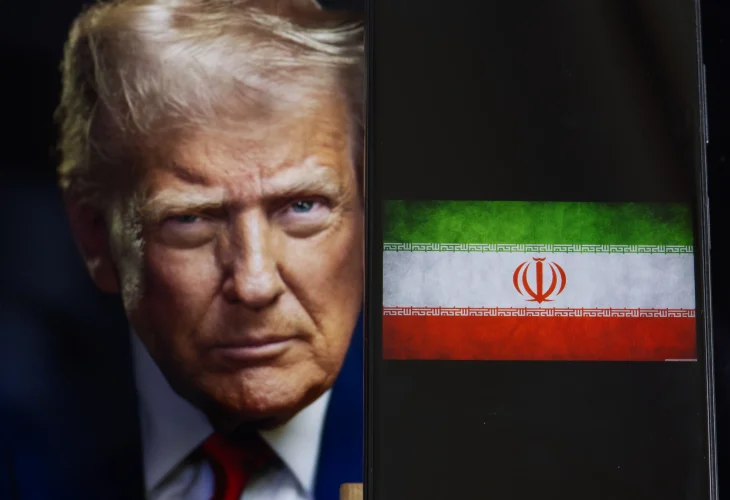 Trump and Khamanei (Shutterstock)
From Wednesday night and into early Thursday, the Middle East appeared to be bracing for the rumored U.S. military strike on Iran. Airspace across multiple countries was cleared, embassies issued warnings, airlines canceled flights, and American military assets shifted toward the region. By morning, no attack had begun, but neither had the sense that the chance of an attack had passed.
Through the night, the indicators built up with momentum. Iran closed its airspace to civilian traffic and map radar showed the skies clear. Iraq shut its skies entirely, while Syria’s airspace was largely cleared. Unconfirmed reports described unusually heavy military aviation activity over Iraq. U.S. and British officials advised personnel to limit non-essential movement at Al Udeid Air Base, calling the step a precaution. The Pentagon ordered a carrier strike group to redeploy toward the Middle East, and multiple U.S. aerial refueling aircraft were tracked departing the Gulf. Germany, Italy, Poland, and other countries urged their citizens to leave Iran immediately.
The Lufthansa Group, including SWISS, Austrian Airlines, Brussels Airlines, and Eurowings canceled all overnight flights to and from Tel Aviv, citing crew safety concerns for the next few days. Italy’s ITA Airways suspended flights from Rome to Tel Aviv, and United Airlines turned back a Newark–Tel Aviv flight shortly after departure. Across the region, carriers including Turkish Airlines and Qatar Airways suspended or disrupted flights to and from Iran following the temporary closure of Iranian airspace, while several Indian airlines reported cancellations and diversions.
Iran, meanwhile, moved openly to a heightened state of readiness. Revolutionary Guard units were placed on full alert, Iranian officials warned of retaliation if the United States intervened, and state television broadcast verses front the Quran commonly associated with wartime messaging.
Adding to the confusion, President Donald Trump himself spoke publicly during the escalation. On Wednesday, as preparations were already underway, he said he had been told by “very important sources on the other side” that Iranian authorities had stopped killing protesters and halted planned executions, actions he has previously described as potential triggers for U.S. military action.
“I hope it’s true. Who knows?” Trump said, adding that Washington would “watch and see” what happens next. At the time, it was unclear whether the comments reflected genuine hesitation, an intelligence-based pause, or a deliberate attempt to mislead Tehran while preparations continued.
Reporting throughout the night began to offer a partial view of internal U.S. deliberations. According to NBC News, Trump has told his national security team that if he authorizes military action in Iran, he wants it to be “swift and decisive,” and not develop into a prolonged conflict lasting weeks or months. One person familiar with the discussions said Trump wants any move to be “definitive.”
The reporting does not suggest the strike option has been removed. U.S. officials said the issue is not willingness, but risk. Advisers have not been able to guarantee that a successful strike would quickly bring down the Iranian regime, and there is concern that Washington may not yet be fully positioned to absorb a broad Iranian response against U.S. forces and allies.
CNN reported that Washington is not interested in a long-term military intervention in Iran and has ruled out the use of ground forces, narrowing the range of options under consideration. United States Central Command has prepared and refined multiple military scenarios in recent days, officials said, but stressed that decisions remain unresolved and the situation continues to evolve.
For Israel, the stakes are clear. U.S. officials have repeatedly warned that any American strike on Iran could trigger retaliation against U.S. forces and allies, including Israel. The IDF said it is closely monitoring developments, conducting ongoing assessments, and reinforcing defensive readiness across its systems, while emphasizing that there is currently no change to civilian protection guidelines.
As of this morning, Iranian airspace has reopened and the urgency seemed to have dropped. As one Western military source told Reuters, uncertainty itself may be part of the strategy of keeping pressure on Tehran while Washington weighs whether the moment for action has arrived.

