

From Cassette King to Spiritual Journey: The Story of Moshe Giat
The Mizrahi music icon of the 1980s reflects on stardom, addiction, and the life changing decision to leave the spotlight for spirituality, family, and Jerusalem
 Moshe Giat
The magic, the simplicity, the innocence and the Mizrahi music of the 1980s became the soundtrack of pirate radio stations. Music apps had not yet been invented, and even mobile phones were rare, so that listening to music was done through transistor radios, turntables, and cassette players.
Within the traditional marketplaces of the 1980s, unusual stalls stood out, selling cassette tapes in a wide variety of colors and styles. These stalls appeared among the vegetable stands of Tel Aviv’s Hatikva Market, near piles of watermelons in the Bedouin market in Be’er Sheva, and even between the old butcher shops of Mahane Yehuda Market in Jerusalem. They carried countless hits by popular singers, from Zohar Argov to Haim Moshe, and bands such as Tzlilei HaKerem led by Deklon and Tzlilei HaOud led by Rami Danoch.
Yet the person who earned the title “the King of Cassettes” was Moshe Giat. His tapes became an inseparable part of immigrant housing projects in Beit She’an and the Wadi Salib neighborhood in Haifa. They echoed from the lower floors of old railway buildings in Ramla-Lod and in towns across Israel’s southern periphery. His songs turned into hits, sold in the thousands, and even received media exposure. Then, one clear day, Giat simply stepped off the public stage and disappeared.
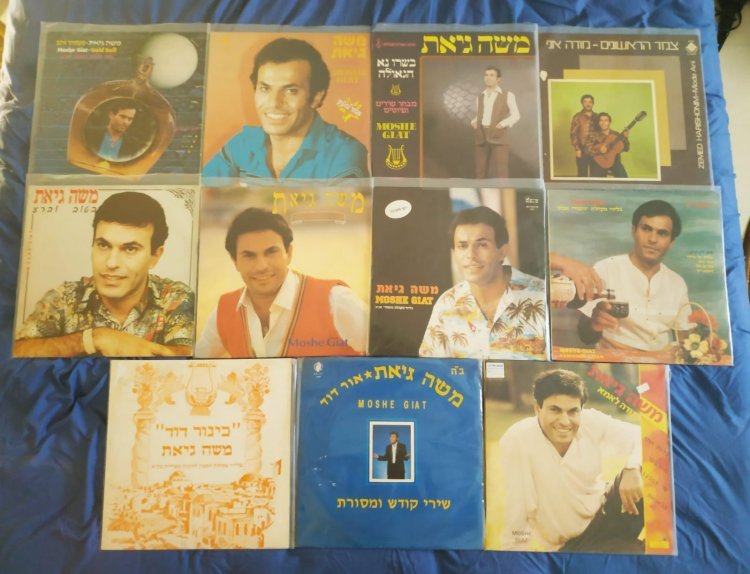 "The Cassette King" of the 1980s
On the Road to the Abyss
Giat, a young man in his twenties from the Hatikva neighborhood in Tel Aviv, broke into the Mizrahi music scene in the early 1980s. It began with the hit “Yuma Yuma,” followed by a full album of Mediterranean style songs. Very quickly, he earned the title “King of the Cassettes,” after his tapes sold more than a million copies.
“Half a million original cassettes and another half a million pirated ones,” he says with a wink.
His few initial records quickly became twenty albums, the best of which turned into major hits. He performed on the biggest stages in Israel and around the world, alongside singers with international careers whom he aspired to emulate.
“And then, in the middle of all the madness of performances, I saw how the biggest stars had no idea how to deal with fame. Some fell into gambling, others into drugs.”
Were you on your way there too?
“Today I admit that I myself was moments away from sinking into the mud. I was surrounded by fame and admiration, immersed in a world of desires and honor. At the age of forty, a miracle happened to me. Suddenly I came to my senses and ran. I was saved at the very last moment.”
Where did you disappear to?
“I ran away from a life of excess. I closed my eyes so I would stop being blinded by admiration and the media. I decided to stop performing in clubs and dark venues and to invest more in spirituality and family.”
 A special project for the children of the Gaza communities (Photo: Moshe Fadida)
What did you give up?
“I gave up everything except spirituality and family. Every person has two desires, a physical desire and a spiritual desire. I know singers who lack nothing in life, yet they are not happy. I know them personally. When they come home from a performance with a check for one hundred thousand shekels in their pocket, they sit on the couch and fall into depression. They are missing spirituality. They are missing family life. Their soul is screaming ‘I want spirituality,’ but instead it is given money as a substitute. They have money, but they have no life.”
How do you explain the fact that you managed to leave this glittering world while others did not?
“The strongest desire a person has is the desire for honor. Even when someone dies, what do people say? Let us give him his final honor. For many singers, the craving for honor does not allow them to shift toward spirituality. They cannot overcome it. They must be under the spotlight nonstop.”
 (Photo: Moshe Fadida)
Did you ever talk to them about this?
“With Zohar Argov, yes. In the mid 1980s I performed with him in Paris, and we stayed in the same hotel room. In the middle of the night we talked, and then he said to me, ‘Moshe, never touch what I touch.’ And it was not only him. Many singers fall into one thing or another. I truly tell them to stop thinking about desire and honor and start thinking about spirituality, family, and keeping Shabbat. Only that will bring them true happiness.”
When you decided to step down from mixed audience stages, did you calculate how much money you would lose?
“Yes, but I want to tell you a secret. As much as I performed in the 1980s, and I performed a lot, I saw no blessing in it. I did many foolish things and wasted all the money. After I became stronger and accepted upon myself to stop performing in clubs and mixed venues, I did perform less, but suddenly I saw blessing.”
Did you fall into gambling as well?
“Yes. After one of my performances in New York, I went to Las Vegas in the middle of the night. Instead of returning home with twenty thousand dollars, I came back with two hundred dollars. Everything was lost at the casino.”
What does that really feel like? You barely covered the plane ticket.
“You get hit hard and start doing soul searching. You are ashamed to tell your close family, even your wife. Blow after blow hits you, and there is an inner voice screaming, ‘Enough, change direction.’”
He Who Laughs Last
“You know something?” Giat adds candidly. “I sat in a yeshiva for eight months, and only afterward did I accept upon myself to stop performing in clubs and mixed venues. I told my rabbi, ‘Why didn’t you tell me from the beginning? Why did you let me wait eight months?’ He answered, ‘I wanted you to reach it on your own.’”
It took you some time to get there.
“Of course. As I told you, desire and honor take a person out of the world, so it took me time to realize that this is what I truly want, to grow spiritually.”
Giat describes the reactions he received from colleagues to the dramatic change in his life.
“When I moved to Jerusalem, everyone said to me, ‘Are you crazy? Most of the work is in central Israel, all the action is in Tel Aviv, and you are moving to live opposite the Western Wall?’ But the moment I closed a door there, many other doors opened for me here. My dream was to buy a house overlooking the Western Wall. Some people dream of Herzliya or Savyon, but I dreamed of the Wall, and thank God I fulfilled that dream. The Western Wall is the heart of every Jew. It is the source of blessing for the entire world.”
After returning to religious observance, did you ever feel a sense of loss?
“No. Today I perform all over the world, and I do not lack work in the religious and traditional sector. I perform for Jewish communities in Israel and abroad, and I never stop with the music. I organize bar mitzvah celebrations at the Western Wall for children from needy families, and in the past two years also for children from the Gaza border communities. Believe me, a child who celebrates a bar mitzvah like this will never forget it. We take them on a tour of Jerusalem, sit with them in a restaurant, throw a celebration, the main thing is that they are happy.”
There is one more thing Giat makes sure to do every day. “I have my regular morning prayer minyan at eight o’clock. Anyone who starts praying at the Western Wall gets drawn back here regularly, like by a magnet. When I see hundreds of Christians coming to the Wall, I ask them, ‘Why don’t you go to church?’ and they tell me, ‘We feel inside that the truth is here.’”
How does it feel to be at the Wall during the days of Selichot?
“Being at the Wall in the mornings is an experience, but at midnight it is an even greater experience. Thousands come to pray and recite Selichot. The human flow grows stronger as Yom Kippur approaches. Every Yom Kippur I organize a large prayer service in the Jerusalem rite, and dozens of people from Israel and around the world attend. I would never give it up.”
“Every year I receive offers to go to communities in the United States and pray with them on Yom Kippur, but I will never give up Jerusalem, and especially not the Western Wall, for any amount of money in the world. No matter how much they offer me, it will never happen.”

