

Magazine
Faithful Fishermen of Tiberias: Into the Heart of the Sea
On the shores of the Kinneret, faith and livelihood intertwine. Meet the fishermen of Tiberias and discover the powerful stories, quiet miracles, and deep faith that guide them through danger, uncertainty, and daily struggle.
- Avraham Yisrael Friedman / Yom Liyom
- | Updated

Joshua the fisherman meets my gaze with a somber, disappointed look. "Listen," he says, against the backdrop of the gently crashing waves of the Kinneret, "the past couple of days have been too stormy for safe sailing in the middle of the sea. Only the bravest fishermen are risking it out there."
At the pier, two fishermen stand, watching the sea with hopeful expressions. Joshua explains, "They're waiting for a break in the eastern winds, which are very dangerous. Some fishermen have drowned in such weather, with some remaining lost to this day, may Hashem have mercy on them."
But this isn't our only disappointment. "You see, this year fishing hasn't been fruitful. Tiberias, unlike its neighbors, has seen little rain, which causes fish to sink to the bottom, making it difficult to catch them. When there's rain, the fish rise to the surface, seeking to drink the water falling from the sky."
Joshua, donning a black kippah and armed with simple faith, shares a moral insight: "Once I heard from a great preacher, Reb Shabtai Yudelevich of blessed memory, that the Jewish people are likened to fish. Why? How much water does a fish have in the sea? Endless. Yet, when it rains, the fish rush to drink it. So too, the Jewish people, when they hear Torah teachings, even if they might be overwhelmed with knowledge, they eagerly absorb it as if they had never heard Torah before."
Catch from the Yellow Net
It's 7:30 on a Friday morning, Shabbat Eve, at the 'Fishermen's Pier' at the entrance to Tiberias. The sight of the Kinneret at this hour is captivating. The sun sends warm rays towards the lake, painting it a reddish-yellow hue. It's truly difficult to close your heart to the marvel of creation that is the Kinneret.
We call it morning, but for the fishermen we are speaking with, the day began long before anyone else awoke.
In front of us, tiny fishing boats line up in a long row. The place carries a small-town scenic style akin to the port of Jaffa, but in some ways, it's even more stunning. There's a lively noise of fishermen here.
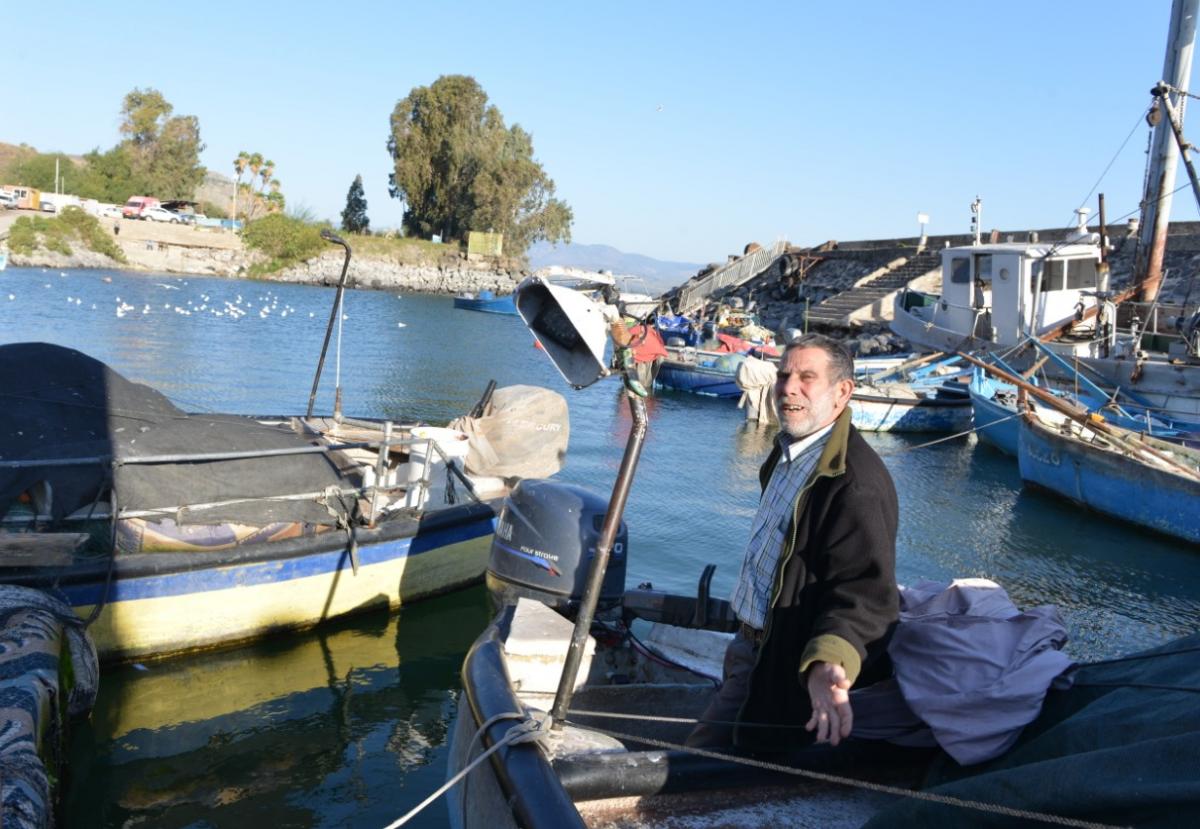 (Photo credit: Michael Khuri, Tiberias)
Michael, a local photographer, gestures toward the road. “Look,” he says. “The merchants are arriving. That man climbing uphill with the bag? Those are fish caught during the night.”
It's Shabbat Eve, and like everywhere else and there's a bustling excitement. Shabbat, "a delight to souls and spirits," is just hours away from spreading its wings over the universe.
We meet Joshua Alfasi, 59, surrounded by friends pulling tilapia from yellow nets.
“The Kinneret tilapia are famous,” he tells me proudly.
Tilapia is the most common fish here. Mullet and silver carp appear seasonally. According to Joshua, recent stocking by the Ministry of Agriculture has increased fish populations and helped support local livelihoods.
How much does it cost to buy a kilogram of fish from you?
“There is no fixed price,” he says. “It changes like the stock market. Sometimes a crate of twelve fish costs one hundred shekels, sometimes two hundred. It depends on supply and season. Today, there are vast amounts of tilapia, so a container might go for around 100 shekels."
Fishing is not an easy life. “Often I go out right after Maariv and return in the morning. You throw the net, wait two or three hours, move locations. We use radar to find the fish. And pulling in a full net requires serious strength.”
As well as strength, it must require faith to face the uncertainty of the sea.
'Indeed,' he immediately agrees. "Faith? A lot of faith. King David wrote, ‘Those who go down to the sea in ships have seen the works of Hashem.’ Every fisherman says, ‘With Hashem’s help,’ before casting the net. Without faith, no one would dare go out there.”
Joshua smiles. “I say something else too. Nun, Nun, Nun. Joshua ben Nun, three times.”
Who taught you this?
“Rabbi Shach.”
He recounts how Rabbi Shach once joined him at sea, along with other respected rabbis. He speaks of it simply, without drama, as though such moments belong naturally to the life of a fisherman.
He also describes how great rebbes often request live fish before Pesach. The fishermen carefully transport the fish alive in water filled containers. They will pay any price for this.
'The Dock Looks Neglected'
Several years ago, the state of fishing in the Kinneret sparked a heated debate in the Knesset Finance Committee, attended by Yaakov Fedida. The discussion followed a request by the Ministry of Agriculture to close fishing in the Kinneret for two years, citing a shortage of fish.
Former Minister of Agriculture Shalom Simhon acknowledged the difficulty of such a move.
“Suspending the livelihoods of 200 families is not simple,” he said. “But the Kinneret is a national symbol and must be handled with responsibility. Even at its peak, it supplied only a small portion of Israel’s fish. Our goal was to protect the lake while compensating fishermen and strengthening the industry in the long term.”
Fedida strongly rejected the ministry’s claims.
“The real problem is stocking,” he argued. “Tenders were canceled without reason, fish were not replenished, and key decisions were never implemented. For years, no mullet were stocked and several species disappeared. We were excluded from the process and left without transparency.”
He believes fishermen are being deliberately sidelined. “We feel pushed out. We are asking for partnership, not conflict.”
He points to the neglected condition of the Tiberias pier compared to well funded marinas elsewhere as further evidence of inequality. Still, despite the frustration, Fedida remains hopeful.
“Baruch Hashem, fishermen are still making a living. Fishing is improving, and we pray it continues.”
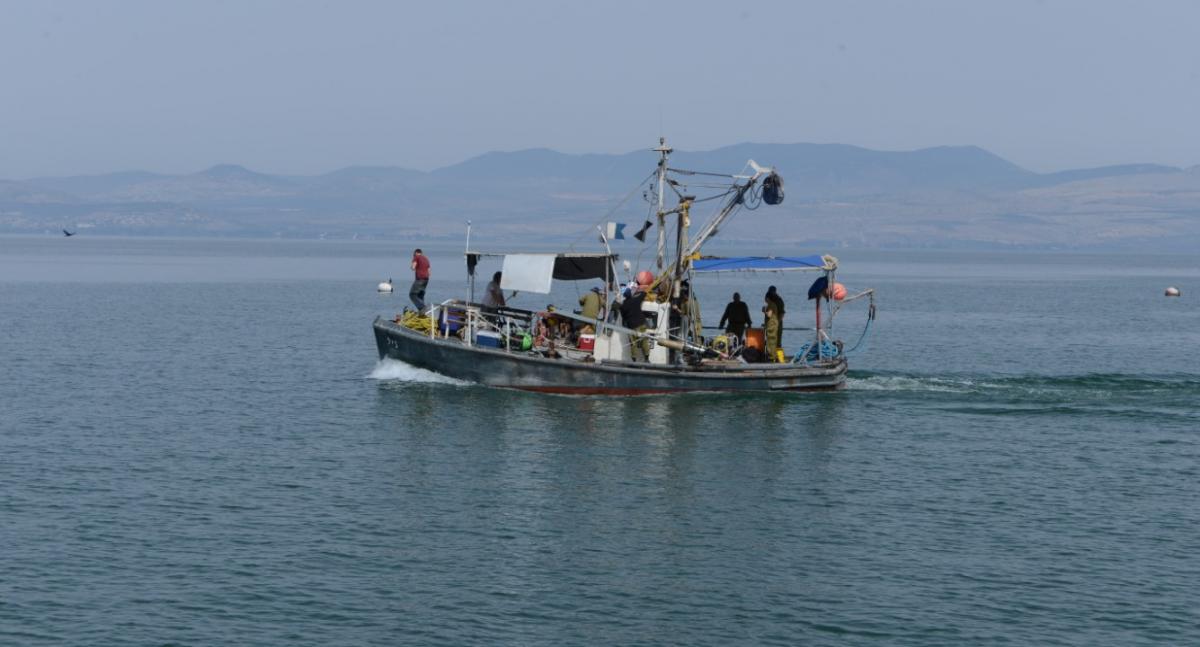
As we part, I ask Fedida to share one final story. He pauses, then recalls:
“Once, a man asked a fisherman to bring him a bottle of water from Miriam’s Well in the heart of the Kinneret for his bedridden sister. He even offered a generous sum in return. The fisherman agreed. The woman drank from the water, and within a week, she had completely recovered.”
Fish-Detecting Radar
We step onto Joshua’s fishing boat, eager to learn more about the little known craft of the traditional, God fearing fisherman.
I begin with a simple question. Why a boat? Why not fish with a rod and bait from shore?
He smiles. “Those who fish with rods and bait without a boat are usually unlicensed. They are mostly amateurs.”
Once aboard, Joshua begins explaining the tools of his trade.
“You see all these nets? Each one has a small red light that flashes at night. It warns other fishermen that a net is already here, so they do not drive over it with their motor or cross into someone else’s fishing area. Almost everyone uses them.”
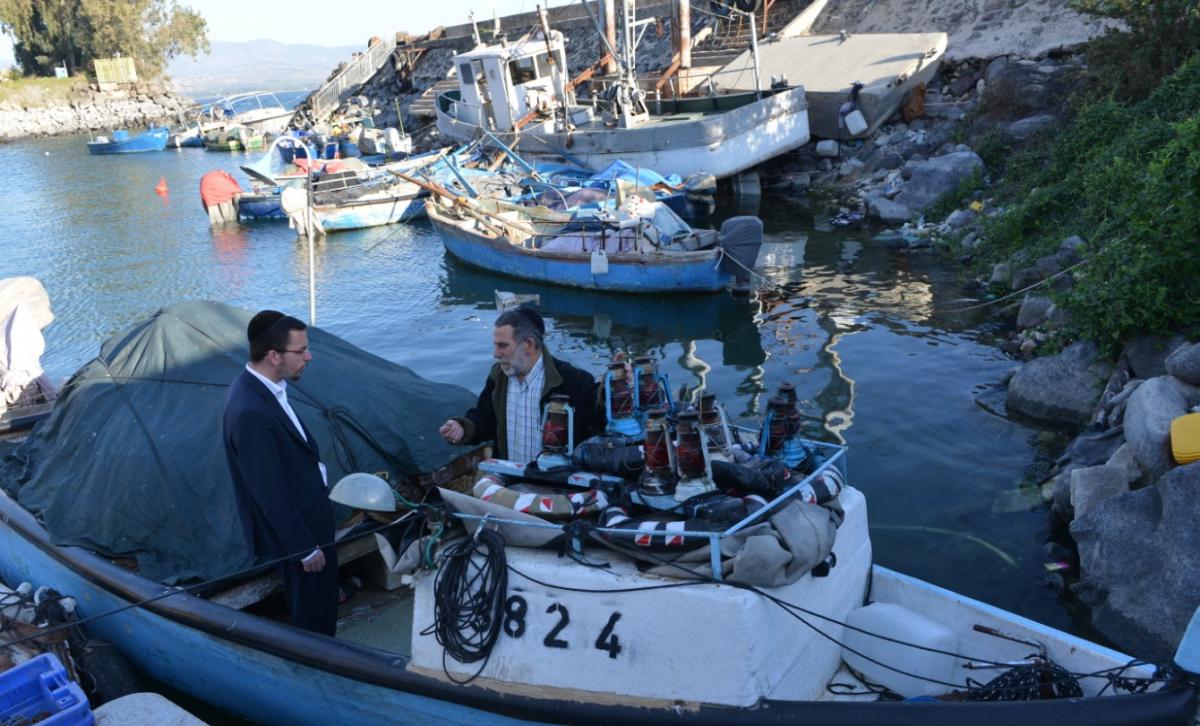
So this is a modern trade, not a relic of the past.
“Of course, Tiberias fishermen have never been wealthy,” Joshua says. “There are high maintenance costs, and not every day is a fishing day. A storm like today keeps everyone ashore. No work means no income. On good days, the earnings are better, but even a haul of four hundred kilograms of mullet happens only once every few months. Fishermen are not rich, but we are not destitute either.”
I point to the net and ask how it works.
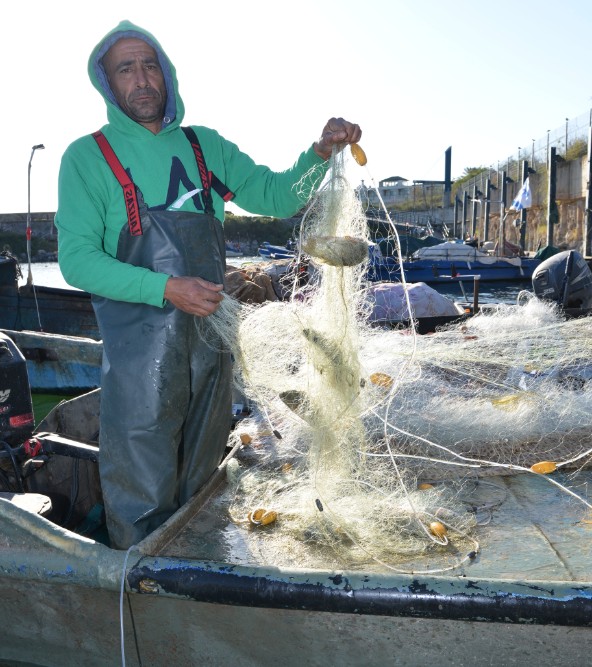
“It is designed specifically to trap fish,” he explains. “There are larger openings and smaller ones. The fish enter through the larger opening and are caught in the smaller pockets. They struggle, and the net holds them in place.”
Nets must be replaced regularly as they wear out. The boat motor, which costs about thirty five thousand shekels, also needs replacing every few years. Joshua mentions the expense quietly, with visible strain.
And does the state offer any support?
“For any income we earn, the expenses are much higher,” he says. “Licenses, insurance, permits, batteries for lighting, it all adds up. The state mostly takes, it does not give.”
He pauses, then adds softly, “Once, I found a man who had drowned, tangled in my net. That was thirty five years ago. I never forgot it.”
Shema Yisrael at Sea
“There are fishermen,” Joshua says quietly, “who returned to their roots while out on the water. They witnessed open miracles. They faced death and were suddenly saved, and that experience led them to recognize the Creator of the sea and the world.”
He speaks from personal experience.
“One night, during a violent storm, I suddenly saw a towering wall of water rising before me. It felt as though it would swallow me whole. I began shouting Shema Yisrael again and again. I was certain these were my final moments. My fellow fisherman, Yossi Mimran of blessed memory, hid among the nets and asked me to tell him when we reached shore. We fled toward Ein Gev and somehow made it back to Tiberias.”
Even seasoned fishermen were shaken by what happened.
“For weeks afterward, I could not sleep properly. The image stayed with me. It haunted my thoughts and stole my peace.”
Joshua is a traditional Jew who observes halacha carefully and loves learning. His personal journey of spiritual return began years earlier, after his daughter recovered from a serious illness against all medical expectations.
“It woke me up,” he says. “It made me search for meaning.”
Around that time, he befriended Rabbi Shalom Arush, who invited him on late night visits to the graves of the righteous in Tiberias.
“From there, everything slowly opened. Doors I never knew existed began to open, one after another.”
As we prepare to part, Joshua offers a simple blessing.
“May every fish be for the honor of Shabbat. May whoever eats them be healthy. And may we merit to see the righteous Mashiach.”
Amen.
Never underestimate the blessing of a fisherman, a man whose faith was forged in the depths of the sea.
Seven Hundred Years of Fishing
“Fishing in the Kinneret has existed for about seven hundred years,” says Joshua Alfasi, a descendant of one of Tiberias’s long rooted families, briefly trading his fisherman’s voice for that of a storyteller. “But we are really talking about two completely different eras.”
What was it like in the past?
“In earlier days, when Syrians controlled the eastern side of the Kinneret, fishermen used only small rowing boats. They never dared sail into open waters because of the danger. There were also many Arab fishermen living here in Tiberias. Today, only a few remain.
“The methods were entirely different too. There was a tool we called a makhshraka. It was an oil drum with small holes, filled with bread. When the fish swam inside, the fisherman would block the opening with his hands. Fishing was so limited that some even used poison, which was dangerous and is no longer done today. In those days we used simple nylon nets. Today, everything is more advanced. The world has changed.”
Did you know any righteous fishermen from that era?
“Yes. I remember Reb Yotam Al Qayim, a deeply G-d fearing man who kept far from wrongdoing. I also knew the Botbool family of fishermen, descendants of the holy sage Rabbi Chaim Abulafia, may his memory be a blessing. After their boat once capsized, they feared they had sailed over what tradition calls Miriam’s Well, and they made the firm decision to leave fishing entirely.”
Fish of Miriam’s Well
Every night at 3:00 a.m., Rabbi Yoav Raphaeli makes his way to the fishermen’s pier to purchase fresh fish for his shop, The Northern Lake, located on Yarkon Street in Tiberias and known locally as the Fish Market. We meet him there to hear his perspective on the Tiberian fish trade and beyond.
We find him carefully wrapping fish in newspaper for a customer who placed a special order.
“These are tilapia,” he explains kindly. “And the white fish you see here arrived this very morning, straight from the fishermen of the Kinneret.”
Raphaeli, a God fearing man, emphasizes the standards he insists on.
“We do not buy from fishermen who fish on Shabbat,” he says firmly. “And each fish is carefully checked and cleaned. Not everyone is strict about this.”
Kashrut experts point out an additional advantage of Kinneret fish. Unlike ocean fish, which can spend days in transit and may be salted together with non kosher species, Kinneret fish reach stores the same day they are caught. This eliminates certain halachic concerns and gives them a clear kashrut advantage.
Raphaeli’s shop is rooted in a five generation family tradition. He gestures to an old photograph on the wall showing his parents in the very same shop forty years ago.
Which fish are most popular today?
“Mullet, tilapia, carp, and sardines,” he answers while coordinating orders with his assistant, Amir.
He then shares a personal story.
“Once I was on a bus transporting boxes of fish, and the bus broke down in the heat. Forty kilograms of fish were at risk of spoiling. I stepped outside and spoke to Hashem from the heart. I said that Chazal teach that one who prays at sunrise is protected throughout the day. As soon as I finished praying, a taxi pulled up. The driver told me he was heading from Tiberias to Jerusalem. He immediately agreed to take all the boxes. I arrived half an hour early. It was a clear miracle.”
He smiles gently.
“One who lives with faith lives differently.”
And with that, he adds one final thought.
“Fish are very healthy. Especially on Shabbat.”

