

World News
Khamenei, Trump Trade Blame as Strike Still on the Table
“We consider the US president a criminal,” Iran’s supreme leader says, as Trump responds: “It’s time to look for new leadership in Iran”
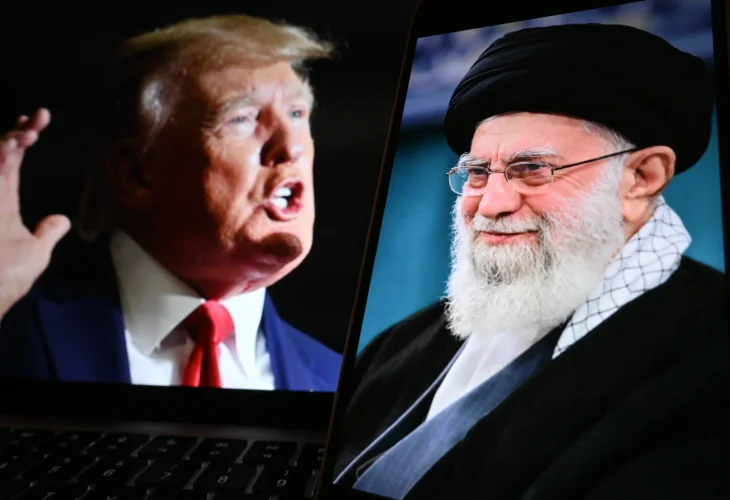 Supreme Leader Ali Khamenei and President Donald Trump (Shutterstock)
Iran’s supreme leader, Ayatollah Ali Khamenei, publicly blamed US President Donald Trump on Saturday for the unrest that has shaken the country for more than two weeks, acknowledging for the first time that thousands of Iranians were killed during the protests and accusing Washington of orchestrating the violence.
In a nationally televised address to the Iranian people, Khamenei said Trump “openly encouraged” the demonstrations and promised protesters US “military support,” calling the American president “a criminal” responsible “both for the casualties and the damage.” He described the protests, which erupted in late December as a coordinated foreign-backed “sedition.”
Khamenei framed those involved as falling into two groups: organizers “supported, funded and trained by the US and Israel,” and young people he described as “naive individuals whom the ringleaders manipulated.” He accused protesters of sabotaging mosques, educational institutions, banks, medical facilities, power infrastructure and grocery stores, and claimed they were armed with live ammunition imported from abroad, without naming countries.
Addressing the death toll, Khamenei said “several thousand” people were killed but placed responsibility on the protesters themselves. “By harming the people, they killed several thousand of them,” he said, adding that the violence followed “a pre-prepared blueprint.” He warned that authorities would not show leniency, declaring that Iran would not release “domestic offenders,” and that “international offenders” would also be pursued. “By God’s grace, the Iranian nation must break the back of the seditionists just as it broke the back of the sedition,” he said.
Despite the harsh rhetoric, Khamenei denied that Iran was seeking a wider conflict. “We do not plan, we do not take the country toward war,” he said, while insisting that “the US must be held accountable.”
Trump responded in an interview with Politico, and he called for an end to Khamenei’s rule, saying, “It’s time to look for new leadership in Iran.” He accused the Iranian leader of destroying his country and ruling through fear, not legitimacy. “Leadership is about respect, not fear and death,” Trump said, adding that Khamenei was “a sick man who should run his country properly and stop killing people.”
Trump framed recent restraint by Tehran as a result of pressure, saying “the best decision he ever made was not hanging more than 800 people two days ago.” He accused the Iranian leadership of “the complete destruction of the country and the use of violence at levels never seen before,” while stopping short of announcing military action.
Behind the scenes, US officials say the military option remains unresolved. A Washington Post report published today said President Donald Trump was close to authorizing a strike on Iran, with senior advisers expecting an imminent decision, as US naval and air assets were repositioned and allies were alerted. The move was stopped though after Trump received a message from envoy Steve Witkoff that Iran had canceled the planned executions of 800 detainees, a claim US intelligence later confirmed. Senior Pentagon officials warned that the United States did not currently have sufficient forces in the region to absorb a large-scale Iranian retaliation, particularly with major assets deployed elsewhere. Regional allies, including several Gulf states, urged Washington to hold back, warning that a strike could quickly spiral into a wider regional conflict.
On the ground, the true scale of the crackdown remains unclear. Khamenei cited “several thousand” dead. The US-based Human Rights Activists News Agency has reported just over 3,000 fatalities, with slight variation across its updates, while Iranian doctors have claimed far higher figures, saying at least 16,500 people were killed and more than 330,000 wounded. None of the numbers can be independently verified, due to an internet blackout imposed during the unrest.
Iranian officials now say the protests have been “extinguished,” and some reporting indicates demonstrations have subsided in major cities. At the same time, images circulating online purport to show security forces firing on protesters. As Washington continues its military posture in the region with additional naval, air and missile-defense assets, US officials emphasize that deployments signal readiness, and a strike is not off the table just yet.

