

Behind the News
Making Sense of the U.S. Plan for Gaza’s Next Phase
What Washington announced on Saturday, how the new governing bodies are meant to work, and what remains unclear
- Brian Racer
- | Updated
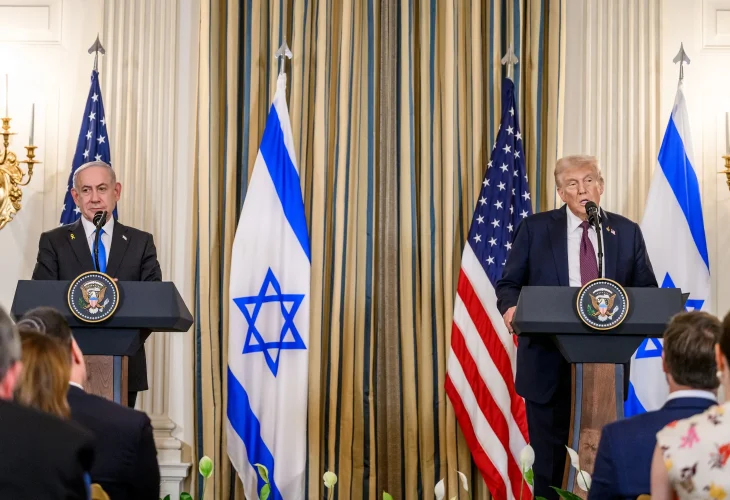 President Donald Trump and Prime Minister Benjamin Netanyahu (Shutterstock)
As questions continue to swirl around how Washington’s Gaza strategy is meant to work in practice, the Trump administration on Saturday publicly unveiled the full leadership and membership of several new bodies that will oversee Gaza under Phase Two of its postwar plan. The announcement added concrete leadership and operational detail to a framework that had previously been outlined in broad terms, bringing clarity to who is meant to govern, rebuild, and secure the enclave once Hamas rule is rolled back.
To understand what was announced, it helps to separate the framework into its different layers and bodies. Together, they operate under what the White House refers to as the Peace Council framework, a broad international initiative that combines political oversight, civilian governance, and future security arrangements. Within that framework sit four distinct but interconnected components: the Board of Peace, the Gaza Executive Board, the National Committee for the Administration of Gaza (NCAG), and the International Stabilization Force (ISF).
According to the White House, Phase Two is intended to transition Gaza away from Hamas rule toward civilian governance, large-scale reconstruction, and demilitarization of Hamas. U.S. officials describe the move as shifting the plan from conceptual planning to practical implementation, combining international oversight, Palestinian administration, and external security support.
At the top of the structure is the Board of Peace, an international body chaired by U.S. President Donald Trump. The board is intended to serve as the highest political and economic authority overseeing the transition, responsible for setting overall direction, coordinating international involvement, mobilizing funding, and ensuring accountability as Gaza moves into the next phase.
On Saturday, the administration named the Board’s founding executive leadership. Those appointed include U.S. Secretary of State Marco Rubio, U.S. envoy Steve Witkoff, presidential adviser Jared Kushner, former British prime minister Tony Blair, businessman Marc Rowan, World Bank president Ajay Banga, and U.S. Deputy National Security Advisor Robert Gabriel. Two senior advisers, Aryeh Lightstone and Josh Gruenbaum, were also appointed to manage day-to-day operations.
Alongside the Board of Peace’s executive leadership, the White House said leaders from more than 60 countries have been invited to participate in the broader Peace Council framework. These invitations are separate from the board’s executive leadership and are intended to bring national governments into the international oversight and reconstruction effort, rather than into day-to-day management roles.
Argentina’s President Javier Milei publicly confirmed that he accepted an invitation to participate. Egypt said it is reviewing an invitation for President Abdel Fattah el-Sisi, while Turkish authorities confirmed that President Recep Tayyip Erdoğan was invited by Trump to participate as a founding member. Prime Minister Mark Carney also accepted an invitation.
Below the Board of Peace, the administration announced a separate Gaza Executive Board, which is intended to translate policy decisions into action on the ground. According to the White House, the body will coordinate the implementation of reconstruction plans, support the functioning of civilian governance, and oversee the delivery of essential services, working directly with the Palestinian technocratic administration and international partners. While the administration outlined the broad responsibilities of each body, detailed authorities and operational mechanisms have not yet been publicly defined.
The Gaza Executive Board includes Turkish Foreign Minister Hakan Fidan, Qatari diplomat Ali Al-Thawadi, Egypt’s General Hassan Rashad, UAE minister Reem Al-Hashimy, Israeli-Cypriot businessman Yakir Gabay, and UN envoy Sigrid Kaag, alongside several U.S. figures who also sit on the Board of Peace.
Civilian governance inside Gaza is intended to be carried out by the National Committee for the Administration of Gaza (NCAG), a 15-member Palestinian technocratic body headed by Ali Sha’ath. The committee is tasked with restoring basic services, rebuilding civil institutions, and stabilizing daily life during the transition. It remains unclear where the committee will operate from or how authority will function on the ground during the transition.
Security under Phase Two is intended to be provided by an International Stabilization Force (ISF), which the White House said will operate alongside the civilian governance bodies. The force is meant to lead security operations, support the demilitarization of Hamas, enable the safe delivery of humanitarian aid and reconstruction materials, and help establish what officials described as a “durable terror-free environment.” On Saturday, the administration formally appointed U.S. Major General Jasper Jeffers as commander of the force.
At the same time, major operational questions remain unresolved. No country has publicly committed troops, no list of participating states or deployment timeline has been released, and rules of engagement have not been defined. It is also unclear whether the ISF would replace Israeli forces entirely, operate only in specific areas, or function alongside them during a transitional period. Several countries have been mentioned in past reporting as possible contributors, including Egypt, Indonesia, Azerbaijan, and Pakistan, while the United Arab Emirates has ruled itself out and Israel has opposed any Turkish military role in Gaza.
Although the outlines of Phase Two were introduced earlier, Saturday’s announcement marked the first time leadership, membership, and responsibilities across all governing and security bodies were presented together. With the architecture now defined, the administration says the plan has entered its implementation phase, with further details expected in the coming weeks.

