

Wonders of Creation
Do Animals Have Consciousness? What Science Reveals About the Difference Between Humans and Animals
A look at animal intelligence, instinct, and why true self awareness sets humans apart as the crown of creation
- Yosef Yabece
- | Updated
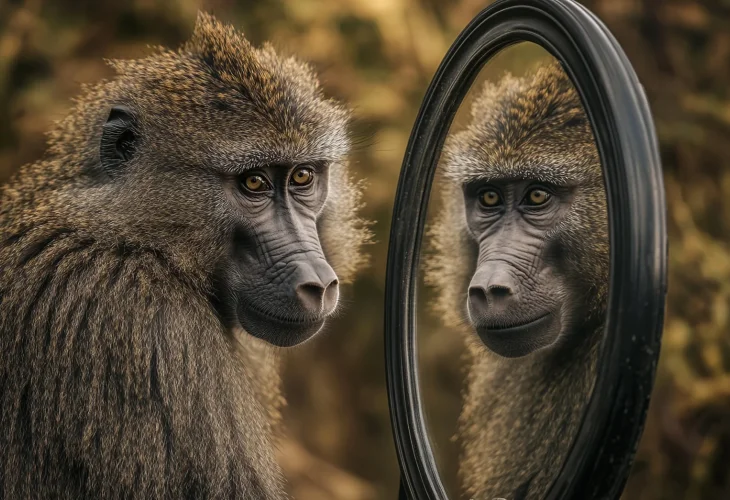
We often read about the intelligence of animals, especially monkeys. Researchers and observers describe social order among primates that resembles laws and rules. We see monkeys caring for one another and, of course, mothers devotedly protecting and nurturing their young. All of this reflects the wisdom the Creator implanted in every living being so it could survive. Even the simplest insects possess remarkable built in knowledge: how to construct their homes, how to ambush prey, and bodies perfectly adapted for these tasks.
Instinct or True Understanding
The key question is whether this behavior reflects consciousness as we understand it in human terms. Human wisdom involves grasping abstract ideas and then acting upon them. When a person builds a house, he understands what a house is, what it is meant for, and what is required. He plans and only then builds.
When an insect builds its home, however, it does not comprehend an abstract concept. It simply follows an instinct embedded within it. It is not even clear that it knows what the final outcome of its actions will be.
Why This Distinction Matters
This distinction is essential because what sets human beings apart from animals is being created in the image of God. A human is not merely a slightly smarter animal or a more advanced ape. He is a fundamentally different being, endowed with a soul capable of understanding abstract meaning.
Therefore, even when a monkey appears to act wisely, we must ask whether it truly knows what it is doing, or whether it is simply instinct driven behavior responding to immediate stimuli.
The Baboon Mirror Experiment
To explore this question, British researchers conducted a fascinating study. Dr. Alicia Carter, who published the findings in Proceedings of the Royal Society, described the research in detail.
The study involved 120 Chacma baboons living in the Tsaobis Nature Park in Namibia. Baboons are considered among the most intelligent animals and display many seemingly sophisticated behaviors. The researchers tested whether a baboon looking into a mirror could recognize that the reflection was itself. Such recognition would indicate abstract self awareness, the understanding that the individual has its own appearance and can perceive itself through a mirror.
Baboons, like many animals, show interest in their reflection. They attempt to interact with the figure in front of them and eventually realize that it is a strange, flat image. The crucial question was whether they could understand that the image was actually themselves.
Testing Self Recognition
To test this, the researchers introduced an unexpected change that would normally provoke concern for the baboon’s own body. A laser was used to project a red dot onto the baboon’s forehead, visible only through the mirror. If the baboon understood that it was seeing itself, it would be expected to panic, recoil, or try to touch its own forehead to remove the mark.
The results were clear. None of the baboons recognized the reflection as themselves. Even though the mirror precisely mimicked their movements, raising a hand or shifting position, they could not reach the abstract conclusion of “I am seeing myself.” The reflection puzzled them, but they lacked the level of self awareness needed to understand it.
Even when the red laser spot appeared on their foreheads, the baboons did not react with fear or attempt to touch themselves. They continued to play with the reflection or simply lost interest.
Instinct Without Abstract Awareness
According to Dr. Carter, these findings strongly suggest that baboons do not possess abstract self awareness. Despite behavior that appears intelligent, their actions are driven by instinct rather than conscious understanding. They lack the awareness that characterizes the human mind.
This difference highlights one of the most fundamental distinctions between humans and animals.
The Human Role in Creation
For this reason, human beings are worthy of divine command and are considered the crown of creation. Animals, no matter how intelligent they may appear, were not created for moral responsibility or spiritual growth. Their role is to serve and support the higher and more meaningful purposes of creation.
Humanity, endowed with consciousness, choice, and a soul that understands meaning, is called to something greater.

