

Wonders of Creation
The Ancient Cherry Blossom: A Timeless Marvel Science Can't Explain
From ancient cherry trees in Japan to cellular renewal, discover how trees stay strong and vibrant for centuries
- Yosef Yabece
- | Updated
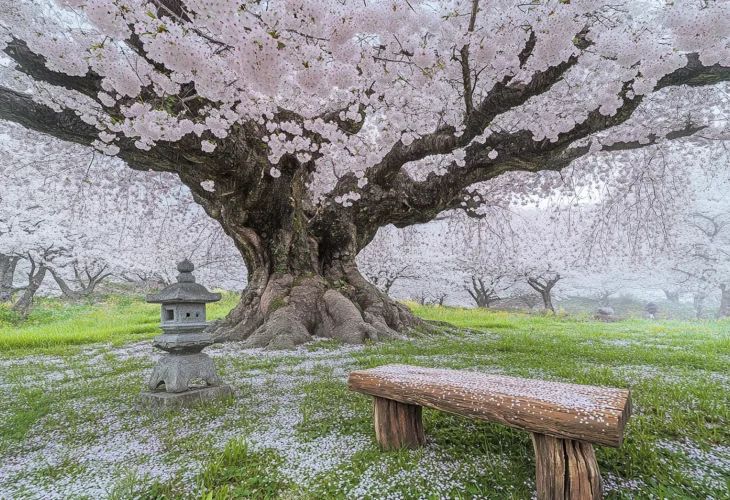
On Oshima Island, off the coast of Japan’s Honshu region, lies one of the most beautiful parks in the country. Famous for its enchanting cherry trees, the park is transformed each spring into vast pink carpets of blossoms. Every cherry tree bursts into vivid, radiant color, and the air is filled with the sweet fragrance of flowers. Yet among all these trees, one stands apart: a giant cherry tree whose expansive, patterned canopy spreads in breathtaking splendor.
A Canopy That Stops Time
The crown of this tree is covered in a rich palette of pale pinks, deep roses, and soft reds, giving it a magical and striking appearance. Each blossom resembles a small, perfect cloud, and the tree itself appears wrapped in a gentle cloak of flowers, as though every cluster could be admired as a work of art in its own right. Standing beneath it, one cannot escape the feeling that time itself has momentarily come to a standstill.
Ancient, Yet Full of Life
This cherry tree is hundreds of years old, yet it shows no sign of fatigue. Despite its advanced age, its branches remain strong and upright, and the blossoms that appear each spring look fresh and new. With its remarkable resilience and enduring vitality, the tree conveys a sense of strength and abundance that is difficult to match. Each time it blooms again, it feels as though time passes around it, while it remains steady, vibrant, and unchanged.
Rethinking Aging
When we think about aging, we usually imagine an inevitable process, part of the cycle of life in which vitality gradually weakens and the body loses its strength. It is often seen as something from which there is no escape. Yet not all living beings are forced to surrender to old age. Trees, for example, offer a powerful illustration that with a sophisticated biological mechanism, it is possible to preserve strength even at an advanced age, and sometimes to reach peak vitality later in life. While the human body loses flexibility and its capacity for growth, trees do far more than simply endure the passage of time. They continue to grow new branches, renew themselves, and reach impressive heights, even after centuries.
Why Living Creatures Age
To understand why trees do not age in the same way, it helps to examine what happens to other living beings as they grow older. Every organism, including humans, is made up of countless tiny building blocks called cells. Each cell lives and functions independently, consuming nutrients and oxygen and carrying out essential processes that allow it to survive. To grow and develop, cells divide through a process known as mitosis, in which one cell splits into two. This process is crucial for the continued functioning of the organism, but each cell has a limited number of times it can divide.
Once cells reach this limit, they can no longer continue dividing. They stop the process and enter a state known as apoptosis, a form of programmed cell death. As more cells reach this stage, the body gradually loses strength, physiological functions slow down, and the signs of aging become increasingly evident.
The Secret of Trees’ Enduring Vitality
Trees, by contrast, are not bound by this limitation. A tree does not undergo aging in the same way animals do. Each year, it produces new layers of vital tissue. The entire transport system of the tree is constantly renewed: the roots that carry water and minerals, and the branches that distribute nutrients from the leaves to the rest of the tree. These new layers do more than add structure. They ensure that the tree’s internal transport systems continue to function efficiently.
Much like the human circulatory system, in which blood vessels age over time and become less effective, the transport system in a tree also ages. The difference is that in trees, it is continuously replaced. Every new layer of wood that grows each year takes the place of the old ones. In this way, the tree remains vigorous and active, sustaining life and growth even after hundreds of years have passed.

