

In Search of God
Counting the Uncountable: What the Sages Taught About the Stars
The sages spoke of countless stars, vast systems, and hidden worlds long before telescopes existed. Discover the ancient sources that echo today’s most advanced scientific findings.
- Daniel Bals
- | Updated
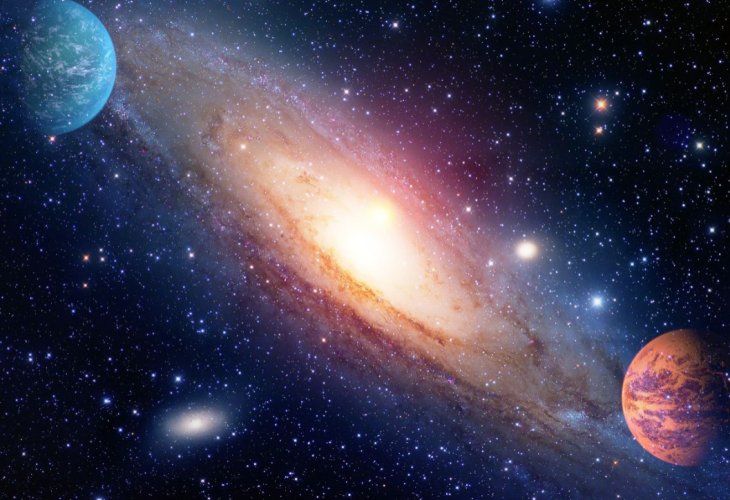 (Photo: shutterstock)
Some claim that modern astronomy has revealed a universe so vast that ancient cultures could never have imagined it. This argument is largely true when applied to the nations of the world. In ancient times, without telescopes, people could see only about 4,000 to 6,000 stars in the night sky. Yet the Torah is not a human document. It is the word of the living God, and its understanding of reality precedes that of all nations.
Stars Beyond Human Counting
From the outset, the Torah makes clear that the number of stars is beyond human counting. This is why the stars are used repeatedly as a metaphor for an immeasurable quantity. Hashem tells Abraham, “Look now toward heaven and count the stars, if you are able to count them… so shall your descendants be” (Genesis 15:5). This comparison would make little sense if it referred only to the few thousand stars visible to the naked eye.
The Torah strengthens this idea by pairing the stars with grains of sand, another symbol of countless multitude: “I will multiply your descendants as the stars of the heaven and as the sand which is on the seashore” (Genesis 22:17). Both images convey numbers that exceed any human ability to measure.
A View Beyond the Atmosphere
Rashi, quoting the Midrash, comments on the verse that Hashem “brought Abraham outside” and explains that this does not only mean outside the tent. Rather, Abraham was lifted above the atmosphere and looked down from beyond the stars. This description implies that true comprehension of the heavens requires a vantage point beyond Earth’s atmosphere, a concept that only became possible with space-based telescopes thousands of years later.
Until the modern era, humanity had no access to such a perspective. The Hubble Space Telescope, launched in 1990, revealed a universe far larger than anything previously imagined. Astronomers today estimate the number of stars in the observable universe at approximately one sextillion, written as:
1,000,000,000,000,000,000,000
or 10²¹.
Even this number is considered an estimate, since we cannot directly observe every star within distant galaxies, and some of the light we see comes from stars that no longer exist.
The Tanakh already expresses this reality. King David writes, “He counts the number of the stars; He calls them all by name” (Psalms 147:4), emphasizing that only Hashem can number them. King Solomon likewise teaches that the work of creation is beyond human comprehension: “No one can find out the work that God does from beginning to end” (Ecclesiastes 3:11).
The Wisdom of the Sages and the Structure of the Cosmos
The sages also conveyed this understanding. Regarding the Pleiades star cluster, ancient cultures believed there were only six stars because that is all the eye could see. Yet the Talmud states that there are at least one hundred stars in that cluster (Berakhot 58b), and Rashi explains that this number implies far more than what appears to the eye. This knowledge did not come from observation but from tradition.
The Talmud goes even further. In Berakhot 32b, the sages present a structured description of the stars organized in systems within systems, using terms such as constellations, legions, divisions, and groupings. When the numbers in this passage are calculated, they reach approximately:
1,064,340,000,000,000,000
or 10¹⁸ stars.
This is astonishingly close to modern astronomical estimates, especially given that this text was written long before any technology existed to suggest such magnitudes.
Some later sages noted that the opening phrase “My daughter” in this passage refers to the collective soul of Israel, numbering 600,000 at Sinai. If applied symbolically, this would raise the total even higher, exceeding current scientific estimates. Whether understood literally or conceptually, the point remains the same: the sages described a universe of overwhelming scale.
What makes this even more remarkable is not only the size of the numbers but the structure described. The Talmud does not present stars as scattered randomly but as organized within systems and sub-systems. Modern science now speaks of solar systems, star clusters, galaxies, and superclusters, reflecting a similar layered structure.
Hidden Wisdom Preserved Through Tradition
The sages also spoke of worlds that existed before ours and were destroyed, a statement found in Midrash Rabbah. Modern astronomy observes light from stars that ceased to exist long ago, meaning we are effectively witnessing remnants of earlier cosmic stages.
Because of the depth of these ideas, the sages taught that such knowledge should be transmitted only to those prepared to understand it. The Mishnah states that the secrets of creation were not taught publicly but reserved for individuals with wisdom and discernment.
In light of all this, it becomes clear that the sages were not surprised by the discoveries of modern astronomy. These findings confirmed what had already been preserved in Torah tradition: that the universe is vast beyond comprehension and that its immensity reflects the greatness of an infinite Creator.

