

History and Archaeology
The Copper Scroll: A Glimpse into the Temple's Treasures
For centuries, Jews dedicated their finest gold and silver to the Temple, creating vast treasures within its walls. But what became of these sacred riches, and where did they disappear to?
- Yosef Yabece
- | Updated
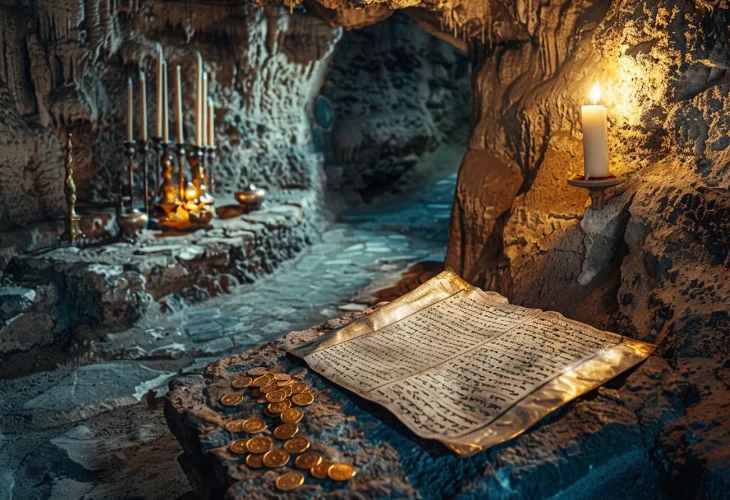
Few things spark the imagination quite like treasure. Throughout history, tales of lost riches have driven adventurers into distant and often dangerous lands. Among the most captivating of these are the treasures of the Temple in Jerusalem.
The Temple was a symbol of unimaginable wealth. Jews dedicated their finest gold and silver to it over the generations, creating a collection of treasures that became legendary. But where did all of this wealth go? Did the Romans take everything, or were some treasures hidden away, waiting for the rebuilding of the Third Temple?
For generations, Jews have hoped that not all of the Temple’s treasures were lost. Stories abound, with some suggesting that sacred artifacts such as the menorah and the curtain reached Rome and may even be stored in the Vatican vaults, awaiting their return to Jerusalem. Other traditions tell of priests who buried treasures before the Temple’s destruction, preserving them for the future.
The Enigma of the Copper Scroll
It is this mystery that leads us to the Copper Scroll. Discovered in a Qumran cave near the Dead Sea in 1952, this scroll was unlike the others. Instead of ink, it was engraved on heavy copper sheets and tightly rolled, a deliberate choice meant to preserve its contents for generations. Researchers initially struggled to open it without causing damage. Only in 1955, in a laboratory in Manchester, was the scroll carefully cut into sixty pieces. What emerged was astonishing: a list of sixty treasures describing vast amounts of gold, silver, and precious items hidden in caves, wells, and secret locations throughout Israel, treasures worth billions today.
The Copper Scroll raises many questions. Is the treasure described real? And if so, where did it come from? Some believe these are Temple treasures, and several clues support this. A later source called The Treatise of Articles, published in Amsterdam in the seventeenth century, describes priests hiding Temple treasures and mentions a copper scroll used to record their locations. The Copper Scroll also refers to a place called Tel Kokhalat, which closely resembles Ein Kahal mentioned in that source. In addition, the scroll lists sacred objects and items dedicated to the Temple, suggesting a clear connection to holy artifacts.
Centuries have passed, and the treasures remain undiscovered. Yet the Copper Scroll continues to fascinate people, not only because of the value of the gold, but because of the deeper meaning behind it.
A Different Kind of Treasure
How is this treasure different from other legendary caches that capture the imagination of cultures around the world? In many societies, treasure represents power and comfort. But for the Jewish people, the dream was never personal wealth. The hope was to use these riches to build a House not for themselves, but for Hashem.
Those sacred items, those hidden caches of gold and precious objects, were significant not because of their monetary worth, but because of their purpose. This gold was meant for holiness.
There is a fundamental difference between material wealth and sacred treasure. The Copper Scroll reminds us that physical objects, when dedicated to holiness, become part of the spiritual story of the Jewish people.
Perhaps the scroll’s deepest message is not about where the treasure lies, but about how we choose to use the gold we already have. Will we use it only for ourselves, or will we dedicate it to a higher purpose?
This is where the uniqueness of the Jewish story shines. It is not a quest for wealth, but a lifelong yearning to connect heaven and earth. Perhaps that is why the scroll was written, to remind future generations of what truly matters and what we are really striving for.

