

History and Archaeology
The Cardinal's Mission: Restoring Stolen Jewish Headstones in Poland
When stolen Jewish headstones were used as building materials in a Polish town, one Catholic cardinal chose to act. This powerful true story follows his effort to restore dignity to the deceased and confront a painful chapter of history.
- Yosef Yabece
- | Updated
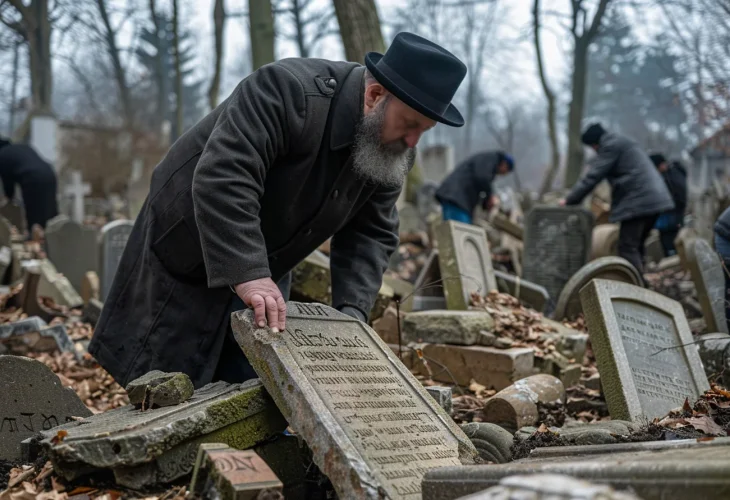
Few moments leave witnesses truly astonished. The cardinal removed his black robe, placed it over the fence, and approached the large barn. He began dismantling sections of stone, loading them up, and carrying them down the path. It was an extraordinary sight, the cardinal himself performing labor usually done by construction workers.
Just a few years ago, this unusual scene unfolded at the Jewish cemetery in Przysucha.
A Town of Deep Jewish Roots
Przysucha was home to the Holy Jew, Rabbi Yaakov Yitzchak of Przysucha, and his student Rabbi Simcha Bunim of Przysucha, making it an important Jewish center in south central Poland. Its Jewish community was established more than three hundred years ago.
The town is deeply connected to the roots of the Kotsk Hasidic dynasty, from which Gur, Alexander, and other influential Hasidic movements emerged. It was here that the ideals of self examination and the pursuit of uncompromising truth were shaped.
During World War II, the Jewish community was destroyed, leaving only a few dozen survivors. Yet the town’s ancient Jewish cemetery, the resting place of the Holy Jew, his disciple, and other esteemed rabbis, was largely preserved and continued to stand for many years.
Desecration of the Cemetery
In 1994, local residents chose to exploit the tombstones from the Jewish cemetery as easily available and inexpensive building material for construction in the town.
With the authorities turning a blind eye, the cemetery was desecrated. Tombstones were uprooted and taken to non Jewish residents’ homes, where they were used as foundations for houses, storage buildings, barns, and more.
One Professor Refuses to Look Away
Several years ago, a Polish professor from Szczecin named Radek Taczynski discovered a barn in the town whose walls were built from broken tombstones taken from the Jewish cemetery. The Hebrew letters and beautiful engravings were still clearly visible.
Professor Radek, who is married to a woman of Jewish descent whose family roots trace back to Przysucha, began to feel a deep connection to Judaism. He devoted much of his energy to preserving Jewish heritage in Poland, commemorating the Holocaust, and promoting educational initiatives that combat antisemitism among local youth.
As part of this work, he helped clean and maintain the Jewish cemetery in Przysucha. When he learned about the barn, he approached the owners and asked them to return the stones to their original resting place.
The barn owners firmly refused. They argued that removing the stones would destroy the structure, which was built entirely from the fragmented tombstones.
Professor Radek did not give up. He appealed to them again and again, and even sought help from the Biala Hasidic group, whose members visit the graves of the righteous in Przysucha. Together they tried to persuade the owners to restore the stones and correct the injustice.
Their efforts failed. The residents saw no reason to return the stones to their original purpose and refused to dismantle the barn.
When Moral Leadership Steps In
Recently, Professor Radek turned to his friend, Cardinal Grzegorz Ryś, the Archbishop of Łódź, and shared the painful situation with him.
The cardinal took the matter seriously. He recognized the moral wrongdoing and the desecration of the dignity of the deceased, and he decided to address the issue directly.
He approached the barn owners himself and asked them to correct the wrong. He assured them that he would personally cover the entire cost of removing the stones and rebuilding the barn walls to a higher standard than before.
Moved by the fact that such a senior figure in the Catholic Church had approached them personally and offered financial support, the owners agreed to return the tombstones to the Jewish cemetery.
Workers were hired to dismantle the wall and bring the stones back to the cemetery. Professor Radek invited young people to take part in the effort, allowing them to be part of repairing the injustice and strengthening historical awareness.
The most moving moment came when Cardinal Ryś himself arrived at the cemetery and joined in the physical work with his own hands. Those present felt that this act, though small, represented a meaningful step toward addressing the painful injustices inflicted on the Jewish people in Poland over the years.

