

History and Archaeology
A Vow That Led to Jerusalem: The Legacy of Hotel Kaminitz
A whispered vow beneath the chuppah led Rebbe Menachem Mendel Kaminitz to Jerusalem, where he founded a modest inn near Jaffa Gate that grew into a renowned hotel, welcoming distinguished guests such as Baron Rothschild and Herzl.
- Yosef Yabece
- | Updated
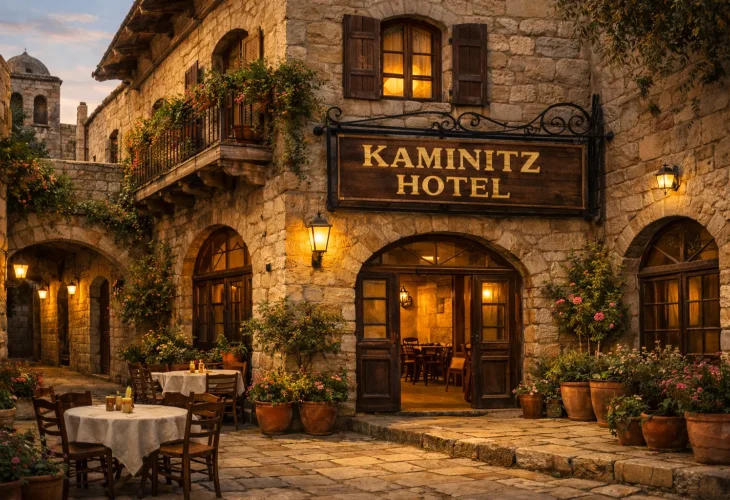
In 1817, the Jewish community in the Lithuanian town of Kaminitz near Brisk was filled with excitement. Rabbi Aaron, head of the rabbinical court, was marrying off his exceptional son Menachem Mendel to the daughter of the wealthy Reb Uri from Kenzitz. The wedding was prepared with elegance and splendor. Yet just as the groom was about to walk to the chuppah, he suddenly stopped and whispered something to his future father in law. His father in law appeared startled, and the procession paused. A murmur spread among the guests. Had the groom developed last minute doubts?
A brief discussion followed, and the wedding continued. Later, the bride’s father revealed what had happened. Menachem Mendel had insisted on receiving a promise that, at the first opportunity, the couple would move to the Land of Israel to walk upon its holy soil and pray at the graves of the righteous such as Rashbi and the Arizal. That promise was given.
A Vow That Could Not Wait
In practice, an immediate move was not possible. Menachem Mendel, who later became known as Rebbe Menachem Mendel, devoted himself to Torah study, work, and family life, yet the vow made under the chuppah remained unfulfilled. Then a cholera epidemic broke out and devastated entire communities. In the midst of fear and suffering, he remembered his promise and vowed that if he survived the illness, he would immediately move to the Land of Israel.
He recovered and began organizing a group to travel with him. By 1837, preparations were complete. Prince Dolgorukov, the regional governor, provided funds that enabled travel permits for a large group of Jews. Families set out by carriage from Kaminitz to Odessa, departing on Rosh Chodesh Nissan 1833. The journey took four weeks, during which they celebrated Pesach within Jewish communities along the way.
A Long Road to the Holy Land
From Odessa, Rebbe Menachem Mendel boarded a ship with dozens of Jews, their belongings, and two Torah scrolls. The voyage lasted several months with stops at Black Sea ports. In Elul 1833, they finally arrived in Haifa, then a small fishing village with a modest Sephardic community. Their goal was the Galilee and the graves of the righteous. An Arab messenger was sent to Safed, and after four days at an inn in Haifa, a donkey caravan arrived to transport the group and their belongings northward.
Rebbe Menachem Mendel later recorded his experiences in his book Korot HaAtzim, which he intended as a guide for future travelers. He wrote that his goal was to show others the path to the Land of Israel and to fulfill the vow he had made during the cholera epidemic. He carefully documented the entire journey so that others might follow.
A Guide for Future Travelers
The book includes practical guidance such as how to find ships, the cost of travel, how to protect belongings, and what foods to bring. He notes that the ship owner in Odessa advised passengers to purchase foods such as gelatin and macaroni so they would have provisions ready when needed.
He also describes the emotional depth of their first visit to a holy site, Elijah’s Cave on Mount Carmel. He writes that the cave still contained stone benches where the prophet’s students once sat and that people of all nations came there to pray. He describes how they immersed in the sea beforehand and then prayed with overwhelming emotion, weeping as they felt the holiness of the place in a way he had never experienced before.
Danger on the Road
After settling in Safed, Rebbe Menachem Mendel continued traveling to holy sites. His book also warns of real dangers. In one incident, while riding alone on a donkey along a mountain path, he encountered a soldier who asked about his destination. He then noticed the soldier loading his rifle, realizing that he intended to shoot him from behind and rob him. Refusing to submit to fear, Rebbe Menachem Mendel turned and declared that he was a poor man traveling to pray, with nothing of value. He emptied his bundle, revealing only a prayer book, Tehillim, a tallit, and a few fruits. Seeing there was nothing to steal, the soldier hesitated. To ensure his safety, Menachem Mendel promised to obtain money later and even gave the soldier his headscarf. In this way, he survived this and many other dangers.
Building a Legacy in Jerusalem
After the earthquake in Safed and the peasant revolt, Rebbe Menachem Mendel moved in 1842 to Jerusalem. There he established an Inn for Guests near the Tower of David by Jaffa Gate. The site included a small hotel and bakery that provided free meals and lodging to Torah scholars. The bakery became famous for the quality of its bread, baked by Rebbetzin Zipporah Kaminitz. Mrs. James Finn, wife of the British consul, wrote in her diary that true European bread could only be found at Kaminitz.
The hotel later expanded and relocated to Hebron Street in the Old City. It hosted prominent figures such as Baron Rothschild and Herzl. Menachem Mendel and Zipporah Kaminitz had fourteen children. Sadly, one son converted to Islam and later became the British consul in Jeddah. Rebbe Menachem Mendel passed away peacefully in old age. His wife and son Eleazar continued to operate the hotel, and additional branches of the well known Hotel Kaminitz were eventually established throughout the land.

