

History and Archaeology
Unearthing History: 2,000-Year-Old Burial Caves Discovered
What was almost lost forever? The discovery of 2,000-year-old burial caves and decorated ossuaries sheds light on ancient Jewish presence while exposing the devastating damage caused by looting.
- Naama Green
- | Updated
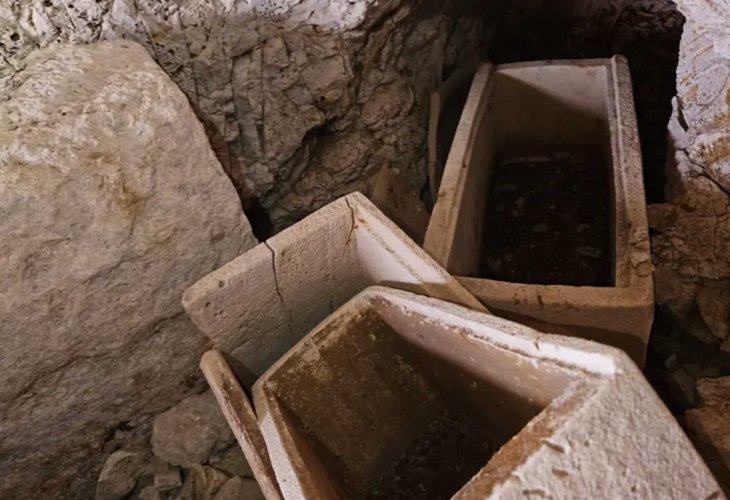 The burial coffins found in the cave in Mosheh (Photo: Nir Distelfeld, Antiquities Authority)
A joint operation by the Israel Police in Kfar Kana and the Antiquities Authority anti-looting unit revealed a surprising discovery from the time of the Bar Kokhba revolt. As part of intelligence activity, police officers from the Kfar Kana station and inspectors from the Antiquities Authority arrived at a private plot in the Mosheh region. To their astonishment, they found extensive infrastructure work underway with heavy engineering tools, which had already caused the complete destruction of an ancient burial cave that once stood there. Only a single burial niche remained from the original cave.
Inspectors from the Antiquities Authority anti-looting unit noticed several piles of earth on the site that appeared to conceal something behind them. The landowner and the construction site supervisor were asked to remove the piles, revealing another ancient burial cave hewn into the rock, containing nine burial niches.
Rare Ossuaries Raise Immediate Suspicion
The inspectors were surprised to find three decorated stone ossuaries at the entrance to the cave, which were used in ancient times to collect human bones. The ossuaries were empty and no longer in their original position, raising immediate suspicion that recent looting had taken place. Construction work was halted, and several suspects were summoned for questioning on suspicion of damaging antiquities and failing to report the discovery of ancient artifacts. At the same time, Antiquities Authority inspectors documented the site and removed the findings, out of concern that the artifacts might otherwise be stolen.
Expert Analysis of the Findings
Dr. Eitan Klein, deputy director of the anti-looting unit at the Antiquities Authority, explained that the ossuaries are made of soft limestone, rectangular in shape, and have flat lids designed to fit the coffin. The decorated coffins were used by the Jewish population in the Galilee during the second and third centuries CE. They are adorned with designs characteristic of Jewish burial traditions, influenced by Greek culture. On one coffin appears a design resembling a burial structure such as a mausoleum, and on the other side a circular wreath is carved, with drilled holes inside that apparently symbolize the victory of the deceased over death. These motifs are typical of stone ossuaries used by the Jewish population in the Galilee during the mid Roman period. Similar decorations have been found on ossuaries discovered at the Tzipori site.
Klein added that archaeological research in the Land of Israel recognizes stone ossuaries as an exclusive feature of Jewish burial practices from the end of the Second Temple period, mainly from the first century BCE until the Bar Kokhba revolt in the second century CE. This practice was widespread in the Jerusalem region and the Judean lowlands, where most ossuaries were produced in workshops operating in those areas. After the failure of the Bar Kokhba revolt and the migration of Jewish populations from Judea to the Galilee, the use of ossuaries became common there as well. Therefore, the discovery of decorated stone ossuaries in a cave in the village of Mosheh points to the existence of a Jewish settlement in the area during the second and third centuries CE.
Severe Damage to Irreplaceable Heritage
Amir Ganor, director of the anti-looting unit at the Antiquities Authority, stated that there is suspicion of severe damage to antiquities in this case. According to him, the excavators completely destroyed one ancient burial cave and were, it is suspected, in the process of looting another. He emphasized that we will never know how the destroyed cave looked or what was inside it. Cultural assets nearly two thousand years old have been lost forever. Thanks to the vigilance and determined action of the police officers from the Kfar Kana station and their cooperation with the Antiquities Authority, one of the caves was saved. Thanks to the discoveries found on site, it is still possible to preserve at least part of the archaeological and historical information about the location and the ancient settlement.
A Call to Protect Israel’s Antiquities
Eli Eskuzido, director of the Antiquities Authority, noted that Israel contains about thirty five thousand antiquities sites, each one a world unto itself, preserving thousands of years of human history. He explained that the destruction of the cave in the north caused irreversible damage and called on the public to remain vigilant and to report any suspicious excavation, quarrying, or construction activity in areas where antiquities may be at risk. In doing so, he said, the public can serve as the eyes on the ground. Together, it is possible to protect this national resource, the treasures of the heritage of the Land of Israel.

