

History and Archaeology
The Untold Story Behind the Lock of Rachel’s Tomb
A copper lock, a hidden inscription, and a key passed through generations tell a story few know. From Montefiore’s protection of the site to the devoted figures who guarded it, this article reveals the untold story behind the lock of Rachel’s Tomb.
- Yosef Yabece
- | Updated
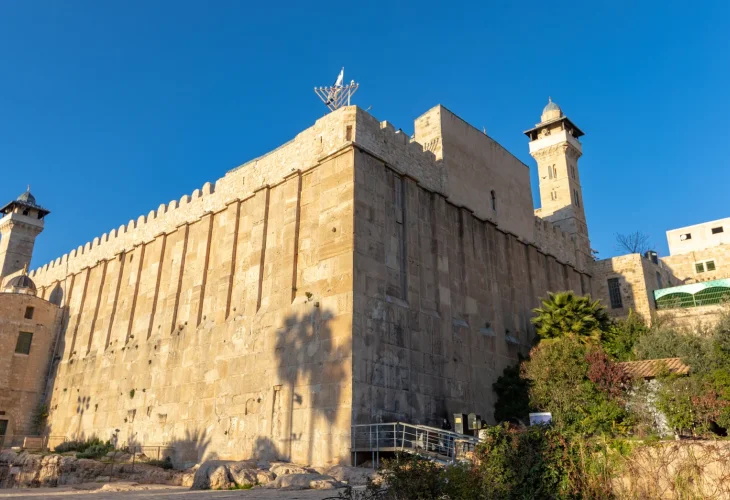 (Photo: shutterstock)
When we visit the Tomb of Rachel today, enclosed within a massive concrete structure, we can still see the original door of the small building that was, until twenty years ago, the actual Tomb of Rachel. This door is fitted with a large copper lock, guarding many secrets within.
Rachel’s Tomb stands on the main road from Jerusalem to Hebron. Until two generations ago, this road was desolate and empty. Photographs from that period show wasteland in every direction, with a lone olive tree beside the tomb. The site was sacred to both Jews and Muslims. The traveler Shlomo of Volterra, who visited the Land of Israel in 1481, describes the structure and the custom of praying there: “And there on the main road, we found on Rachel’s grave a high monument made of stones, and the Ishmaelites erected above the burial four columns and a dome above and honor it. Jews and Ishmaelites pray there.”
From Reverence to Restriction
As Jewish settlement in the land grew, however, hostility increased. Muslims began to restrict Jewish access to the site. Rabbi David of Beit Hillel, who visited in 1824, wrote that “opposite the mountain is a village whose inhabitants are Arabs, and they are very wicked. A stranger who came to visit Rachel’s Tomb was robbed by them.”
Moses Montefiore visited the site shortly afterward and saw the ancient structure, which bore “tens of thousands of names” carved upon it, the signatures of Jews who had come to pray there. Yehudit Montefiore recounts, “We came to Rachel’s gravesite and wrote our names among thousands upon thousands of names of our ancestors, and we prayed there at the tomb.”
After this visit, Montefiore resolved to build a protective square structure around the tomb so that Jews could remain there safely. A permit was later obtained to dig a water cistern for pilgrims. Jews would travel to the site and stay for several days at certain times of the year, especially in the month of Cheshvan, the time of Rachel’s passing. Some journeyed from as far as the Galilee to spend the first days of Elul at the tomb, along with other longstanding customs.
The Man Behind the Lock
For the new structure, Montefiore commissioned a special lock. It was crafted by a remarkable Jerusalem figure named Eliyahu Shlomo Zalman Baasan, originally from Vilna. Baasan had settled in Safed with his family, but during the devastating earthquake of 1837, they were trapped beneath the rubble. After more than two days, rescuers saw a hand emerging from the debris and saved him, but his wife and children perished. He later moved alone to Jerusalem.
Baasan was known as both a genius and a man of courage. He helped design the foundations of the Churva synagogue. When residents of Mishkenot Shaananim were plagued by wolves and jackals, he built a special trap that captured the animals. During the rule of Ibrahim Pasha, when the Shiloach spring mysteriously stopped flowing, Baasan investigated, found the blockage, and restored the water. From then on, he was respected even by Muslim leaders. The mufti once requested that he repair structures on the Temple Mount, but Baasan declined on religious grounds, and his refusal was accepted.
The lock he designed for Rachel’s Tomb was unique. It required special technical movements to open, meaning that even if a stranger obtained the key, they would not be able to unlock the door. This offered real protection to Jewish visitors. The key was entrusted to the caretaker of the tomb.
In 2003, researcher Ze’ev Ehrlich of blessed memory, who was killed recently in Lebanon by terrorist fire, dismantled the lock and discovered a hidden inscription inside, signed by Baasan with the words “to our Mother Rachel.”
The Key That Became a Segulah
The key itself was a heavy metal key about twenty five centimeters long. It was first entrusted to Abraham Leib Monzon, and later passed to his son Shimon Monzon, who served as caretaker of both Rachel’s Tomb and the Churva synagogue. During the British Mandate, the key was held by his great grandson, Rabbi Shlomo Eliyahu Freeman.
After the establishment of the state, Rabbi Shlomo lived in the Katamon neighborhood. At that time, Rachel’s Tomb was not under Jewish control, yet the key was regarded as a segulah for childbirth. Women struggling in labor would send urgent messengers to the Freeman family to borrow the key and place it beneath their pillow. The demand became so great that the street where Rabbi Shlomo lived was nicknamed “Mother Rachel's Street,” a name it still bears today.
Struggles Over the Tomb
In 1995, Prime Minister Yitzhak Rabin sought to transfer control of Rachel’s Tomb to Muslim authorities as part of the Oslo process. With great effort, rabbis and spiritual leaders explained to him the deep significance of the site for the Jewish people.
Only in 2010 did Prime Minister Benjamin Netanyahu declare Rachel’s Tomb a National Heritage Site. Even then, the decision faced international opposition. A UNESCO committee declared the site to be “the Mosque of Bilal ibn Rabah” and demanded the removal of the protective fortifications that had been built in 2003 during the second intifada.
The Lock That Still Guards the Secret
Today, we are privileged to visit Rachel’s Tomb freely. The original room built by Montefiore is now far too small to hold the crowds of visitors. Large concrete walls have been erected for protection, and above all, the merit of Mother Rachel continues to guard those who come to pray.
Yet the special lock still stands at the entrance to the original tomb. The key is now held by Rabbi Gadi Freeman, the son of Rabbi Shlomo.

