

History and Archaeology
From Power to Ruin: How Herod Took Control of Jerusalem
Betrayal, Roman power, and ruthless ambition sealed Jerusalem’s fate. This article follows the fall of the Hasmoneans and Herod’s calculated rise to power.
- Yosef Yabece
- | Updated
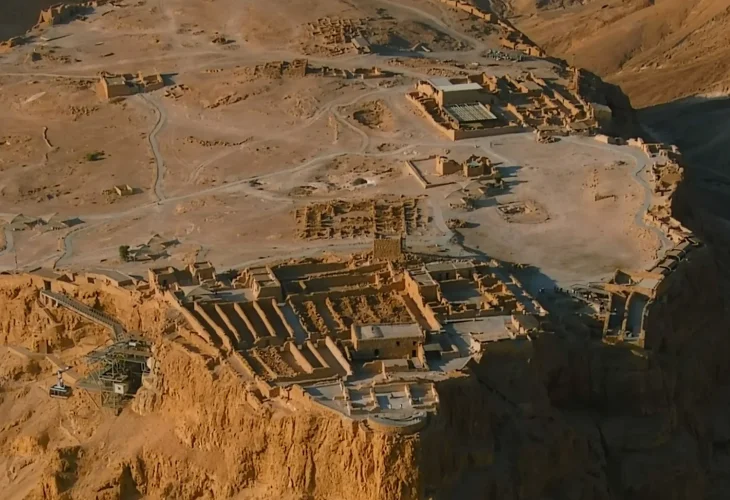 Masada (Photo: shutterstock)
In 43 BCE, 113 years before the destruction of the Second Temple, High Priest Hyrcanus changed course. He became disillusioned with his longtime ally Antipater, distanced himself from him, and appointed new advisers, including some Gentiles. One of these advisers, Malichus, sought to eliminate Antipater entirely, fearing he might again influence the indecisive ruler. He ultimately poisoned him.
Around the same time, Julius Caesar was assassinated in Rome, throwing the empire into turmoil. The Parthians, Rome’s eastern rivals, advanced westward, and the family of Aristobulus, brother of Hyrcanus, saw an opportunity to revolt. The final surviving son now stepped forward: Mattathias Antigonus, son of Aristobulus and grandson of King Yannai. He aligned himself with the rising Parthian power and in 40 BCE, 110 years before the destruction, declared himself King of Judea. Together with the Parthians, he launched a campaign against the sons of Antipater.
Herod managed to escape, though not before hiding his family in the fortress of Masada. His brother Phasael was captured by the Parthians and took his own life before they could torture him. Hyrcanus was deposed, exiled to Babylon, and his ears were cut off, rendering him unfit for service in the Temple.
The Last Hasmonean King
Mattathias Antigonus ruled Judea for three years. If he can truly be called a king, then he was the last Jewish ruler to reign in Jerusalem since the days of King David. He minted coins bearing the images of the menorah and the table of showbread, inscribed with the words “Mattathias the King and the Jews.” Through this, he expressed confidence in the Sanhedrin, with Yohanan the High Priest at the beginning of his reign.
In 37 BCE, Herod aligned himself with the Roman governor of the east, Marcus Antonius, and together they launched a campaign to restore power to Herod.
Herod’s Rise Through Force
Herod was with his family in Masada while Antigonus besieged the fortress. Once again, Herod escaped and joined forces with a Roman legion, advancing on Jerusalem. Antigonus appealed to the Roman general Silo, arguing that the Romans should not appoint a Gentile Edomite to rule Jerusalem when descendants of the Hasmonean dynasty were still alive. The Romans refused to listen. Antigonus fought back with arrows until they were forced to retreat.
Meanwhile, Herod and the Romans waged war throughout the land. When Herod learned that rebels were hiding in the fortress on the Arbel Cliff above the Sea of Galilee, he led his army there. The fortress was hundreds of meters above the ground, accessible only by dangerous ladders. Any soldier who attempted to climb was immediately killed or pushed to his death. Herod devised a brutal tactic: he constructed open-fronted crates, lowered them from the top of the cliff, and surprised the rebels by dropping soldiers directly onto them. In this way, he succeeded in killing them all.
Yet Antigonus still controlled Jerusalem and Jericho. While Herod traveled to Rome to secure support, Antigonus struck Herod’s forces near Jericho, catching them unprepared. He inflicted a temporary defeat and killed Joseph, Herod’s brother. However, the victory was short-lived.
Execution and a Possible Tomb
Herod returned from Rome with the renowned Roman general Gaius Sosius. Antigonus’s army collapsed, and Antigonus himself was captured. Fearing that the Roman Senate might accept Antigonus’s claim to the throne as a legitimate Hasmonean heir, Herod pressed for his immediate execution. Marcus Antonius ultimately ordered his beheading.
About fifty years ago, a burial cave was discovered at Givat Hamivtar in Jerusalem, known as Avah Cave. Inside was a stone coffin containing a decapitated body, bearing the inscription “Mattathias son of Judah.” Some believe this may be the burial place of the last King of Judea. Herod also ensured that Malichus, who had poisoned his father Antipater, was executed.
A Kingdom Reduced to Shadows
Herod now ruled Jerusalem with absolute power. Yet he understood the people’s attachment to the Hasmonean dynasty. To gain their trust, he brought Hyrcanus son of Yannai back to Jerusalem, creating the illusion that a Jewish leader still held influence. In reality, the elderly Hyrcanus was merely a puppet.
What remained of the once-mighty Hasmonean kingdom? As noted in earlier chapters, the two sons of King Yannai and Queen Salome, Hyrcanus and Aristobulus, had become in-laws. Aristobulus’s son Alexander married Hyrcanus’s daughter Alexandra. All other descendants had perished. From this union were born two children: Aristobulus and Mariam, known as Miriam. Their father Alexander was killed during battles involving Herod.
Only four members of the Hasmonean house remained alive: Hyrcanus son of Yannai, now nearly eighty, his daughter Alexandra, his grandson Aristobulus, and his granddaughter Miriam.
Thus, Herod ruled Jerusalem under the lingering shadow of the last remnants of the Hasmonean dynasty.

