

History and Archaeology
The Lost Treasure: Where is the Temple Menorah?
Stolen, lost, and shrouded in legend, the Temple menorah remains one of Judaism’s greatest mysteries. Where is it today?
- Yosef Yabece
- | Updated
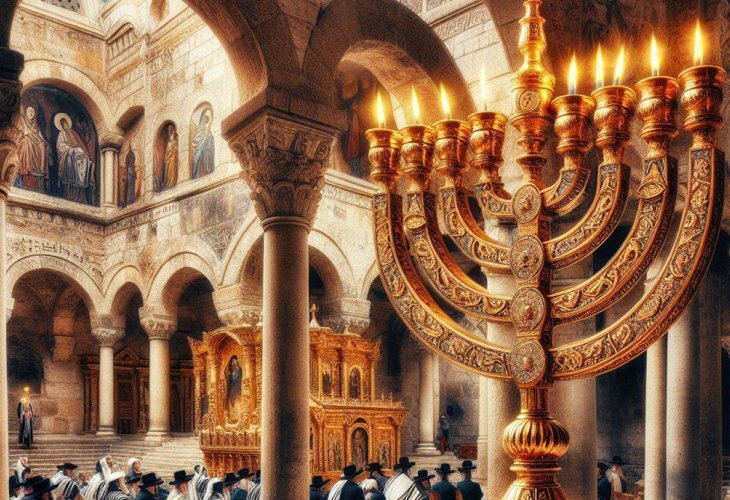
The golden menorah crafted by the returnees from Babylon was stolen by the wicked Antiochus. When the Hasmoneans entered the Temple, they found no menorah and lacked the gold to make a new one. They therefore assembled a menorah from seven lead pipes. According to halacha, when gold is unavailable, a menorah may be fashioned from any material. It was with this simple menorah that the famous miracle of the oil occurred, when a single flask of oil lasted for eight days.
As the Hasmoneans later grew wealthy and powerful, they commissioned a magnificent golden menorah, three cubits tall, fashioned from a single piece and adorned with flowers, knobs, and cups, exactly as described in the Torah. This menorah became one of the most powerful symbols of the Temple and the Jewish people. The sages taught, “One who wishes to become wise should turn south,” toward the menorah in the Temple. From the days of the Temple until today, the menorah has appeared on coins, artifacts, tombstones, and Jewish symbols across the world.
So where is the menorah now?
From Jerusalem to Rome
Titus, the Roman general who destroyed the Second Temple, famously carried the menorah with him in his triumphal procession. A carving of the menorah can still be seen today on the Arch of Titus in Rome. There, along with other Temple vessels, it was displayed in a special hall known as the Temple of Peace.
Our sages, the Tannaim, testified that they saw the Temple vessels in Rome and even examined them to resolve halachic questions, such as how the Name of Hashem appeared on the High Priest’s crown.
Wars, Chaos, and Disappearance
In the fifth century CE, various tribes from the Germanic regions attacked Rome repeatedly and plundered its treasures. In 410 CE, the Visigoths led by King Alaric I sacked the city. While we know much about the course of their raid, it is unclear whether the menorah was taken at that time. After an earthquake damaged the area of the Temple of Peace, it is possible that the Temple vessels had already been moved elsewhere in Rome.
The later destruction of Rome by the Vandals and the Huns fueled the imagination of many Jews who longed to recover the menorah, the symbol of Israel’s glory.
Legends and Theories
One legend claims the menorah was buried with King Alaric I. Others suggest this story was deliberately spread by the Visigoths to divert attention and end the search. A similar idea lies behind the claim that the menorah was thrown into the Tiber River during battle, a story that seems unlikely, as who would casually discard such a priceless treasure?
Medieval writers often claimed that the Vandals took the menorah to Carthage, in modern Tunisia. When the Byzantines later conquered Carthage, the menorah allegedly came into the possession of the Byzantine Empire.
According to tradition, Emperor Justinian dreamed that as long as he misused the sacred menorah of the Jews, his empire would remain in danger. He therefore sent it back toward Jerusalem. There, the menorah is said to have disappeared during a sudden battle against the Persians.
The Hidden Menorah
Another Jewish legend offers a different ending. It tells that Justinian discovered a crack in the base of the menorah and hesitated to send it damaged. He summoned a Jewish goldsmith and ordered him to repair it, binding him by oath to secrecy. The goldsmith confided in the local rabbi, who devised a bold plan. The community would donate gold so the craftsman could create a perfect replica. The replica would be sent to the emperor, while the authentic menorah would remain in Jewish hands.
So it was done. The replica was delivered to Justinian, and the true menorah stayed with the goldsmith. Fearing he could not safeguard it for long, he was instructed by the rabbi to journey to the Land of Israel, reciting special prayers until Heaven would reveal to him where it should be hidden.
When he arrived in Jaffa, he hired a camel, loaded the heavy bundle, and set out. The camel walked steadily until reaching the region of Hebron, where it suddenly knelt and refused to move. Understanding this as a sign, the goldsmith dug a deep pit and buried the menorah there. He planted a wooden marker, intending to pass the secret to his descendants so it could be revealed in the time of redemption.
But at that moment, a powerful sandstorm erupted. Forced to flee, he lost his bearings. When the storm passed, the camel, the marker, and the entire landscape were unrecognizable. He wandered through the night until reaching a Bedouin encampment and eventually returned to Jaffa, where he told the rabbi, “I have fulfilled my mission. The menorah is now in safe hands, in the hands of Hashem.”

