

World News
Tucker Carlson Argues Nuclear Iran Could Stabilize Middle East
In a newsletter published yesterday, Carlson likens Iran’s nuclear ambitions to North Korea and challenges decades of U.S. and Israeli warnings
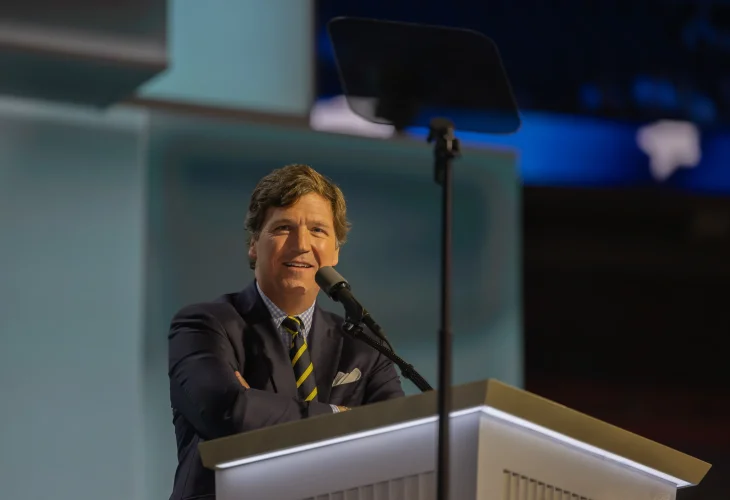 Tucker Carlson (Shutterstock)
Far-right conservative commentator Tucker Carlson sparked controversy yesterday after publishing a newsletter questioning whether Iran’s acquisition of nuclear weapons would necessarily destabilize the Middle East. In the piece, Carlson argues that fears surrounding Iran’s nuclear ambitions have been overstated and suggests that nuclear deterrence could, in fact, produce regional stability.
Carlson’s argument directly challenges long-standing U.S. and Israeli security assessments that view a nuclear-armed Iran as an existential threat. He frames his position as a critique of what he describes as decades of “alarmist rhetoric,” arguing that nuclear weapons have historically constrained state behavior rather than encouraged aggression.
To support his case, Carlson pointed to North Korea. He writes, “Those warnings sound pretty scary, but the past 20 years have proven them unwarranted. North Korea became a known nuclear nation in October 2006, and its proliferation has yielded a total of zero nuclear strikes on America, the West, or any other country.” According to Carlson, North Korea’s nuclear weapons ultimately deterred conflict and helped keep the Korean Peninsula stable.
He went further, arguing that North Korea’s acquisition of nuclear weapons coincided with a period of relative regional calm. “The region has seen no wars, coups, or interventionist-forced regime changes since 2006,” Carlson writes, presenting this as evidence that nuclear deterrence restrains conflict.
Carlson then applied this logic to Iran. “Could the Iranians obtaining The Bomb wind up being a good thing?” he asks. He suggested that, as with North Korea, a nuclear Iran could deter foreign intervention and reduce the likelihood of large-scale war. “Would Iran becoming a nuclear power have the same effect on its region?” Carlson continued, raising the possibility that nuclear deterrence could alter regional dynamics.
In outlining the potential consequences, Carlson argued that a nuclear-armed Iran could lead the United States to scale back its military presence in the Middle East. He also suggested it could pressure Israel to abandon what he described as its goals in Gaza and the West Bank.As part of this argument, Carlson used sharp language about Prime Minister Benjamin Netanyahu, referring to him as the “warmonger-in-chief” and portraying him as a leading advocate of military confrontation with Iran.
The newsletter explicitly rejected warnings from senior political and intelligence figures. Carlson quotes Sen. Lindsey Graham, who has said, “I can guarantee you that if the Ayatollah gets a nuclear weapon, he will use it. I believe that with all my heart and soul.” Carlson also cited former U.S. intelligence chief James Clapper, who warned that Iranian leaders might be more willing to conduct attacks against the United States, dismissing these assessments as exaggerated.
He further disputed comparisons between Iran and Nazi Germany, citing Netanyahu’s past warnings that Iran would seek nuclear weapons and then “start a world war.” Carlson argued that no state labeled part of the so-called “Axis of Evil” has ever deployed nuclear weapons, writing that doing so would amount to “an act of suicide.”
Beyond official warnings, Carlson’s argument has also faced broader criticism from commentators who argue that Iran is fundamentally different from North Korea. Critics point to Iran’s internal repression, including its violent suppression of domestic protests, as well as its extensive network of regional proxies. Others liken Carlson’s logic to arming an already volatile regime, warning that nuclear weapons would embolden Tehran rather than restrain it.
The newsletter prompted a political response from Sen. Ted Cruz, who wrote on X, “Unbelievable. Now Tucker Carlson is arguing it would be ‘a GOOD thing’ if the Ayatollah had a nuclear weapon.”
Carlson has not publicly responded to the criticism of this report.

