

History and Archaeology
What Mark Twain Saw: His Remarkable Journey to the Holy Land
In 1867, a world famous author set out to explore the Holy Land. What he encountered was not what he expected. Mark Twain’s observations still resonate with striking relevance today.
- Yosef Yabece
- | Updated
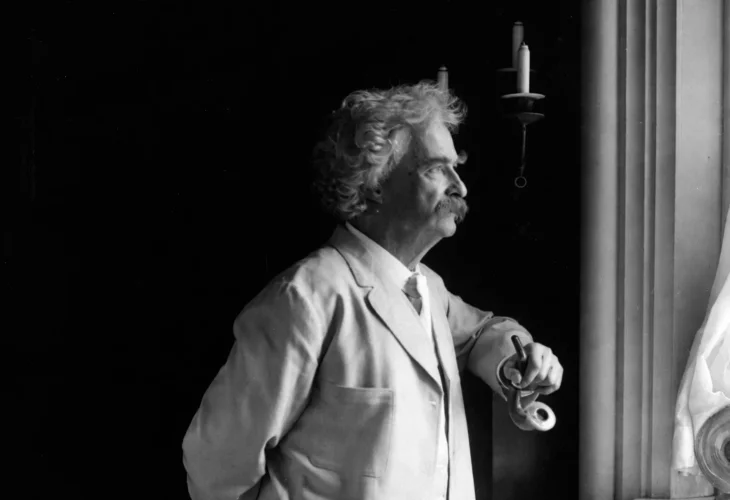 Mark Twain (Photo: shutterstock)
“As we entered the village of Migdal, it appeared deserted, with not a soul in sight. Suddenly, to the sound of our horses' hooves, dozens of heads peeked out from behind the huts, and in an instant they rushed toward us, shouting and crying. What do they want? Baksheesh! Hwaij! Baksheesh! they all screamed together, children showing us their wounds and adults displaying their scars and disabilities. I had never encountered such a storm before.”
This is how the famous American author Mark Twain described one of the most striking experiences of his journey to the Holy Land. The writer of The Adventures of Tom Sawyer, The Prince and the Pauper, and other works that earned him worldwide fame traveled to the land of the Bible to see for himself the places where the great biblical events had unfolded. In 1867, he boarded the ship Quaker City with a group of English pilgrims.
The travels of Western gentlemen through a land that was, on the one hand, desolate, and on the other, inhabited by primitive Bedouin tribes, led to many unusual and sometimes humorous encounters, which Twain recorded with his characteristic wit.
Witness to Ancient Prophecy
At times, Twain set aside humor and expressed genuine awe at what he perceived as the fulfillment of biblical prophecy. Describing his journey through the Jezreel Valley, he wrote:
“About fifteen hundred years before the common era, our stopping place, Mei Marom, was the site of one of the extermination battles of Joshua ben Nun… He left no room for doubt about who was victorious, wiping out the Canaanites completely…”
He then contrasts the ancient past with the landscape he saw in his own day:
“Such scenes no longer occur in this valley; you will not find a single village along its entire length, for thirty miles in either direction. You might encounter a few Bedouin tents, but not a single permanent settlement. You could ride ten miles and not meet ten people. Regarding this land, the prophecy says: ‘And I will lay waste the land, and your enemies who dwell there shall be desolate… and your land shall be desolate, and your cities shall be waste.’ No one can stand here next to the desolate Ayin Melach and say that this prophecy has not been fulfilled.”
The Eternal Mystery of the Jewish People
At the end of his book, Twain reflects on the enduring mystery of the Jewish people:
“If statistics are correct, the Jews constitute only one percent of the human race. A tiny, flickering star. Logically, one would scarcely need to hear of the Jew, yet the world hears of him and has always heard of him.
“The Egyptians, Babylonians, and Persians rose and filled the heavens like comets, then faded and vanished. The Greeks and Romans thundered across history and then fell silent. Other nations rose and held the torch for a time, only for it to be extinguished. Today they sit in darkness beneath the sun.
“The Jew saw them all, survived them all, and still shows no sign of decline, no loss of vitality, no fading of strength. His alertness has not diminished, and his wisdom has not faded. All things pass, but he remains. What is the secret of his immortality?”
A Living Fulfillment
May every Jew in the world sense what this Western gentleman perceived more than 150 years ago: how the land lay desolate under foreign rule, how the prophecies of destruction were fulfilled, and how, in our time, Hashem reveals His kindness once again, showing the world the secret of the Jewish people’s eternity.

