

History and Archaeology
What a 3,500-Year-Old Egyptian Seal Reveals About The Land of Israel
The discovery of a small scarab from the era of Pharaoh Thutmose III reveals Egypt’s presence in the Land of Israel and offers rare insight into the region’s ancient history.
- Naama Green
- | Updated
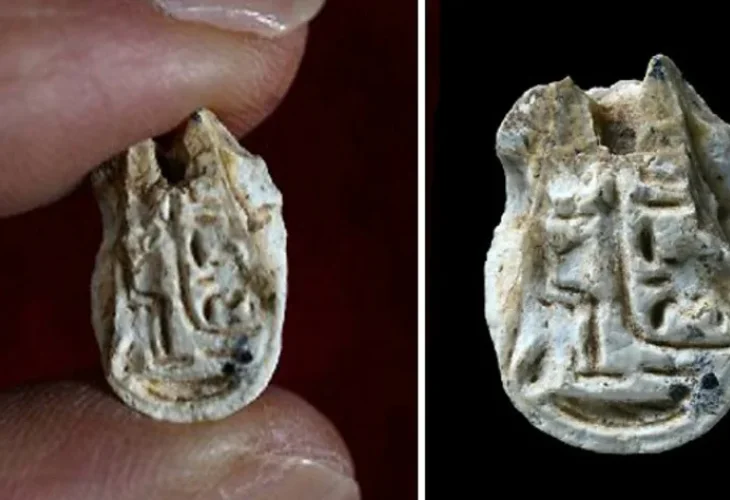
A visitor to Carnion National Park in the Lower Galilee made a remarkable discovery: a 3,500 year old Egyptian seal. The small white artifact, carved in the shape of a beetle and decorated with intricate engravings, was found during a routine visit to the site.
The finder promptly handed the seal over to the Israel Antiquities Authority, where experts identified it as a scarab, an amulet dating to Egypt’s New Kingdom period. This rare find offers valuable insight into the era when Egypt ruled over the land of Canaan.
Dr. Dafna Ben Tor, curator of ancient Egyptian culture at the Israel Museum, explained that the scarab depicts Pharaoh Thutmose III seated on his throne, with a cartouche in front of him, an oval frame containing hieroglyphs that spell out the king’s name. Thutmose III reigned during the fifteenth century BCE, a period when Egypt established administrative control over Canaan and launched numerous military campaigns there, including the famous Battle of Megiddo in the Jezreel Valley.
Scarabs were carved in the form of dung beetles, which held deep symbolic and cosmological meaning in ancient Egyptian culture. Many scarabs have been discovered throughout Israel, and together with other Egyptian artifacts, they testify to Egypt’s cultural, economic, and political influence in Canaan during the Late Bronze Age.
In recognition of the responsible action taken by the finder, the Israel Antiquities Authority awarded him a certificate of appreciation for good citizenship.

