

Shabbat
Shabbat as a Living Temple: Discovering the True Spiritual Essence of the Day of Rest
Shabbat as a direct encounter with the Divine Presence
- Hidabroot
- | Updated
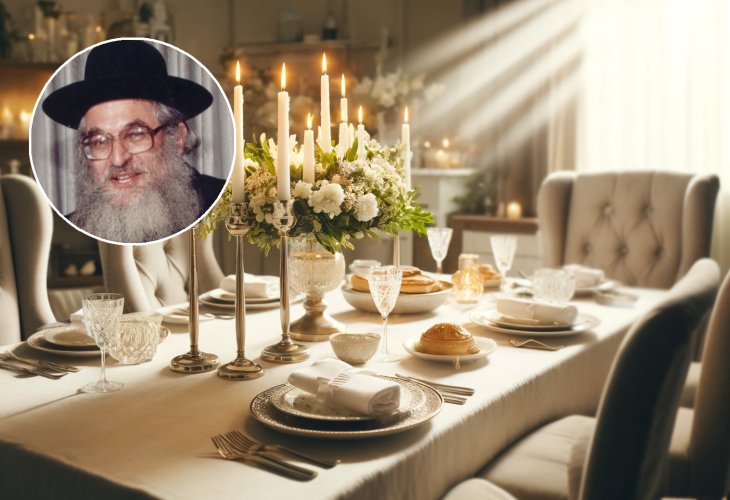
Shabbat, the sacred day of rest, is far more than a time for physical relaxation and renewal. Rabbi Shimshon Pincus, in his profound and captivating teachings, reveals the true essence of Shabbat and the deep spiritual dimension embedded within it. In his book Shabbat Malka , Rabbi Pincus explains the unique nature of Shabbat and its deep connection to God and the Jewish people.
What Is the Essence of Shabbat?
In the introduction to his book Shabbat Malka , Rabbi Pincus writes: “What is the essence of Shabbat? We know the essence of the festivals — whether it is a time of freedom, a time of joy, or the Day of Judgment — but what is the essence of Shabbat?!”
We are familiar with the meaning and significance of the Jewish festivals: Passover is the time of our liberation from slavery to freedom, Shavuot is the time of the giving of the Torah, and Rosh Hashanah is the Day of Judgment for all of creation. We understand the meaning of the festivals, yet we barely grasp the inner essence of Shabbat. What is Shabbat’s true essence?
“Shabbat, in its precise definition, is the day of the Holy One, blessed be He — without any other title. It is a day on which the unity of God spreads throughout all of reality, and all creation ceases and nullifies itself, and there is nothing besides Him.”
Shabbat is defined as God’s day. It is a day on which the truth that God is One, the Creator of all worlds, and that there is none besides Him, permeates all of existence.
Mitzvot and the Divine Presence
“Indeed, all mitzvot are also expressions of submission to His will. However, mitzvot are one thing, and receiving the Divine Presence is another. There is a distinction between different mitzvot — for example, one who eats matzah performs a mitzvah, but one who ascends to the Temple on the pilgrimage festivals performs a mitzvah of a different kind.”
While all mitzvot are expressions of submission to God’s will, they are not all of the same nature. Eating matzah is one type of mitzvah, whereas ascending to the Temple on the pilgrimage festivals is an encounter with the Divine Presence.
The Temple: Encountering God Directly
“This does not mean that seeing the Divine Presence in the Temple courtyard is a ‘greater’ mitzvah, but that its nature is different — it is an actual reception of the Divine Presence. Our Sages emphasized this regarding the Temple: ‘It is not the Temple itself that you fear, but the One who commanded concerning the Temple.’”
Ascending to the Temple is not merely the fulfillment of another commandment; it is a direct engagement, so to speak, with the Creator of the world — an actual encounter with the Divine Presence.
Shabbat as a Living Temple
“So too is the reality of Shabbat, a reception of the Divine Presence. The very essence of holy Shabbat is the reality of a sanctuary for God. Anyone who is present within it and connected to it is engaged in receiving the Divine Presence in the most literal sense.”
Shabbat is likened to the Temple itself. Just as ascending to the Temple is cleaving to the Divine Presence, so too Shabbat is a Temple reality. Anyone who is part of Shabbat is, in essence, standing before the Divine Presence.
“If so, how foolish we are that we do not truly ‘engage’ with holy Shabbat.”
If the essence of Shabbat is receiving the Divine Presence, how tragic it is that this day passes us by week after week without our recognition of its immense power and greatness.
The Temple as a Place of Salvation
When King Solomon inaugurated the Temple, he offered a lengthy prayer describing the greatness of this holy House — the place of God’s glorious throne, where anyone seeking God could come before Him with every prayer and supplication for any need, as described in Kings I (chapter 8).
The Temple was the address for salvation. Anyone in the world who sought healing or deliverance would come to God’s House and pray, much like traveling to a capital city to consult a renowned physician.
“Because of this our hearts ache and our eyes grow dark over Mount Zion, which lies desolate. When the Temple stood, we had a clear address to whom we could turn.”
After the destruction of the Temple, we were left bereft. When troubles arise or doubts cloud our path, how can we achieve closeness to God as we once did during the time of the Temple?
Shabbat: The Temple of Our Time
“But regarding this, King Solomon said: ‘That which was is that which shall be.’ The tremendous closeness to God that existed when the Temple stood also exists in our time — and that is the holiness of Shabbat. Shabbat is literally the Temple of God, and every seeker of God will find Him close on His holy Shabbat.”
The great closeness to God that once existed in the Temple still exists today, on Shabbat. Shabbat itself is considered a living Temple, and anyone who seeks God can find Him close on this sacred day.
The words of Rabbi Shimshon Pincus in Shabbat Malka open a window into a rich and profound spiritual world. Understanding the essence of Shabbat, as Rabbi Pincus presents it, allows us to connect more deeply to the meaning of this sacred day of rest.

