

Israel News
Trump Administration Unveils ‘New Gaza’ Reconstruction Plan at Davos
Jared Kushner unveils a “New Gaza” plan to rebuild cities, create hundreds of thousands of jobs, and transform Gaza’s coastline under U.S.-led oversight
- Brian Racer
- | Updated
 White House official YouTube livestream
At the World Economic Forum in Davos, the Trump administration on Wednesday presented its postwar blueprint for Gaza, branding the effort “New Gaza” and framing it as the implementation phase of a concluded ceasefire under the newly established Board of Peace. Senior U.S. officials said the focus has shifted from ending the war to enforcing security and rebuilding, with President Donald Trump and his team describing the conflict as effectively over. “We have achieved a peace deal in Gaza,” said Steve Witkoff. “We have brought the hostages home, all of the bodies except for one, and we will bring that body home, too.”
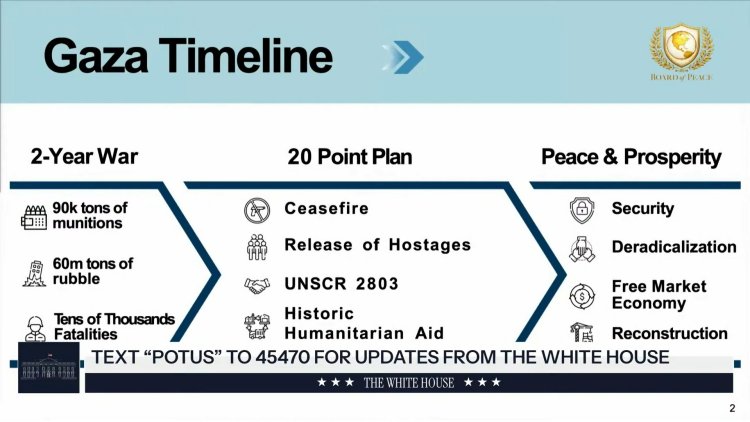
U.S. officials said the “New Gaza” plan is rooted in the aftermath of the two-year war, which they said involved roughly 90,000 tons of munitions, left more than 60 million tons of rubble, and resulted in tens of thousands of fatalities. According to the administration, the ceasefire that ended the fighting enabled a 20-point framework, the release of hostages, the passage of a United Nations Security Council resolution authorizing the next phase, and what officials described as an unprecedented humanitarian operation.
 Screenshot from White House official YouTube broadcast
Under the plan, reconstruction is explicitly conditioned on security. U.S. officials said Gaza is now being administered by a technocratic, a-political committee selected with the involvement of Arab partners and supported by the Palestinian Authority. Demilitarization was described as the gatekeeper for all rebuilding and investment. “Hamas's mission statement was we need to destroy the state of Israel,” said Jared Kushner. “People ask us what our plan B is. We do not have a plan B.”
Kushner said the initial phase focuses on stabilizing daily life while shifting Gaza away from long-term aid dependence. He said more than 55,000 aid trucks and over 1.4 million pallets have entered Gaza, adding that food needs are currently fully met and prices have fallen. At the same time, he argued that an economy built on aid cannot endure, noting that roughly 85 percent of Gaza’s economy has relied on assistance. The stated goal, he said, is to replace aid with jobs, wages, and private-sector growth.
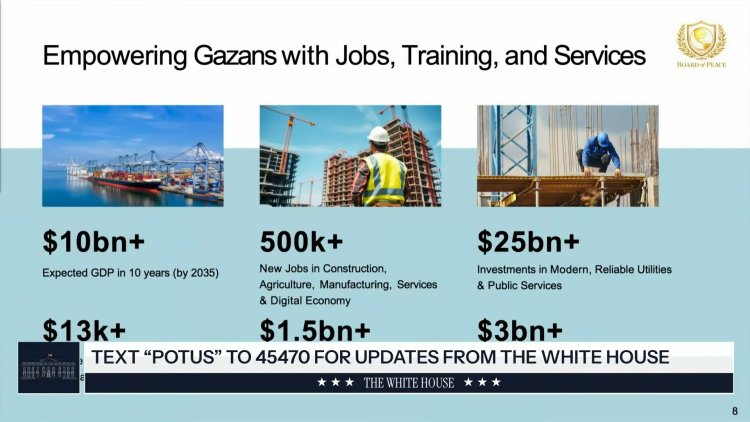
The economic component of the plan, presented in slides, outlined a 10-year vision through 2035. According to those projections, Gaza’s gross domestic product would exceed $10 billion, while average annual household income would rise by more than $13,000. The plan aims to create more than 500,000 jobs across construction, agriculture, manufacturing, services, and the digital economy, backed by more than $25 billion in infrastructure and public services, $1.5 billion for workforce training and retraining, and $3 billion for commercial zones, business districts, and micro-grants or loans.
 Screenshot from White House official YouTube broadcast
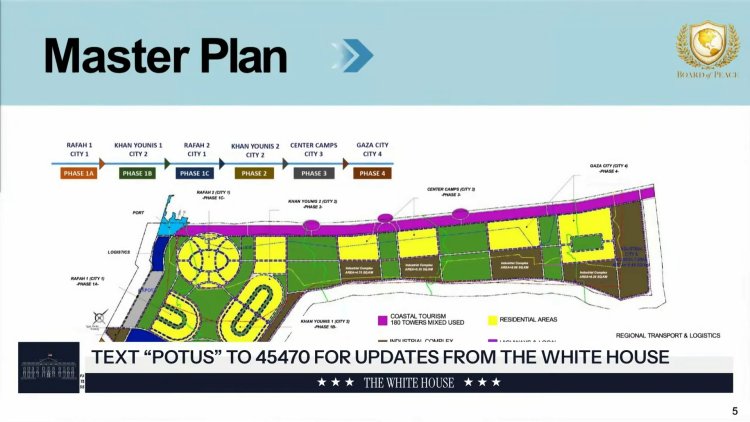
Kushner also presented a physical reconstruction "Master Plan," crediting Israeli businessman Yakir Gabay as its architect. The plan divides Gaza into development zones, with large portions of the coastline designated for tourism and mixed-use development. One slide showed 180 residential and commercial towers planned along the shore, while interior areas are set aside for large industrial complexes and housing. “New Gaza,” Kushner said, “could be a hope, it could be a destination, have a lot of industry,” adding that once rebuilding gains momentum, “we think there should be 100% full employment, an opportunity for everybody there.”
 Screenshot from White House official YouTube broadcast
Reconstruction is designed to move in phases, beginning in Rafah, expanding through Khan Younis, then moving to the central camps before concluding with large-scale rebuilding in Gaza City. Kushner said similar projects elsewhere in the Middle East show that cities of this scale can be built within a few years.
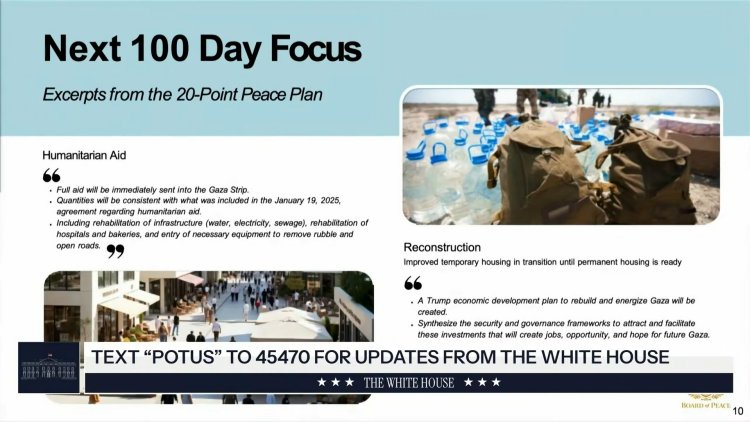
Looking ahead, U.S. officials said the next 100 days will focus on enforcing security commitments, continuing humanitarian support, and advancing demilitarization. Kushner said a conference planned in Washington in the coming weeks will present investment opportunities and outline private-sector contributions.
 Screenshot from White House official YouTube broadcast
In closing remarks, Kushner urged restraint due to criticism and regional tensions surrounding the plan. “Just calm down for 30 days. I think that the war is over,” he said, calling for cooperation between Israel, Arab states, and international partners. “If we believe that peace is possible, then peace really can be possible.”

