

Parashat Bo
Exile, Redemption, and the Power of Renewal
Why Sanctifying the New Moon Was the First Commandment of Freedom
- Rabbi Moshe Shainfeld
- | Updated
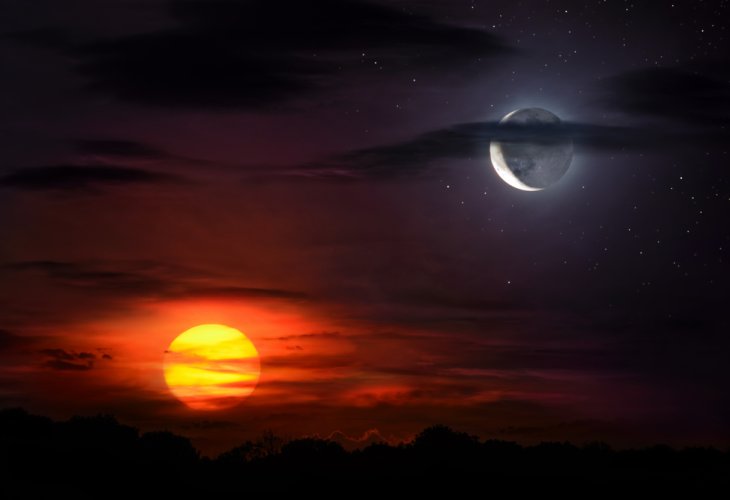 (Image: shutterstock)
“This month shall be for you the beginning of months; it shall be the first of the months of the year for you” (Shemot 12:2)
Just before the Plague of the Firstborn — the final and most decisive of the Ten Plagues, God commands Moshe with the mitzvah of Sanctifying the New Moon (Kiddush HaChodesh). At other times, we have explored the meaning of this unique commandment. Here, we will focus on its timing: why was this mitzvah given before the Exodus, while the Children of Israel were still in exile?
The fact that this mitzvah appears at this precise moment teaches a profound lesson about the nature of exile and redemption.
To understand it more deeply, we must ask another question.
“This One — See and Sanctify”
The Midrash, cited by Rashi, tells us that Moshe struggled to understand this mitzvah until God showed him the image of the moon at its renewal and said, “This one — see and sanctify.”
“This month — He showed him the moon in its renewal and said to him: when the moon renews itself, it shall be for you the new month” (Rashi, citing the Mechilta)
Rashi adds that Moshe was perplexed about the precise moment at which the moon becomes fit to sanctify. God therefore pointed to the moon in the sky and said, “Such as this — see and sanctify.” And how was this shown, if God spoke with Moshe only by day? Rashi explains that this command was given near sunset, as darkness was falling.
What is the deeper meaning here? Why did Moshe struggle with this mitzvah more than with others, and why was it taught specifically at twilight?
Renewal as the Essence of Redemption
The Sfat Emet (Bo, 5631) offers a beautiful explanation.
The mitzvah of sanctifying the month expresses, more than anything else, the importance of renewal. Exile represents stagnation and aging; redemption, by contrast, is renewal itself. The Jewish people believe that God “renews, in His goodness, every day — constantly, the work of Creation” (from the blessings of the Shema).
Notice the language. Renewal is not only a visible, daily cycle of the sun and moon — it is continuous, at every moment. Today’s sunrise is not truly connected to yesterday’s. Creation itself is being recreated at every instant, entirely dependent on God’s will. Our physical senses struggle to grasp this, because we recognize the sun and the world from yesterday and the day before. Yet faith demands that we internalize this deeper truth.
The idea of anticipating redemption means believing that everything can become entirely new. This is not only true for the Jewish people as a whole, but for each individual, within their own home and inner world.
A person must constantly reassess themselves, their actions, and the meaning of their life. Old habits must be examined honestly, and one must ask where they truly stand in relation to truth.
Exile as the Loss of Renewal
The story of exile opens with the verse: “A new king arose over Egypt, who did not know Joseph” (Shemot 1:8)
What does a “new king” represent? God relates to us measure for measure. When Israel ceased living with a sense of renewal, a “new king” arose against them. In exile, the awareness that God renews the world at every moment was lost. The sense that new life-force descends constantly — capable of transforming reality from end to end, faded away.
Moshe foresaw this when he told God that the people would not believe his message of redemption. Exile breeds stagnation and despair: I cannot change. My situation cannot change. What was will always be.
The Prerequisite for True Redemption
The Jewish people cannot truly be redeemed until they grasp this essential point and understand that God demands of a person to renew himself. Free yourself from familiar patterns of thought. Believe that everything you know can change, and that you can find yourself in an entirely new world. Believe that you can become a new person, capable of making completely new beginnings.
Creation itself is renewed every moment. You, too, must renew yourself.
Egypt, Nature, and the Illusion of Stagnation
Exile is a period of concealment, in which a person feels distant from God. Egyptian culture exalted the natural world as ultimate reality and viewed existence as static, bound by rigid laws of nature. Judaism, by contrast, points to the divine vitality animating reality at every moment. Beneath the surface of nature lies a living God who sustains everything.
Jewish faith teaches that the world is dynamic, not imprisoned by nature. The antidote to exile is reconnecting intellectually and emotionally, to the truth that God continually gives life to the world, and that renewal is the foundation of existence. The stronger this connection, the faster the release from the bonds of exile.
Why Moshe Struggled With the Moon
Moshe’s difficulty with sanctifying the new month now becomes clear. The Talmud teaches that “the face of Moshe was like the sun” (Bava Batra 75a), and Kabbalistic sources describe him as seeing through a “clear lens” (aspaklaria me’ira).
Moshe lived in a constant state of renewal and he perceived creation as continuously refreshed by God. For him, it was difficult to relate to the moon — a symbol that sometimes shines brightly and sometimes disappears entirely, because Moshe represented the constancy of divine illumination, the opposite of the moon’s cycles.
To convey this concept, God spoke to Moshe at the end of the day, as darkness fell, and said: when it grows dark and you see the moon reappear, this is what renewal looks like. “Such as this — see and sanctify.”
“This Month Is for You”
Each person must find within themselves their own point of renewal.
The sections of the Torah describing the Exodus teach us to expect something new in every area of life. God gives life to everything at every moment. Renewal is always present — the question is whether we are attentive to it.
The month chosen for redemption is Nisan, the month of spring. Every new month calls us to shine again, and every new spring brings us our own human spring. Each time we see the moon’s renewed light, each time we encounter the fresh sunlight of spring, we are being called to return to the light, even if we have drifted from it.
This is the Torah’s call to us: Renew yourselves. Anticipate redemption. Believe that miracles can happen.

