

History and Archaeology
The Altar of Mount Ebal: A Discovery That Divided Scholars
An unusual stone structure uncovered on Mount Ebal sparked one of the fiercest debates in Israeli archaeology. Was it Joshua’s biblical altar or something entirely different? The discovery, the evidence, and the controversy that still divides scholars.
- Hidabroot
- | Updated
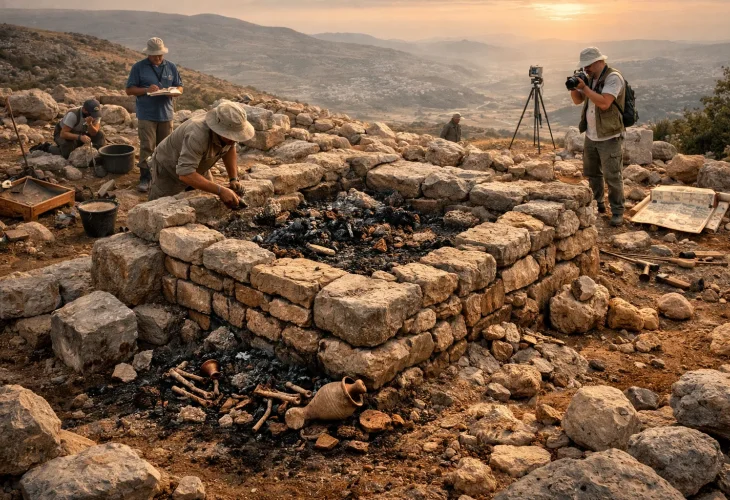
The archaeological discovery sparked a fierce debate that only intensified with time. The site, located on Mount Ebal, was excavated by Professor Adam Zertal and immediately became the focus of competing interpretations. Below is a clear overview of the findings, the arguments surrounding them, and the broader controversy.
It is important to emphasize that while archaeology can illuminate historical questions and sometimes align with tradition, it is not an absolute proof tool. The field is relatively young and constantly evolving, often reshaped by new discoveries and reinterpretations.
The Discovery
In the Torah portion of Re’eh, Moses commands the people: “When you cross the Jordan into the land that Hashem gives you, you shall place the blessing on Mount Gerizim and the curse on Mount Ebal.” Later, in the portion of Ki Tavo, the Torah instructs the Israelites to build an altar on Mount Ebal upon entering the land.
The Book of Joshua describes how Joshua fulfilled this command, constructing an altar of uncut stones upon which no iron tool was used. Remarkably, excavations conducted between 1982 and 1988 by teams from Tel Aviv and Haifa Universities under Zertal’s leadership uncovered a site on Mount Ebal that closely matches this description.
The Encyclopedia of Archaeological Excavations in the Land of Israel reports that the site belongs to the earliest phase of Israelite settlement in the hill country and consists of two short-lived occupation layers. There is no evidence of destruction by fire. Scarabs, pottery, and other artifacts date the site to approximately 1240–1140 BCE.
At the center stood a carefully constructed structure filled with layers of earth, stone, ash, pottery shards, and animal bones. Its design and contents suggested a large burnt-offering altar, echoing the biblical description with striking precision.
The Doubts
The implications were dramatic. Could this be the very altar Joshua built? Could such a structure truly have survived millennia of erosion, conflict, and human activity?
Skepticism arose immediately. Some pointed to the Samaritan tradition, which claims that the altar should have been on Mount Gerizim instead. Others argued that the Book of Joshua was composed centuries later and reflects a retroactive theological narrative rather than historical memory. Still others questioned whether the Israelites entered Canaan as described at all.
In his book A Nation Is Born: The Altar on Mount Ebal and the Beginning of Israel, Zertal documents the excavation process in detail, including both the discoveries and the intense opposition he faced.
The Context
Following the Six-Day War, Israeli archaeologists gained access to Judea and Samaria, areas that had previously been inaccessible for systematic research. This led to a renewed urgency to survey the landscape.
Zertal initially participated in these surveys as a volunteer and began identifying numerous settlement sites from the early Israelite period. Returning later as a professional archaeologist, he launched a comprehensive survey of Samaria, which was then largely unexplored archaeologically.
In 1980, he noticed an unusual stone mound on the northern slopes of Mount Ebal. Excavation revealed a unique structure unlike typical domestic buildings. Its architecture did not resemble houses, storage facilities, or fortifications, deepening the mystery.
The Debate
A turning point came in 1983 when a member of the excavation team recognized similarities between the structure and the altar described in Mishnah Middot, which details the Second Temple altar. This insight, however, triggered fierce resistance.
Prominent scholars such as Professor Yigael Yadin expressed skepticism. Critics proposed alternative explanations, claiming it was a tower base, a farmhouse, or a pagan cultic structure. Some accused Zertal of confusing Mount Ebal with Mount Gerizim. Despite this, Zertal stood by his conclusions, even when they left him in the academic minority.
The Continuing Controversy
Over time, additional scholars offered competing theories, ranging from secular cultic use to agricultural functions. Yet, the consistency of the evidence, including location, structure, ash layers, animal remains, and the absence of domestic activity, continued to support the altar interpretation.
The resistance to Zertal’s conclusions often stemmed not only from methodological disagreements but also from broader ideological positions regarding the historical reliability of the biblical narrative. The debate extended into questions about early Hebrew literacy and the dating of Israelite national identity.
The Mount Ebal excavation remains one of the most compelling and controversial finds in Israeli archaeology. It highlights how archaeological discoveries can challenge accepted academic frameworks and reopen discussions about the early emergence of Israelite religious and national life.

