

For the Woman
“Chesed Shel Emet”: The Women Who Perform Taharah and Discover Life’s True Purpose
Three volunteer metaharot from northern Israel share why preparing Jewish women for burial became their life mission, and how this sacred work reshaped everything they value
- Eti Dor-Nachum
- | Updated
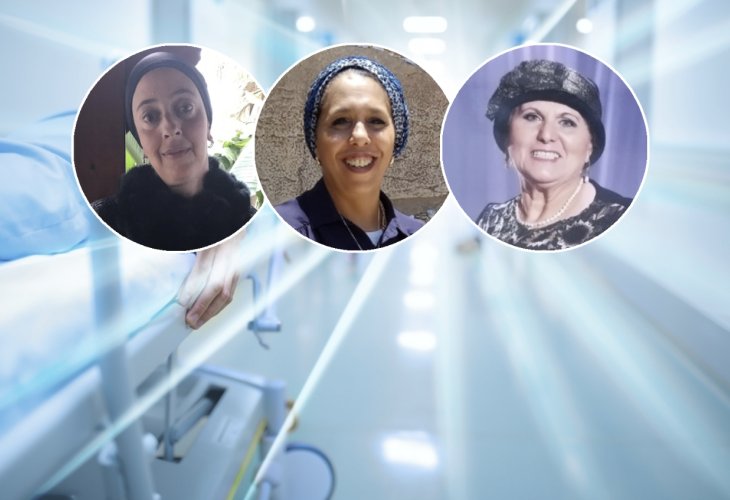 From right to left: Rachel Ben Binyamin, Ilana Cohen, and Orit
“Every person has a purpose in this world. My calling is to perform taharah (ritual purification) for women who have passed away,” says Orit, a resident of northern Israel who has been doing taharah for the past five years.
She is not alone in feeling that this volunteer work is more than a mitzvah. Ilana Cohen and Rachel Ben Binyamin, who also serve as metaharot at the “Tohar Rachel” cemetery, where those from Tiberias and the surrounding area are buried, describe the very same sense of mission. For them, preparing a Jewish woman for her final journey, the last preparations before she stands before the Heavenly court, is not simply something they do. It is what they believe they were destined to do.
What Is Taharah?
In Jewish tradition, taharah is the process of respectfully washing and cleansing the deceased before dressing them in burial shrouds. Those who perform the taharah treat the person with the full dignity they would show someone still living, as though she can see and hear them.
Taharah is typically done at a funeral home or in a cemetery facility. After a careful washing, water is poured over the entire body in a measure traditionally described as nine kavim, similar in concept to purification through a mikveh. Women perform taharah for women, and men perform taharah for men.
Mothers Orit, Rachel, and Ilana allowed a rare glimpse into a world that is often hidden. Their work is called chesed shel emet, true kindness, because it is given to someone who can never repay it and can never say thank you. And in a paradox that feels almost inevitable, they admit that working so close to death, to endings, to tragedy and separation, has forced each of them into a deep reckoning with life itself. In that room, they say, wealth and status disappear. In the end, every woman arrives at the taharah table in the same simple shrouds. In the end, every soul stands before its Creator.
Orit’s Story: A Decision She Could Not Ignore
Orit began volunteering after a moment that shook her.
“A friend’s mother from the center of the country passed away on Friday close to Shabbat,” she recalls. “Because there was no one available to do taharah for her, the funeral was delayed until after Shabbat. I was horrified. I decided I had to do something.”
It was not a role she had ever imagined for herself. But she could not let go of what she had seen. “I knew in advance that some cases would be difficult,” she says. “But I was ready for the challenge, and more than that, for the mitzvah.”
She contacted the chevra kadisha, gathered the needed recommendations, and began training, which mostly meant watching experienced metaharot, learning through observation, and building practical knowledge case by case. She visited taharah rooms, spoke with women across the country, and absorbed their experience long before she ever led a taharah herself.
“The first time I did taharah, I felt that God had arranged the circumstances so I would reach my destination in life,” she says. “Every person has a purpose, and I felt that this is mine. I connect to this mitzvah. No one will ever thank you. It is true kindness.”
Some cases are especially painful, such as women who passed away after illness, women who were injured in accidents, and infants.
“For each one,” Orit says quietly, “I relate with awe and respect. Every case is sad, even when a woman dies at an old age. It touches the heart. We are strong, but we are also sensitive. During the taharah we are strong. Afterwards, we may cry.”
No Fixed Schedule, Only Readiness
There is no routine. “They can call me at night, in the morning, at almost any hour,” she explains. “We drop everything and show up, even if it’s inconvenient and even if it disrupts personal plans.”
She remembers one night close to midnight when she received a message that an infant had been released from Schneider Hospital, and there was no one to perform taharah.
“I prepared her shrouds and did the taharah. I cared for her with total devotion for fifty minutes, and then the ambulance came and took her for burial. I felt it was my purpose for that earlier case, the friend’s mother whose funeral was delayed because there was no one.”
 Photo: Shutterstock
Why She Does Not Attend the Funeral
Orit says she generally does not go to the funeral or the shivah. “I don’t want anyone to thank me,” she says. “And I want to avoid questions from family members. People are naturally curious, but we have an obligation to protect privacy and the dignity of the deceased. We are not allowed to share details.”
In one case, she did attend a shivah, but only because she knew the family personally and they pressed her to come.
“When I arrived, I told them it was my privilege to care for their baby, a soul who surely had a great purpose and completed her purpose.”
The Center of the Work: Dignity
“One of the most important things is kavod (respect),” she says. “Before taharah we wash our hands and say a prayer that nothing should go wrong through us. We believe the soul is present above us. It sees and hears everything.”
They speak only what is necessary. There is no casual talk, no unnecessary words. If a complex halachic question arises, they consult the chevra kadisha rabbi, though experience often allows them to manage most situations on their own.
“The body held a pure soul that is going up to God,” she says. “We must be careful with her dignity. Everything is done with modesty and sensitivity. Everything is done under a sheet, with the respect a person deserves.”
The Lessons Taharah Teaches About Life
Orit says the work changes a person.
“There isn’t a day when the day of my own passing leaves my mind,” she admits. “I think about the end, and I ask myself: what am I collecting to take with me? We take nothing. Rich and poor alike stand on the taharah table with the same shrouds. What do we take, if not mitzvot?”
She even wrote down instructions for how she hopes she will be treated one day in the taharah room. “As I treat the women with modesty and dignity, that is how I hope they will treat me.”
And she adds one more dream. “I pray that until my last day, into old age, I will have the strength to continue. And I still have another dream: to volunteer with ZAKA.”
 Photo: Shutterstock
Rachel’s Story: Drawn to It From the Soul
Rachel Ben Binyamin lives in Tiberias. For more than twelve years she has performed taharah as a full volunteer.
“I worked in the welfare department of the Tiberias municipality with the elderly,” she says. “Recently I retired. I prayed a lot to merit being a metaheret. I wanted to do this.”
She cannot fully explain why. “I don’t know the source of the pull,” she says, “but it is something in the soul that can’t be explained.”
Only later did she discover that her grandmother and her mother in law had also done taharah. Her own entry into the role happened almost by chance, after she helped arrange the burial of a woman and met a chevra kadisha representative.
“I asked to volunteer,” she says. “And that’s how I began.”
The First Taharah and the Hardest Ones
“The truth is, until today I don’t understand how I did it,” she says. “But the mitzvah was all I could see. It was a real baptism by fire.”
The hardest cases, she says, were the ones closest to her. “When I did taharah for good friends, the goodbye was crushing. But I felt I was doing something good at the end of their lives. I was with them.”
She also describes moments when families needed extra patience and calm, especially when grief looked like denial. “You need a lot of patience and respect,” she says.
Quiet Kindness, Not Public Credit
Rachel says her husband and family support her deeply, even when the calls come at impossible times.
“On the morning before Rosh Hashanah I was called in the middle of kneading dough,” she recalls. “Then I was called again, and again an hour before the holiday began. Even though guests were coming, I went. My family told me, ‘What a merit you have before the holiday.’”
She adds that she often performed taharah for women she had known through her work with the elderly.
“It felt like closing a circle,” she says. “I knew the women, their children, their families. I felt I gave them the best respect I could, and I said goodbye the way I would have wanted.”
Her training came from the older metaharot, passed from woman to woman, mostly orally, in a chain of lived experience.
And like Orit, she does not tell families she was the one who performed the taharah. “I don’t publicize it,” she says. “I feel I am doing kindness, and God gives me the merit.”
Her Message
“I want women not to be afraid to come volunteer” she says. “It isn’t frightening. It isn’t terrifying. I’m more afraid of life than of the dead.”
Then she offers an image that surprises her even as she says it. “I always wanted to learn to be a doula,” she explains. “In my eyes, this is a closing of a circle, on the line between passing and birth.”
Ilana’s Story: A Car So She Could Arrive Faster
Ilana Cohen lives in Tiberias and also describes a lifelong desire to do taharah.
“I always wanted it,” she says. “It’s in the soul. When someone has a mission, God lights the path.”
At first, she contacted the religious council, but no one called back. Then one day, they were short staffed and she was summoned. The first call was ultimately canceled, but soon after she was called again.
“The first time I did taharah, I felt like I’d been doing it for years,” she says. “I didn’t feel fear. The woman looked like someone sleeping. It was as if I separated thoughts about death from the act of the mitzvah itself.”
“This Is Something That Has to Be Done”
Ilana describes a period about two years ago when several difficult cases came one after another. “It was emotionally shocking,” she says. “Before I even recovered from the first case, another one arrived. We had two hard weeks, but God helped.”
Still, she says, she never pulled back.
“You understand this is a task that needs to be done. It’s chesed shel emet. The deceased cannot thank you. You aren’t doing it to receive anything back. It is purely the mitzvah.”
Her commitment was so strong that she bought a car so she could reach the taharah room quickly, and a mobile phone so she could always be reachable.
Family Support and Personal Cost
At first, her husband struggled with the idea. “But once I started, he accepted it,” she says. “I have support from him and from the children.”
She does not attend shivah visits either, partly because it is too painful to see the depth of grief.
“When families come to say goodbye in the taharah room, I cry with them,” she says. “What can you say? Either you shed a tear or you try to calm them. It’s not easy.”
The calls come whenever they come, no matter what is happening in her home.
“In the middle of kneading dough on Friday, before a holiday, if they call me I go. Even at the wedding of one of my children, I went. Once they called when I had finished cooking all the food for my grandson’s brit. I went. You can’t do this mitzvah without mesirut nefesh.”
What It Changes Inside You
“Since I started, everything looks smaller,” she says. “It isn’t a disaster if there is furniture or there isn’t. Material things speak less to you. You get a different perspective. You want to give more, to help, to laugh and to smile. There is sadness, but you learn to value life.”
And she emphasizes a point all three women repeat in different words. “Everyone is equal in the taharah room. There is no reason to feel superior to anyone.”
“Death is the way of the world. There’s nothing to run from. We should run after kindness, after mitzvot, after doing good. What will material things give us? They will never fill a person the way a mitzvah fills the soul.”
How long will she continue? “Let’s just say: woe to me if they stop calling,” she says. “You can’t explain the longing for this mitzvah. It is a mission. If the deceased cannot speak, we must take responsibility for their dignity in every detail, especially in taharah.”
A Word of Gratitude
Yaakov Shitrit, head of the religious council in Tiberias, expressed personal thanks to the metaharot.
“I personally thank each of the women who do this holy work, every day and every hour, morning and night. They come every time they are called, and all without pay.”

