

Jewish Law
Why Do Torah Sages Disagree? Understanding Debate in Divine Law
How human interpretation, the Oral Torah, and halachic decision-making turn disagreement into a foundation of living Jewish law
- Yosef Yabece
- | Updated
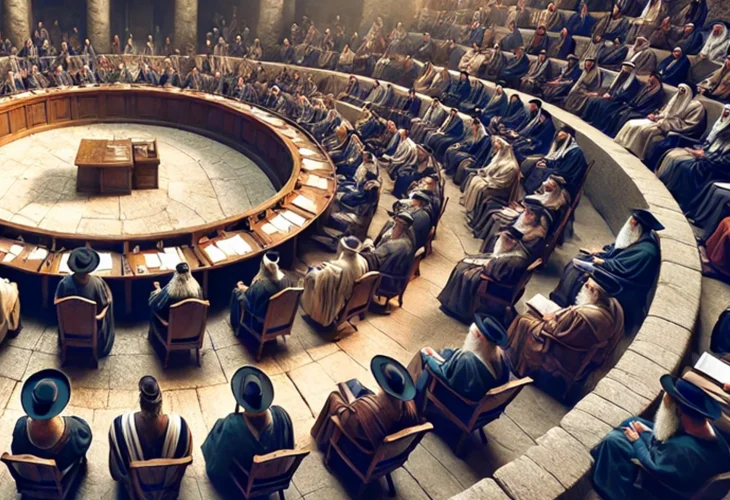
Why do disputes arise among the Sages of Israel? Does this contradict the Divine nature of the Torah?
Differences of opinion among human beings are part of the natural order of creation. A single issue can be viewed in different ways, and more than one solution can be proposed for the same problem.
When people disagree, it does not mean that one is wise and the others are foolish. Even among great scholars, disagreements exist in every field. Just as two physicians may recommend different treatments, two military commanders may suggest different strategies, and renowned philosophers may present competing philosophical systems.
Disagreement, then, is a human trait. How does this relate to a Torah that is divine?
The Oral Torah and Human Understanding
The Oral Torah was transmitted to the sages of Israel. This does not imply that information was simply passed orally from one generation to the next, but that the Torah was entrusted to the understanding and interpretation of the sages themselves.
The very essence of the Oral Torah is the connection between the Torah and real life. Any written and fixed law, by its nature, creates a certain gap between text and reality. In the complex situations of daily life, questions inevitably arise about the precise meaning of words. Even when an explanation exists, further questions arise about the exact meaning of that explanation — especially as time passes and living conditions change.
A written law always requires living human understanding. That living interpretation is the Oral Torah.
The Human Dimension Is Not a Flaw
The sages do not treat the Torah as something they can manipulate freely. They are extremely careful to preserve and transmit what they received through tradition with precision. Yet inevitably, anything that passes through human beings contains a human dimension, because human beings are not robots.
On the contrary, the human soul has the ability to sense, understand, and grasp the depth and reasoning behind ideas. Therefore, teachings that pass through human beings become adapted to human understanding and perception.
For this reason, the Torah established a hierarchy and a legal decision-making system. “The judge who will be in those days” is charged with ruling according to how he understands the tradition he received. It is entirely possible that another judge, receiving the same tradition, will understand it differently.
This subjectivity, which gives rise to disagreement, is the human dimension within the transmission of the divine Torah. Far from being a weakness, this is precisely what makes the Torah a living, relevant guide. By being understood through the inner world of the sages, the Torah is brought down into the reality of life.
Of course, this does not mean that anyone may interpret or rule however they wish. The Torah provides precise guidelines for transmission, interpretation, and boundaries of authority. Only interpretations that operate within this system and follow its rules are included in what is called “the ruling of the judge who will be in those days,” and only these are considered part of the Torah itself.
How Are Disputes Decided?
How, then, are such disputes resolved? How do we determine who is correct? Is it possible that both sides are correct? And what does the statement “These and those are the words of the living God” mean?
Based on what we have explained, the meaning becomes clear. Both opinions in a dispute reflect sincere understandings of God’s words as grasped by the judges. Both approaches are legitimate expressions of Torah truth.
What do we do in practice, being that we cannot follow two opposing rulings simultaneously?
Majority Rule and Practical Halacha
As described in the Oral Torah, in the early history of our people, disputes were relatively few. Differences of opinion existed, as human nature requires, but when they arose, the Sanhedrin would convene, and the ruling would follow the majority.
This decision does not determine who is “absolutely right,” because in non-physical matters there is no absolute truth in that sense. Rather, it determines how we must act in practice.
If one court reached a majority decision that differed from another court, the halacha followed the court that was greater in wisdom and in number.
This system is familiar even in modern legal systems. Courts rule by majority, and higher courts can overturn the decisions of lower courts within a legal hierarchy.
At a time when legal decisions among the nations were often made arbitrarily by kings or judges, the Torah introduced a structured judicial system remarkably similar in form to modern systems.
Why the Sanhedrin Was Not Reestablished
It is noteworthy that although it was technically possible to appoint a supreme court even after the destruction of the Temple and the exile, the sages refrained from doing so. The reason is that the loss of authority and the dispersion of the nation undermined the shared foundations of judgment.
If seventy sages were appointed to a court with absolute authority, the immediate question would arise: who decided that these seventy were worthy? Who appointed them? Such a body would only increase controversy rather than reduce it.
The Sanhedrin originally functioned through an unbroken chain of transmission. Each generation appointed the judges of the next. Moshe ordained Yehoshua, Yehoshua ordained the elders, and so on. No one questioned an institution sustained by continuous tradition. Once exile and upheaval disrupted this chain, there was no way to restore a Sanhedrin with unquestioned authority until the coming of the righteous redeemer.
Majority Is Central, but Not Absolute
The principle of following the majority is central to halachic decision-making, but it is not the only factor. Suppose thirty sages support one position and ten support another. Who can guarantee that the ten are not greater scholars, with deeper wisdom and experience?
Pure numerical majority carries decisive authority only when all those counted are equal in status, which applies only to fully ordained judges who received their authority from the previous generation.
Nevertheless, the nature of halacha requires that practice follow the majority view, not the minority. Halacha expresses the living Oral Torah of the collective sages of Israel, not the opinion of a small group.
When the Minority Prevails
Therefore, when it is clear that a particular sage surpasses others in greatness, halacha may follow his opinion even against several colleagues. In many cases, however, there is no consensus about who is greater, or ordinary people have no way to evaluate scholarly stature.
For this reason, the sages established accepted rules of decision-making among the Tannaim, such as: “The halacha follows Rabbi Akiva over his colleagues,” because he was considered greater than them; “Between Rabbi Meir and Rabbi Yehuda, the halacha follows Rabbi Yehuda”; “Wherever Rabban Shimon ben Gamliel appears in the Mishnah, the halacha follows him.”
These rules are based on the sages’ collective assessment of who held greater authority, whose rulings were accepted, and whose understanding carried greater weight.
Even the establishment of these rules can itself be subject to dispute. Some hold, for example, that the halacha follows Rabbi Akiva only when he disagrees with a single colleague, not with multiple ones. And in such disagreements as well, the rules of halachic decision-making are applied to reach a conclusion.

